Family Relationships: Birth, Marriage, and Lasting Prohibitions
This chapter identifies which family relationships are forbidden through birth and which arise through marriage. It explains how divorce or death affects those prohibitions, and distinguishes prohibitions from Rabbinic safeguards and permitted family connections.
פרק ב14 halachosWednesday, October 21, 2026י׳ במרחשון תשפ״ז◷ Estimated study time: 45–60 min
אTap any Hebrew word to see its meaning and how it works in the phrase.
Chapter progress 0 of 14 completed🔎 0 learned in depth
A Marriage Can Create a Lasting Family Prohibition
,,
His father’s wife and his son’s wife,
,—
his brother’s wife and his father’s brother’s wife—
,
all four remain forbidden to him as an permanently,
,,
whether their marriages reached only consecration or also full marriage,
,,
whether they were divorced or were not divorced,
,
whether during their husbands’ lifetimes
or after their husbands’ deaths,
.
except for the wife of his brother who left no son.
An is a woman whose relationship to him falls within the ’s category of , such as the prohibited family relationships listed here. This is a specific category; not every prohibition concerning marriage has this status.
, also called , establishes the first stage of a binding Jewish marriage; it is more than an engagement. completes the marriage. The family prohibitions discussed here begin with , even before or marital relations.
In these cases, the family prohibition arises through a relative’s marriage. Once established, it continues after divorce or the husband’s death.
The exception concerns , the ’s provision for the widow of a man who died without descendants. Although the Hebrew says “left no son,” the exception requires that the deceased leave no surviving descendants: neither a son nor a daughter, nor descendants of either. It applies only when the other requirements of are satisfied, including that the deceased and surviving brother share a father. It does not give general permission to marry a brother’s former wife.
The precise distinction between different kinds of paternal uncles is explained in the next .
,
If he has relations with one of them during her husband’s lifetime,
—,
he incurs two liabilities: one for the prohibited family relationship
;
and one for relations with a married woman,
.
since the two prohibitions take effect simultaneously.
The additional prohibition of adultery applies while she remains married to the relative. If she has already been divorced, her former husband’s being alive does not make her a married woman; the lasting family prohibition nevertheless remains.
Here, “two liabilities” means two separate sin-offerings for an inadvertent transgression, when the requirements for those offerings are met. It does not mean that an intentional transgression is resolved by bringing offerings.
An inadvertent transgression——can occur when someone is unaware of the relevant facts or does not know that the act is prohibited. It does not necessarily mean that the physical act itself happened accidentally.
One act can violate both prohibitions because they take effect together: the same make her both a married woman and the wife of his relative.
Synopsis
The wives of the specified relatives remain forbidden after divorce or widowhood, subject to the defined exception of . While the woman remains married, relations with her also violate the prohibition against adultery.
Accordingly, one who has relations with his mother,
—,
who is his father’s wife, incurs two liabilities.
,—
Whether during his father’s lifetime or after his father’s death,
,
he incurs two liabilities: one because she is his mother
.
and one because she is his father’s wife.
His mother falls under two separate family prohibitions: the prohibition against one’s mother and the prohibition against one’s father’s wife. His father’s death removes neither prohibition.
These are the two family prohibitions that apply in both periods. If his father is alive and she remains married to him, there is also a third prohibition: relations with a married woman. When the requirements for sin-offerings are met, the separate prohibitions require separate offerings.
,
Whether his brother shares his father or his mother,
—
whether the relationship arose through marriage or outside marriage,
.
that brother’s wife is forbidden to him as an .
Sharing either biological parent establishes the brotherhood relevant to this prohibition. It does not matter whether either brother was born to married parents.
This prohibition is broader than the brotherhood required for . A maternal brother’s wife is forbidden, but sharing only a mother does not create a exception.
,
However, the wife of his father’s maternal brother
,.
is a , as we have explained.
Here, the father and the uncle share a mother but do not share a father. The uncle’s wife is forbidden as a : an additional relative prohibited by the Sages as a safeguard around the ’s prohibited relationships.
Thus, the prohibition against the wife of one’s father’s brother applies when the father and uncle share a father. The wife of the father’s maternal half-brother is also forbidden, but on a Rabbinic level. See 1:5.
,
Likewise, whether his sister shares his father or his mother,
,
whether the relationship arose through marriage or outside marriage—
,
for example, his mother or father had relations with someone else,
—
and he thereby had a sister born outside marriage—
,
she is forbidden to him as an ,
״״(,).
as it is stated: “Born within the home or born outside” ( 18:9).
A sister who shares either biological parent is included in the prohibition. The parents’ marital status does not change that relationship. The verse includes both a sister born within marriage and one born outside marriage.
Synopsis
One’s mother can be forbidden under multiple prohibitions. A brother or sister related through either parent counts as a sibling regardless of the parents’ marital status. The wife of the father’s maternal half-brother, however, is forbidden as a .
Picture the CaseA concrete example + illustration
Which Kind of Uncle?
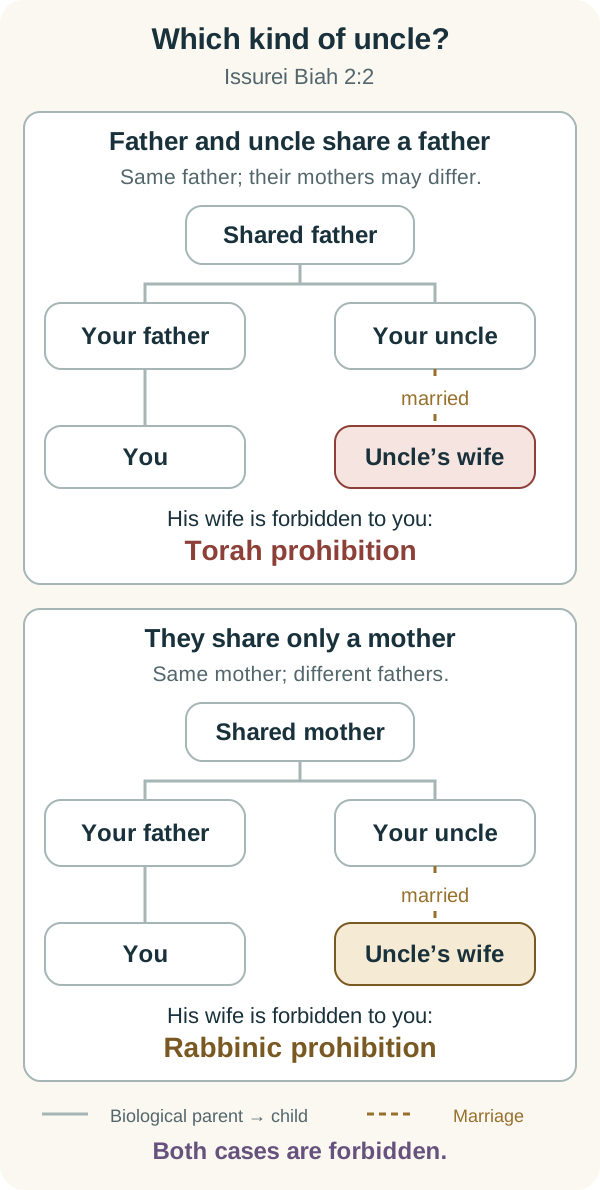
A man’s father and uncle share the same mother but have different fathers. The uncle’s wife is forbidden to the man as a , a relative prohibited by the Sages. If his father and uncle instead share a father, the uncle’s wife is a -level. Both relationships are forbidden; the difference is the source of the prohibition.
Halachah 2: the wife of the father’s paternal brother is a -level. The wife of the father’s maternal half-brother is a , prohibited by the Sages. Both relationships are forbidden; the difference is the source of the prohibition. Only the shared grandparent relevant to each comparison is drawn.Open full-size illustration
✦Live ItSee the Person
See the Person
The teaches that a biological family relationship remains a relationship whether the parents were married or not. Their circumstances do not erase the connection. This invites us to notice how easily people become defined by circumstances they never chose: their parents, their upbringing, or a difficult family history.
teaches us to look deeper than someone’s outward circumstances and recognize the . distinctions must be respected, while every Jew must be treated with dignity and . Someone’s family story is never permission to embarrass them, speak dismissively about them, or make them feel that they do not belong.
Try today
Include someone you might otherwise overlook, without making their background the subject of the interaction.
A Father’s Wife’s Daughter Is Not Necessarily a Sister
–
The daughter of his father’s wife who is his paternal sister
,
is forbidden to him as an ,
״״(,).
as it is stated: “The nakedness of your father’s wife’s daughter, your father’s offspring” ( 18:11).
The words “your father’s offspring” identify the relationship: she is a daughter born to his father and his father’s wife. She is therefore also his biological sister.
,
But if his father married a woman
—
who had a daughter by another man,
,
that daughter is permitted to him,
.
because she is not his father’s offspring.
His father’s marriage does not turn the woman’s daughter from another man into his biological sister. Assuming no separate prohibition applies, he may marry her.
The woman herself becomes forbidden to him because she married his father. Her daughter from another man does not acquire the status of his sister through that marriage.
,
But he is already liable for relations with her because she is his sister!
״״?
Why, then, does the say “your father’s wife’s daughter”?
.
To make him liable under this prohibition as well.
The question returns to the first case, in which the daughter is his father’s biological child. The prohibition against one’s sister already covers her. The additional verse establishes a second prohibition when she is also the daughter of his father’s wife. The next explains the resulting distinction.
Synopsis
A paternal sister born to the father’s wife involves an additional prohibition. A woman’s daughter from another man does not become forbidden to her husband’s son merely because their parents married.
Picture the CaseA concrete example + illustration
Their Parents Married
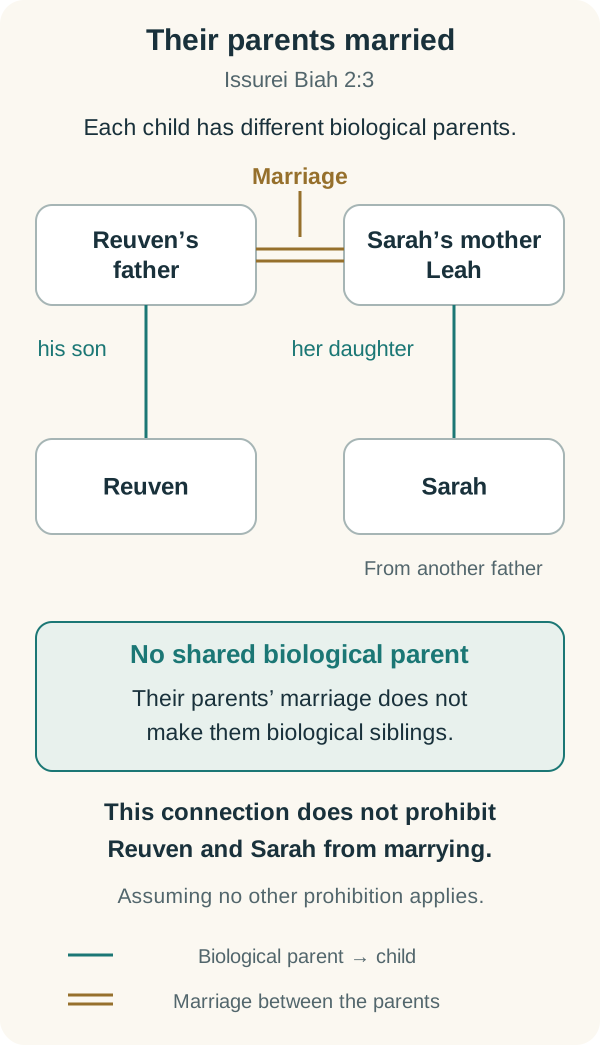
’s father marries , who already has a daughter, , from a previous marriage. and do not share either biological parent. Their parents’ marriage does not make them biological siblings, so this family connection does not prohibit them from marrying each other, assuming no other prohibition applies. herself, however, is forbidden to as his father’s wife.
Halachah 3: the parents’ marriage does not make and biological siblings. is ’s daughter from another man. This family connection does not itself prohibit their marriage, assuming no other prohibition applies. herself is forbidden to as his father’s wife.Open full-size illustration
🔎Dig DeeperA Father’s Wife’s Daughter Is Not Necessarily a Sister
A Father’s Wife’s Daughter Is Not Necessarily a Sister
The rules that this permission extends even to children who grew up together in the same household and appeared to others to be brother and sister. Their upbringing does not create the biological relationship that would prohibit their marriage.
The marriage is also not prohibited merely because observers might mistake them for biological siblings. In this case, the appearance of a sibling relationship does not establish a prohibition.
and one for “the nakedness of your father’s wife’s daughter” ( 18:11).
The same woman is both his sister and the daughter of his father’s wife. When an inadvertent transgression meets the requirements for sin-offerings, the two prohibitions require two offerings.
But if his father raped a woman
,,
or seduced her, and fathered a daughter with her,
The father has a daughter through relations outside marriage. The next clause concerns his son having relations with that daughter—his paternal sister.
—,
and he has relations with her, he is liable only for the prohibition against his sister,
.
for the daughter of the woman who was raped is not the daughter of his father’s wife.
She is fully his sister even though her parents were not married. However, because her mother was not his father’s wife, the additional prohibition against a father’s wife’s daughter does not apply.
The same distinction applies whether the father’s relations with the mother involved rape or seduction. “Only” identifies the family prohibition applicable here; the relationship remains forbidden.
Synopsis
A paternal sister born to the father’s wife involves two prohibitions: sister and father’s wife’s daughter. A paternal sister born from the father’s relations outside marriage is forbidden as his sister, without that additional prohibition.
🔎Dig DeeperWhen a Paternal Sister Involves Two Prohibitions
When a Paternal Sister Involves Two Prohibitions
The explains that the father’s later marriage to the mother does not add this second prohibition to a daughter already born from their earlier relationship outside marriage.
Although the mother subsequently becomes the father’s wife, the daughter remains one born from the earlier relationship. Her brother therefore remains liable under the sister prohibition alone, rather than under the additional prohibition against his father’s wife’s daughter.
His mother’s sister, whether she shares his mother’s father
,
or shares his mother’s mother,
whether the relationship arose through marriage
—
or her sister was born outside marriage,
.
is forbidden to him as an because she is his mother’s sister.
The aunt need not be his mother’s full sister. A sister who shares only one parent with his mother is also included. The biological relationship establishes the prohibition regardless of whether the parents were married.
,,
Likewise, his father’s sister, whether related through their mother or their father,
—
whether the relationship arose through marriage or outside marriage,
.
is forbidden to him as an because she is his father’s sister.
The prohibition concerns the father’s biological sister herself. It applies whether she shares his father’s father or his father’s mother.
This differs from Halachah 2’s distinction concerning the wife of the father’s brother. A parent’s biological sister is a -level through either parental connection; the wife of the father’s maternal half-brother is prohibited as a .
Synopsis
The biological sister of either parent is forbidden as an aunt, including a half-sister through either parent and a sister born outside marriage.
A Daughter Is Forbidden Regardless of Her Parents’ Marriage
When a man has relations with a woman outside marriage
—
and fathers a daughter with her—
,
that daughter is forbidden to him as his daughter.
The prohibition follows the biological relationship. It makes no difference whether he was married to her mother.
Although the does not explicitly state,
׳׳,
“Do not uncover your daughter’s nakedness,”
since it prohibited relations with a daughter’s daughter,
.
it left the prohibition concerning the daughter herself unstated.
The expressly prohibits a granddaughter whose relationship to him comes through his daughter. That prohibition already presupposes that the daughter herself is forbidden. The therefore treats the daughter’s prohibition as though the had stated it explicitly.
,
Her prohibition is a prohibition,
.
and is not “from the words of the Sages.”
Here the is addressing a technical distinction concerning how a law is expressed or derived. He is emphasizing that this prohibition has the standing of an expressly stated law.
—
Therefore, one who has relations with his daughter born to his wife
:
incurs two liabilities: one because she is his daughter,
.
and one for the forbidden relationship involving a woman and her daughter.
Two distinct prohibitions apply to the same person: she is his biological daughter, and she is his wife’s daughter. When the transgression is inadvertent and the requirements for sacrificial liability are met, he must bring two sin-offerings. This does not mean that two executions are imposed for an intentional transgression.
Synopsis
A biological daughter is forbidden regardless of whether her parents married. A daughter born to his wife also carries the separate prohibition against his wife’s daughter.
🔎Dig DeeperA Daughter Is Forbidden Regardless of Her Parents’ Marriage
A Daughter Is Forbidden Regardless of Her Parents’ Marriage
Why the Emphasizes the Source
The connects this wording to the Rambam’s discussion in the second general principle of . In that discussion, “words of the Sages” can be a technical description of laws established through interpretation; it does not necessarily mean a new Rabbinic enactment. Here, however, the daughter’s prohibition is treated as implicit in the ’s explicit wording itself.
The Maggid Mishneh also understands the Rambam’s two liabilities as requiring two sin-offerings in an appropriate case of inadvertent transgression. The objects in a brief gloss whose meaning is difficult to establish. The Maggid Mishneh explicitly says that he does not understand the objection, while explaining the Rambam’s ruling as requiring two sin-offerings in the appropriate case.
Sources: Maggid Mishneh and Raavad, 2:6; , General Principle 2.
six of her female relatives become forbidden to him.
—
Each of them remains an to him permanently—
,
whether he proceeds to full marriage or divorces her,
.
during his wife’s lifetime and after her death.
These prohibitions begin with , the first stage of marriage. They do not depend on completing , the second stage, or on marital relations.
Once established, the prohibitions continue even if the marriage ends through divorce or death. Halachah 8 will explain that the wife’s death changes the punishment, although it does not remove the prohibition.
:,
These relatives are: her mother,
,,
her maternal grandmother, her paternal grandmother,
,,.
her daughter, her daughter’s daughter, and her son’s daughter.
The six relatives include three in the generations above his wife and three in the generations below her. Her daughter and granddaughters are forbidden to him even when they descend from another man.
If he has relations with one of them
,.
during his wife’s lifetime, both are subject to execution by burning.
“Both” means the man and the relative who knowingly and willingly participates in the transgression. His wife is not punished for their conduct.
As with the capital laws discussed in Chapter 1, judicial execution requires all the prescribed conditions, including valid and warning. Divorce does not remove the punishment described here while his former wife remains alive.
Synopsis
Consecration permanently prohibits six of a woman’s relatives. Divorce does not remove these prohibitions, and her death changes their punishment rather than making the relationships permitted.
✦Live ItA Bond Brings Responsibility
A Bond Brings Responsibility
creates responsibilities that reach beyond the couple themselves. The carefully identifies which relationships become forbidden through that bond. Marriage establishes a sacred connection, and protecting that connection requires clear boundaries.
In daily life, caring for a marriage also means giving it attention. teaches that a Jewish home can become a dwelling place for through the ordinary choices made within it. Listening patiently, speaking respectfully, and making time for one another give that purpose practical expression. The holiness of the home is something we help build through the way we treat the people inside it.
Try today
Give your spouse a few minutes of undivided attention, with your phone put away.
After the Wife’s Death, the Prohibition Remains but the Penalty Changes
—
If he has relations with her after his wife’s death—
,
they are liable for ,
,
but are not subject to execution by the court.
“Her” refers to any of the six relatives listed in the preceding .
According to the , the intentional transgression remains punishable by , a punishment imposed by Heaven, commonly translated as spiritual excision. The wife’s death removes the judicial death penalty; it does not permit the relationship.
״״—
As it states: “They shall burn him and them in fire”—
meaning his wife and the woman with whom he had relations,
;
he and the forbidden relative are subject to execution by burning.
The verse’s plural wording establishes a condition: his wife and the relative must both be alive for this judicial punishment to apply. It does not mean that his innocent wife is executed.
,
But when the two women are not both alive,
.
execution by burning does not apply.
In the case under discussion, his wife has died and her relative is still alive. The phrase does not require that both women have died.
Synopsis
According to the , relations with these six relatives remain forbidden after the wife’s death and carry , but no longer carry judicial execution.
🔎Dig DeeperAfter the Wife’s Death, the Prohibition Remains but the Penalty Changes
After the Wife’s Death, the Prohibition Remains but the Penalty Changes
What Remains After the Wife’s Death?
Concerning a mother-in-law after the wife’s death, , the , and the understand the continuing prohibition as not carrying . The maintains that remains.
The Rambam also applies the removal of execution by burning to the other five relatives listed in Halachah 7. The explains that this extension is itself debated. The discussion therefore involves two separate questions: which punishment remains for a mother-in-law after the wife’s death, and how the rule extends to the other relatives.
Sources:76b and Rashi there; Maggid Mishneh, 2:8, citing the Ramban and Rashba.
A Wife’s Sister Is Forbidden During the Wife’s Lifetime
,
His wife’s sister, too,
.
is an to him until his wife dies.
A wife’s sister differs from the six relatives listed earlier. Those six remain forbidden after the wife’s death. The prohibition against her sister ends when the wife dies, provided no other prohibition applies.
Divorce does not end this prohibition. Even after divorcing his wife, he may not marry her sister while his former wife is alive. The expressly limits this prohibition to the wife’s lifetime: 18:18.
,
Whether she is her sister through their mother or through their father,
—
whether the relationship arose through birth within marriage or outside marriage—
.
she is an to him.
The prohibition includes a full sister and a half-sister through either parent. Whether their parents were married does not change their biological relationship.
Synopsis
A wife’s full sister or half-sister remains forbidden throughout the wife’s lifetime, even after divorce. After the wife’s death, this particular prohibition ends.
Picture the CaseA concrete example + illustration
Divorce Does Not Permit Her Sister
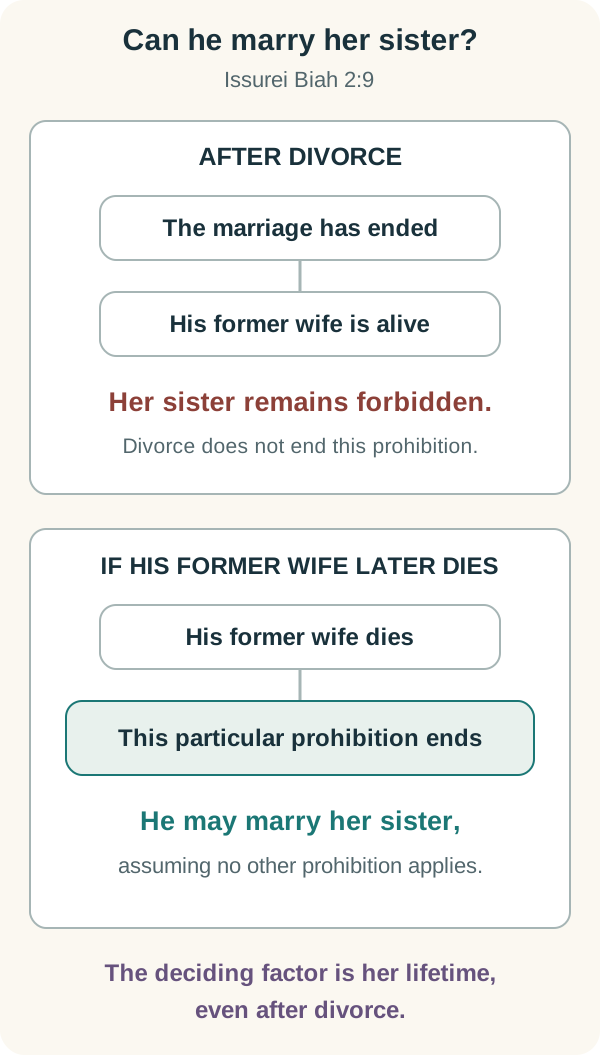
A man divorces his wife. Several years later, someone suggests her sister as a possible match. Although his marriage has ended, he may not marry her sister while his former wife is alive. If his former wife later dies, this particular prohibition ends, provided no other prohibition applies.
Halachah 9: divorce does not permit the former wife’s sister while the former wife lives. Her death ends this particular prohibition, assuming no other prohibition applies.Open full-size illustration
A Husband’s Transgression Does Not Ordinarily Forbid His Wife
,
If he transgresses by having forbidden relations with one of these seven women,
,
whether inadvertently or intentionally,
The seven women are the six relatives listed in Halachah 7 together with his wife’s sister, discussed in Halachah 9.
although he and the woman who participates in the transgression
—
are subject to judicial execution or —
.
his wife does not become forbidden to him.
The reference to execution or describes the severity of these forbidden relationships when committed intentionally under the relevant conditions. It does not mean that an inadvertent transgression carries those intentional punishments.
His wife has not committed the transgression. His sin with her relative does not, by itself, prohibit continuing his marriage to her.
,
The exception concerns the sister of his bride,
,
who causes his own wife to become forbidden to him,
.
as we explained in the Laws of Divorce.
The explains that this exception concerns a particular case described in 10:8–10:
A man consecrates a woman, but they have not yet entered full marriage. She travels elsewhere, and he hears that she has died. Relying on that report, he marries her sister. The first woman is then discovered to be alive. In this case, both women require a , and he may not return to his original bride.
The distinction depends on the stage of the first marriage. If it had reached only , the special restriction applies. If the couple had already completed , the mistaken marriage to her sister does not prohibit his original wife to him.
Relations alone with his bride’s sister, without the attempted marriage described here, do not create this exception.
Synopsis
A husband’s forbidden relations with his wife’s relative do not ordinarily prohibit his wife. The exception here concerns a specific mistaken marriage to his bride’s sister and the Rabbinic requirements that follow.
🔎Dig DeeperA Husband’s Transgression Does Not Ordinarily Forbid His Wife
A Husband’s Transgression Does Not Ordinarily Forbid His Wife
Why Does the Attempted Marriage Matter?
Ordinarily, cannot take effect with a wife’s sister while the wife is alive. Nevertheless, when the first relationship had reached only , people might mistakenly assume that those first were conditional and that the condition was never fulfilled. They could therefore regard the marriage to the sister as valid. To address that appearance, the Sages require a for the sister.
Once the sister receives a , returning to the original bride could appear to be marrying the sister of one’s divorcee. The Sages therefore prohibit that return as well.
When the first woman was already fully married to him, the law does not impose this same requirement of a for the sister. His original wife consequently remains permitted to him.
Relations Outside Marriage Do Not Create the Same Family Prohibitions
—
When a man has relations with a woman outside marriage,
,
her relatives do not thereby become forbidden to him under these prohibitions,
.
meaning the seven women we mentioned.
The seven are her mother, her two grandmothers, her daughter, her two granddaughters, and her sister.
These prohibitions arise through , which establishes a marriage bond. Relations without do not establish that bond and therefore do not create these particular prohibitions against her relatives. Nevertheless, the Sages prohibited marrying these relatives during the original woman’s lifetime, as the now explains.
However, the Sages prohibited a man who had illicit relations with a woman
from marrying any of these seven relatives of hers
;
as long as the woman with whom he had relations is alive.
Here the ’s description refers to the woman with whom he had illicit relations. It does not require that she be a professional prostitute.
,
For that woman will come to visit her relatives,
,
and he may be alone with her.
,
Since he is already familiar with her,
.
he may come to transgress by having relations with an .
The sequence matters. His earlier relations did not create a marriage bond. Once he marries her relative, however, the original woman becomes an to him through that marriage.
For example, if he marries her daughter, the original woman becomes his mother-in-law. Their previous familiarity, together with opportunities to meet during family visits, could then lead to a severe transgression.
After the original woman’s death, this particular Rabbinic restriction no longer applies.
,—
Furthermore, even if he is suspected of relations with a woman,
he may not marry one of these relatives of hers
.
until the woman concerning whom he was suspected has died.
In his , the describes a suspicion that has been substantiated. This is not a statement that any unsupported accusation establishes the restriction.
If he nevertheless marries the relative
,.
whose relative he had illicit relations with, he is not required to divorce her.
Although the Sages prohibited entering this marriage, they did not require dissolving it once it had taken place. This applies even when the earlier relations occurred, rather than only when they were suspected.
The original woman is now an to him through his marriage. The prohibitions against relations and forbidden seclusion with her remain binding.
Synopsis
Relations without do not create these prohibitions against a woman’s relatives. Nevertheless, the Sages prohibited marrying those relatives during her lifetime because the earlier relationship could lead to further transgression.
Picture the CaseA concrete example
Why the Sages Prohibited the Marriage
A man previously had relations with a woman without . Later, he wishes to marry her adult daughter from another man. The earlier relationship did not create the prohibition against marrying a wife’s daughter. Nevertheless, the Sages prohibit this marriage while the mother is alive: she may visit her daughter, and the earlier familiarity could lead to forbidden relations. Once he marries the daughter, the mother becomes his mother-in-law.
✦Live ItLet Your Boundaries Support Your Values
Let Your Boundaries Support Your Values
The Sages consider what could happen after a marriage: family visits, opportunities for seclusion, and familiarity from an earlier relationship. Their safeguard addresses a foreseeable situation before it develops into a more serious transgression. Knowing what is right includes thinking honestly about what helps us remain faithful to it.
In , this means arranging our surroundings to support our commitment to . We need not repeatedly place ourselves in situations that demand a difficult struggle. A thoughtful boundary around a conversation, a screen, or a relationship can express and protect the good we want to build.
Try today
Choose one recurring situation that weakens a Torah commitment, and make one practical adjustment before it arises again.
Distance Is Required When There Is Suspicion of a Forbidden Relationship
Someone suspected of relations with an ,
—
or about whom a damaging report concerning her has circulated,
,
may not live in the same lane as she does,
.
and may not be seen in that neighborhood.
An here means a woman with whom relations are forbidden under the severe prohibitions discussed in these chapters.
The requires distance from the setting associated with the suspected relationship. The restriction extends beyond avoiding actual relations or being alone together: he must also avoid the nearby residential surroundings described here.
These restrictions do not mean that the underlying transgression has been established through the testimony required to impose its punishment.
,
An incident occurred involving a man rumored to have relations with his mother-in-law,
,
and the Sages administered disciplinary lashes to him
.
because he passed by the entrance to her house.
means lashes administered as a disciplinary measure under Rabbinic authority. They are distinct from the ’s prescribed punishment of lashes.
The conduct identified as the reason for this disciplinary punishment is passing her doorway in the circumstances described.
Synopsis
When there is suspicion of relations with an , the requires avoiding the nearby residential setting as well as the forbidden relationship itself.
🔎Dig DeeperDistance Is Required When There Is Suspicion of a Forbidden Relationship
Distance Is Required When There Is Suspicion of a Forbidden Relationship
Does the Mother-in-Law Case Establish a General Rule?
The questions extending the restriction from this incident to every suspected relationship with an . He understands the case of a mother-in-law as warranting particular stringency.
The supports the ’s broader requirement to keep a distance. He suggests that the disciplinary punishment may distinguish the mother-in-law incident from other cases, but also considers the possibility that the Rambam treats the mother-in-law and other alike in this respect.
Family Prohibitions Through Marriage Require a Marriage Bond
,
If a man has relations outside marriage with a woman and her daughter,
,—
or with a woman and her sister, or in similar cases—
;
it is as though he had relations with two unrelated women.
Here, “outside marriage” means that no established a marriage bond with either woman. It does not mean merely that the couple had not yet completed .
“Unrelated women” means women who have no relevant family relationship to him. The word נָכְרִיּוֹת here does not mean non-Jewish women.
The comparison concerns the particular family prohibitions created through marriage. It does not permit the relations or remove any other prohibition that applies.
For one does not become an to him because of the other
,.
except through marriage, rather than relations outside marriage.
For example, with a woman prohibits her daughter to him. Relations with that woman without do not create this particular prohibition against her daughter.
“Marriage” here includes the bond established through , as Halachah 7 explained. The Rabbinic restrictions discussed in Halachah 11 still apply.
Similarly, if his father or his son raped a woman,
,
or his brother or his father’s brother did so,
—
or seduced her—
For example, if a man’s father had relations with a woman without marrying her, the next clause discusses whether the son may marry that woman.
;
she is permitted to him, and he may marry her.
Those relations alone do not make her his relative’s wife. They therefore do not create the prohibitions against a father’s wife, son’s wife, brother’s wife, or paternal uncle’s wife. This permission assumes that no independent prohibition applies.
׳׳,
For the ’s prohibition refers specifically to a “wife,”
.
and no marriage bond exists here.
A marriage bond is established through . The act of rape or seduction does not itself establish that bond, even though the conduct may involve serious transgressions and other legal consequences.
Synopsis
Relations alone do not create the family prohibitions that depend on marriage. Those prohibitions require a marriage bond, while other applicable prohibitions and safeguards remain in force.
The prohibition against his father’s wife or his son’s wife does not automatically extend to that woman’s relatives.
For example, if his father marries a woman who has a daughter from another man, that daughter does not become his biological sister merely because their parents married.
Each permission assumes that no separate blood relationship or other prohibition applies.
.
A man may also marry his nephew’s wife.
This means his nephew’s former wife, after the nephew has died or divorced her. While she remains married to the nephew, she is forbidden as a married woman.
The prohibits a brother’s wife, but that family prohibition does not extend to the wife of a brother’s son.
,
A man may marry a woman and her sister’s daughter,
.
or a woman and her brother’s daughter, at the same time.
The is discussing which family relationships prohibit marriage within the legal framework in which a man could have more than one wife.
A wife’s niece is not included among the seven relatives prohibited through marriage. Conversely, marrying the niece does not make her aunt one of those seven prohibited relatives. This statement addresses the family prohibition itself; separate laws governing taking an additional wife must also be observed.
,
It is a taught by the Sages for a man to marry his sister’s daughter,
,
and the same applies to his brother’s daughter,
״״.
as it states: “Do not turn away from your own flesh.”
This identifies a marriage the Sages commend. It does not require every man to seek a niece as his wife.
The direction of the relationship is essential: the permits a man to marry his niece. A man marrying his aunt is an entirely different relationship and is forbidden, as explained in Halachah 5.
Synopsis
Marriage does not prohibit every relative of one’s relatives. The precise family connection determines the law: a nephew’s former wife and a niece are permitted, while an aunt is forbidden.
Picture the CaseA concrete example
A Nephew’s Former Wife
A man’s nephew was married and subsequently gave his wife a valid . The uncle later considers marrying her. Being his nephew’s former wife does not itself prohibit the marriage, assuming no other prohibition applies. This differs from his own brother’s former wife, who remains forbidden to him even after divorce.
🔎Dig DeeperSome Relatives of Relatives Remain Permitted
Some Relatives of Relatives Remain Permitted
Why Commend This Marriage?
The explains that people naturally feel affection for their close relatives. Within a permitted marriage, that existing affection can join the affection developed between husband and wife and help strengthen peace in their home.
The applies the special to both a sister’s daughter and a brother’s daughter. Other , including and , understand it as applying specifically to a sister’s daughter. Their disagreement concerns the special commendation, rather than the basic permission to marry either niece.
Sources: Maggid Mishneh, 2:14; 76b and the commentaries there.
Translation and elucidation: Independently prepared for Rambam, Clearly in contemporary English. Translation follows the Rambam’s words; elucidation supplies only the context needed to understand them.
Word cards and glossary: Hebrew word cards distinguish a word’s basic meaning from its meaning in the particular phrase. Shared glossary entries explain recurring terms; biography entries identify the cited authorities.
Explain and Background: Explain provides context needed for the ruling. Optional Background panels provide additional context that can be skipped without losing the essential explanation.
Synopsis: A short summary follows each halachah. It is a guide to the central ruling, not a replacement for the full text and its qualifications.
Dig Deeper: Based on the classic commentaries named inside each panel. Editorial explanations are not presented as quotations.
Live It: Where present, these panels connect a particular halachah to a suggested personal reflection and an action to try. Original applications are labeled as suggested reflections. They are distinct from the ruling and are not attributed to the Rebbe merely because his guidance supports seeking a practical lesson.
Measurements: Modern equivalents draw on Chabad.org’s measurement glossary and cited halachic calculations. They show a range when major accepted calculations differ. Monetary equivalents fluctuate with the price of silver.
The Rebbe’s teachings and guidance: Source links accompany the completion teachings and the guidance inside Dig Deeper and Live It. Quotations, translations, and adaptations are identified; the general guidance is separate from the sources for a panel’s particular discussion.
Editorial responsibility: Created and prepared for this project by Levi Gelb. Corrections and suggestions can be submitted below. This presentation supports learning; practical halachic questions should be brought to a qualified rav.
Chapter 2 at a glance
Chapter Synopsis
The chapter distinguishes biological family relationships, prohibitions established through , their duration, and additional Rabbinic safeguards.
The wives of the specified relatives remain forbidden after divorce or widowhood, subject to the defined exception of . While the woman remains married, relations with her also violate the prohibition against adultery.
One’s mother can be forbidden under multiple prohibitions. A brother or sister related through either parent counts as a sibling regardless of the parents’ marital status. The wife of the father’s maternal half-brother, however, is forbidden as a .
A paternal sister born to the father’s wife involves an additional prohibition. A woman’s daughter from another man does not become forbidden to her husband’s son merely because their parents married.
A paternal sister born to the father’s wife involves two prohibitions: sister and father’s wife’s daughter. A paternal sister born from the father’s relations outside marriage is forbidden as his sister, without that additional prohibition.
The biological sister of either parent is forbidden as an aunt, including a half-sister through either parent and a sister born outside marriage.
A biological daughter is forbidden regardless of whether her parents married. A daughter born to his wife also carries the separate prohibition against his wife’s daughter.
Consecration permanently prohibits six of a woman’s relatives. Divorce does not remove these prohibitions, and her death changes their punishment rather than making the relationships permitted.
According to the , relations with these six relatives remain forbidden after the wife’s death and carry , but no longer carry judicial execution.
A wife’s full sister or half-sister remains forbidden throughout the wife’s lifetime, even after divorce. After the wife’s death, this particular prohibition ends.
A husband’s forbidden relations with his wife’s relative do not ordinarily prohibit his wife. The exception here concerns a specific mistaken marriage to his bride’s sister and the Rabbinic requirements that follow.
Relations without do not create these prohibitions against a woman’s relatives. Nevertheless, the Sages prohibited marrying those relatives during her lifetime because the earlier relationship could lead to further transgression.
When there is suspicion of relations with an , the requires avoiding the nearby residential setting as well as the forbidden relationship itself.
Relations alone do not create the family prohibitions that depend on marriage. Those prohibitions require a marriage bond, while other applicable prohibitions and safeguards remain in force.
Marriage does not prohibit every relative of one’s relatives. The precise family connection determines the law: a nephew’s former wife and a niece are permitted, while an aunt is forbidden.
פרק ב
End of chapter.
You have reached the end of all fourteen halachos.