רRambam, Clearly
Aa
Hilchos Issurei Biah · Perek 4Issurei Biah · Ch. 4
22 left0% read22 halachos left

·

, Immersion, and Evaluating Bleeding

This chapter explains the statuses that prohibit marital relations, the requirements for immersion, reliance on a woman’s established status, and the evaluation of bleeding. It presents the ’s underlying legal framework, with clarifications where accepted practice differs.

These cases illustrate ’s rulings in this chapter; the chapter’s explanations about present-day practice still apply.

פרק ד22 halachosFriday, October 23, 2026י״ב במרחשון תשפ״ז◷ Estimated study time: 65–85 min

אTap any Hebrew word to see its meaning and how it works in the phrase.

Chapter progress 0 of 22 completed🔎 0 learned in depth
Halachah 10% through
הלכה א

Status and the Prohibition of Relations

A woman in the state is treated like the other .

-

One who performs the initial stage of penetration, whether in the usual or unusual manner, incurs .

is a defined state of ritual impurity associated with qualifying uterine bleeding. are relationships prohibited by the in the severe category discussed in the preceding chapters. The prohibition applies even to a man’s own wife.

is a punishment imposed by Heaven; the liability stated here concerns an intentional transgression. The initial stage of penetration already establishes this liability; completion is not required. The usual and unusual manners refer respectively to vaginal and anal intercourse.

This applies even if she was a minor

aged three years and one day, as with the other .

This age is the threshold relevant to the other participant’s liability under these laws, as explained in chapter 1, halachah 13. It does not mean that the child is subject to punishment, or that conduct below this threshold is permitted.

For a girl can acquire impurity

even on the day of her birth,

and a girl ten days old can acquire impurity.

The age at which ritual impurity can begin is different from the age relevant to liability for intercourse. If the qualifying bleeding occurs, even a newborn can become a .

is a separate category of uterine bleeding during the days designated for it. The ten-day threshold refers to the full status resulting from three consecutive days of bleeding: the earliest possible sequence is the eighth, ninth, and tenth days of life, after the initial seven-day period.

This rule is received through the Oral Tradition:

there is no distinction between an adult and a minor

regarding and impurity.

Synopsis

Intercourse with a carries even at its initial stage. and impurity can begin in infancy, but the age relevant to another participant’s liability is a separate matter.
הלכה ב

The Periods During Which the Prohibition Applies

The same applies to one who has relations with a during any of the seven days,

even if she saw blood only on the first day,

or with a woman who gave birth to a boy during any of the seven days,

or with a woman who gave birth to a girl during any of the fourteen days,

or with a throughout the days of her flow and her counting,

-

whether a maidservant or a freedwoman—all these cases carry liability for .

The prohibition follows the woman’s status, not merely whether blood is presently flowing. Under the ’s basic framework, bleeding on the first day establishes a seven-day period even if it stops immediately afterward. Childbirth establishes a period of seven days for a boy or fourteen for a girl.

has two categories. A must count seven clean days after her bleeding ends. These are seven consecutive days without qualifying uterine bleeding, counted according to the prescribed examination rules. A has a shorter required period of observation, as explained in chapter 6. The prohibition applies during the relevant bleeding and counting periods, subject to the specific immersion rules explained there. The essential point here is that the cessation of bleeding alone does not permit relations.

“Maidservant” here refers to a Canaanite maidservant subject to these ritual laws. Her status differs from that of the non-Jewish women discussed in halachah 4. These are the underlying categories. Under present practice, the distinction between and is not used to dispense with the requirement of seven clean days before immersion, as explained in chapter 11.

For concerning a it states:

“She shall remain in her state for seven days” ( 15:19).

Concerning a it states:

“Throughout the days of her impure discharge, she shall be as in the days of her state” ( 15:25).

Concerning a woman who gives birth, it says:

“She shall be impure as during the days of her affliction” ( 12:2),

and “She shall be impure for two weeks, as in her state” ( 12:5).

These verses connect and childbirth impurity to . The connection establishes that the prohibition of relations carrying applies to these states as well. The two childbirth verses refer respectively to the birth of a boy and the birth of a girl.

Synopsis

The prohibition carrying applies throughout the prescribed , childbirth, and periods. The end of bleeding does not itself permit relations; the applicable counting and immersion requirements must be fulfilled.

הלכה ג

Time Alone Does Not End the Prohibition

When does this apply—

that impurity is dependent on the specified days?

When she has immersed in the waters of a

after the designated days.

A is a body of water meeting the ’s requirements for ritual immersion. An ordinary bath does not substitute for it. The preceding ’s time periods do not eliminate the requirement to immerse.

Immersion must take place at the time prescribed for the particular category of impurity. For a , immersion during her seven-day period does not remove her status. Under the underlying framework, a may immerse during her seventh clean day, although relations remain prohibited until evening, as explained in chapter 6, 11–14. This is distinct from the accepted present practice described in chapter 11.

But a , a , or a woman after childbirth

who have not immersed in a —

one who has relations with any of them,

-

even several years later, incurs .

The end of bleeding and the passage of time do not automatically remove this status. Until the required immersion takes place, the prohibition remains, however long it has been since the bleeding or birth.

For Scripture makes the matter depend on both days and immersion,

-

as it states: “They shall bathe in water” ( 15:18)—

a model establishing the rule for every impure person:

the person remains in a state of impurity until immersing.

A is a rule derived from a case that serves as a model for others. Here, the requirement of washing in water establishes that the passage of the relevant time does not replace immersion. It does not mean that immersion dispenses with any other purification requirements.

Synopsis

A , , or woman after childbirth remains prohibited until the required immersion, even years after the relevant period has ended.

Picture the CaseA concrete example

The days have passed—but she has not immersed

Picture the case: A woman’s bleeding has stopped, and she has completed the required waiting period. Her plans to go to the fall through. Several more days pass without any bleeding.

Does the additional time make her permitted to her husband?

No. The passage of time does not replace immersion. She remains prohibited until she fulfills the requirements for purification, including immersion in a .

Live ItFollow through with the action

Follow through with the action

explains that the passage of time does not complete the purification process. Even after the required days have passed, immersion in a is still necessary. The change depends on fulfilling the steps that requires.

A lesson for our is to carry a good intention through to its concrete action. For example, after deciding to give , choose the amount and actually give it. Thinking about generosity can inspire us; placing money in the brings that intention into the physical world and fulfills the .

Try today

Choose one good resolution you have already made and take its next concrete step.

Suggested reflection on , 4:3.

הלכה ד

Non-Jews and These Categories of Impurity

-

With non-Jews, no liability is incurred on account of ,

, or childbirth impurity.

The same physical bleeding does not, by itself, create these -defined statuses in a non-Jewish woman. Consequently, relations with her do not incur liability under these particular prohibitions. Such relations remain prohibited on other grounds; this does not permit them.

The Sages decreed, however, concerning all non-Jews,

male and female, that they are always treated like ,

-

whether or not they experienced a discharge—

with respect to ritual impurity and purity.

is the plural term used here for the discharge-related impurity category. The decree assigns a ritual status regardless of whether a qualifying discharge actually occurred. It was instituted as a safeguard against intimate association, as discussed in 2:10. This Rabbinic decree does not create the -level liability for described above.

Synopsis

The -level liabilities for , , and childbirth impurity do not apply to non-Jewish women. A separate Rabbinic decree treats non-Jews as for matters of ritual purity.

הלכה ה

Blood During the Days of Purity After Childbirth

Any blood seen by a woman after childbirth

during the thirty-three-day period for a boy,

-

or the sixty-six-day period for a girl—

is what is called , “blood of purity,”

and does not keep the woman prohibited to her husband.

These days follow the initial childbirth-impurity period; they do not begin at birth. After a boy, the seven initial days are followed by thirty-three days, making forty altogether. After a girl, fourteen initial days are followed by sixty-six days, making eighty altogether.

This is the ’s underlying law, not the accepted practice today. As explained in chapter 11, 5–6, the practice is not to permit uterine bleeding on the basis of . Bleeding during these days also requires the applicable purification process, including seven clean days before immersion.

Rather, she immerses after the seven days for a boy

or after the fourteen days for a girl

and may have marital relations,

even while blood continues to flow.

Within this basic framework, the blood’s legal classification changes at the prescribed boundary even though the physical source of the bleeding is the same. The distinguishes the initial seven or fourteen days from the subsequent thirty-three or sixty-six days; the permission still requires immersion.

There is also an essential qualification within the ’s law itself. As the explains, citing chapter 7, halachah 7, a woman who entered childbirth with an outstanding requirement must complete seven clean days before immersion. The childbirth timetable alone does not remove that separate requirement.

Qualifying clean days can count toward her requirement even within the initial childbirth-impurity period. She does not automatically have to add seven more days after the seven or fourteen days of childbirth impurity. Both requirements must be satisfied; their relationship is explained in chapter 7, 5–7.

Synopsis

Under the ’s basic law, blood during the thirty-three or sixty-six days following the initial childbirth-impurity period does not itself prohibit relations after the required immersion. An outstanding requirement must still be resolved, and present practice does not apply this permission for .

Picture the CaseA concrete example + illustration

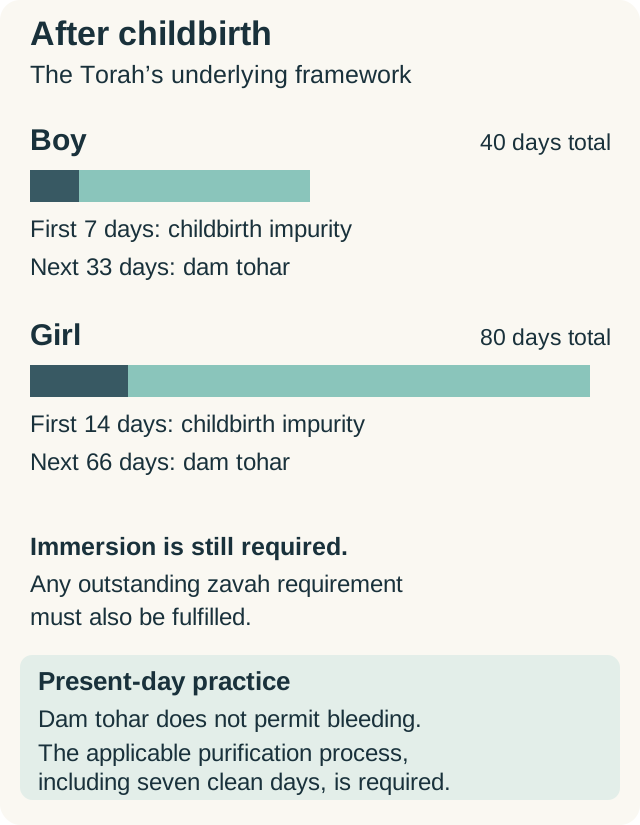
Counting from childbirth

Picture the case: A learner reads “thirty-three days” after a boy and wonders whether these days begin at birth.

They begin after the initial seven days of childbirth impurity: seven plus thirty-three makes forty. After a girl, fourteen plus sixty-six makes eighty.

The point

This timeline illustrates the ’s underlying framework. Immersion is required, and any outstanding requirement must also be fulfilled. Under accepted present-day practice, does not permit uterine bleeding; the applicable purification process, including seven clean days before immersion, is required.

Boy: seven days of childbirth impurity followed by thirty-three days of dam tohar, forty total. Girl: fourteen followed by sixty-six, eighty total. The image explicitly distinguishes present-day practice.
Halachah 5: the two bars use the same day scale. The thirty-three or sixty-six days follow the initial seven or fourteen. This is the ’s underlying framework, subject to immersion and any outstanding requirement. Accepted present-day practice does not permit uterine bleeding on the basis of .
Open full-size illustration
הלכה ו

Why a Immerses at Night

And all those required to immerse perform their immersion by day,

except a and a woman after childbirth.

The general time for the immersions discussed here is daytime. A and a woman after childbirth are exceptions: their prescribed periods must end completely before immersion can remove their status.

For concerning a , the says:

“She shall remain in her state for seven days” ( 15:19).

She remains a throughout all seven days,

and immerses on the night beginning the eighth day.

Immersion cannot shorten the seventh day. The entire seven-day period must finish, so her immersion takes place on the following night.

Here, the is discussing the ’s basic seven-day period. This is different from seven clean days counted after bleeding stops. Under present practice, seven clean days are required, and the regular immersion time is the night following their completion, as explained in chapter 11.

Similarly, a woman who gives birth to a boy immerses on the night beginning the eighth day,

and one who gives birth to a girl on the night beginning the fifteenth day,

because a woman after childbirth is like a , as we explained.

As established in halachah 2, the connects childbirth impurity to . The full seven days following the birth of a boy, or fourteen following the birth of a girl, must therefore end before immersion.

These are the earliest nights permitted by the childbirth timetable itself. Any outstanding requirement to count seven clean days must also be fulfilled; the childbirth timetable does not replace it.

Synopsis

The full or childbirth period must end before immersion. Their regular immersion time therefore begins at night, subject to the other requirements for purification.

הלכה ז

Nighttime Immersion Even After a Delay

-

If she delayed for many days without immersing,

when she does immerse, she must do so only at night.

This concerns a or a woman after childbirth whose required period has already ended. Although she has waited beyond the earliest possible immersion date, the ordinary rule still requires nighttime immersion.

For if she immerses during the day, people may misunderstand,

and another may come to immerse on her seventh day.

Someone observing a daytime immersion may not know that the woman has already waited beyond her required period. She might mistakenly conclude that immersion is permitted during the seventh day itself.

The nighttime requirement after a delay is a safeguard against that misunderstanding. The exception for difficult circumstances follows in the next .

Synopsis

Even after the required period has long ended, immersion ordinarily remains at night, to prevent confusion with immersion on a ’s seventh day.

הלכה ח

Daytime Immersion in Difficult Circumstances

If she was ill,

or the place of immersion was far away,

and the women could not travel there and return at night

because of robbers or the cold,

-

or because the city gates were locked at night—

she may immerse during the eighth day,

or during the daytime on subsequent days.

Illness that makes nighttime immersion difficult, or the nighttime travel obstacles described here, allows an exception to the ordinary nighttime requirement. These circumstances do not allow immersion before the required period has ended.

For a in the ’s basic framework, the eighth day comes after all seven days have passed. This allowance does not permit immersion during the seventh day, even if the couple intends to wait until night before resuming relations. The makes this distinction explicit ( 197:4).

The eighth day is not a universal immersion date. A woman after childbirth must complete the applicable childbirth period, and under present practice the required seven clean days must also be completed. The concession changes the permitted time of day; it does not shorten the required count.

Synopsis

Illness or serious obstacles to nighttime travel can permit daytime immersion after the required period has fully ended. They do not permit immersion on a ’s seventh day.

Picture the CaseA concrete example

The road is unsafe at night

Picture the case: A woman has completed the waiting period described here, but the only available requires traveling along a road that is dangerous after dark. She can make the journey safely during daylight.

Does provide an exception to nighttime immersion?

Yes. In the circumstances described here, she may immerse during the daytime on the eighth day or later. The exception does not allow her to immerse during the seventh day.

This illustrates the exception within ’s framework; arranging an actual daytime immersion requires guidance.

הלכה ט

Relying on an Established State of Purity

All women who have a

are presumed pure with respect to their husbands,

until she tells him, “I am impure,”

or she becomes established among her neighbors as a .

A is an established pattern indicating when menstruation is expected to begin. Outside the time associated with that pattern, the husband may rely on her established pure status unless there is a recognized reason to regard it as changed.

Becoming established as a among her neighbors means that her conduct identifies her as such—for example, wearing clothing specifically designated for her period. An unsupported rumor does not establish this status.

The words “who have a ” qualify the ruling. The and explain that when she has no fixed , the husband must ask about her status rather than rely on this particular presumption.

If her husband traveled to another country

-

and left her in a state of purity,

when he returns, he need not question her,

-

and even if he finds her asleep,

he is permitted to have relations with her,

provided it is not the of her ,

and need not suspect that she is a .

His absence does not itself overturn the presumption of purity. The permission remains subject to the stated conditions: she has a fixed , he left her pure, and it is not the period when her menstruation is expected. An here is the relevant daytime or nighttime period, as explained in 12–13.

If enough time has elapsed for menstruation and the necessary purification, he may presume that she completed that purification, including immersion, if she became impure during his absence. The passage of time itself does not make her pure.

The reference to finding her asleep concerns whether he must ask about her ritual status. It does not permit relations with a woman who is fully asleep. The separate requirement that marital relations take place willingly remains in force (chapter 21, halachah 12; , 184:31).

-

But if he left her as a , she remains prohibited to him

until she says, “I am pure.”

When her last known status was , he cannot assume that purification has taken place merely because enough time has passed. He must hear from her that she has become pure.

This differs from the earlier case: there, he left her pure and could rely on that established status under the stated conditions.

Synopsis

Under the stated conditions, a husband may rely on his wife’s established purity outside the of her fixed . If he left her as a , she must tell him that she has become pure.

הלכה י

Explaining a Retraction of “I Am Impure”

If a woman told her husband, “I am impure,”

and then retracted, saying, “I am pure;

-

I said that to you before as a joke,”

she is not believed.

But if she provides an explanation for her earlier words, she is believed.

This is a retraction of her original statement, rather than a report that she subsequently completed purification. Her first statement established that she was prohibited, and simply calling it a joke does not undo its legal effect.

An is a credible explanation accounting for why she made the earlier statement even though it was not true. Such an explanation can resolve the contradiction, as the following example demonstrates.

The ’s ruling also distinguishes a correction made within —the brief recognized interval for retracting a statement. A correction within this interval is accepted ( 185:3). A later retraction requires the credible explanation described above.

What is an example? Her husband sought marital relations with her,

while his sister or his mother was with her in the courtyard,

and she told him, “I am impure.”

Afterward, she retracted and said, “I am pure;

I told you that I was impure only

because of your sister or your mother,

-

lest they see us.”

In this case, she is believed.

The same applies in comparable cases.

Her explanation gives a specific reason for her original words: she wanted to avoid an intimate encounter while his relatives were nearby. She accounts for the statement rather than simply withdrawing it.

Other credible explanations can serve the same function. The gives examples such as an initial mistake about her status or a statement made because she lacked the strength for relations.

Synopsis

After declaring herself impure, a woman cannot simply retract by saying she was joking. A credible explanation for her original statement can allow the retraction to be accepted.

Picture the CaseA concrete example + illustration

“I said that because we had company”

Picture the case: A husband privately suggests spending time together. His mother is visiting, and his wife feels uncomfortable discussing their plans while she is nearby. She tells him, “I’m a .”

Later, she explains: “I’m actually . I said that because your mother was here, and I was embarrassed that she might notice.”

Can he accept her explanation?

In ’s example, yes. She has given a credible explanation—an —for her earlier statement. Simply saying, “I was joking,” would not be enough.

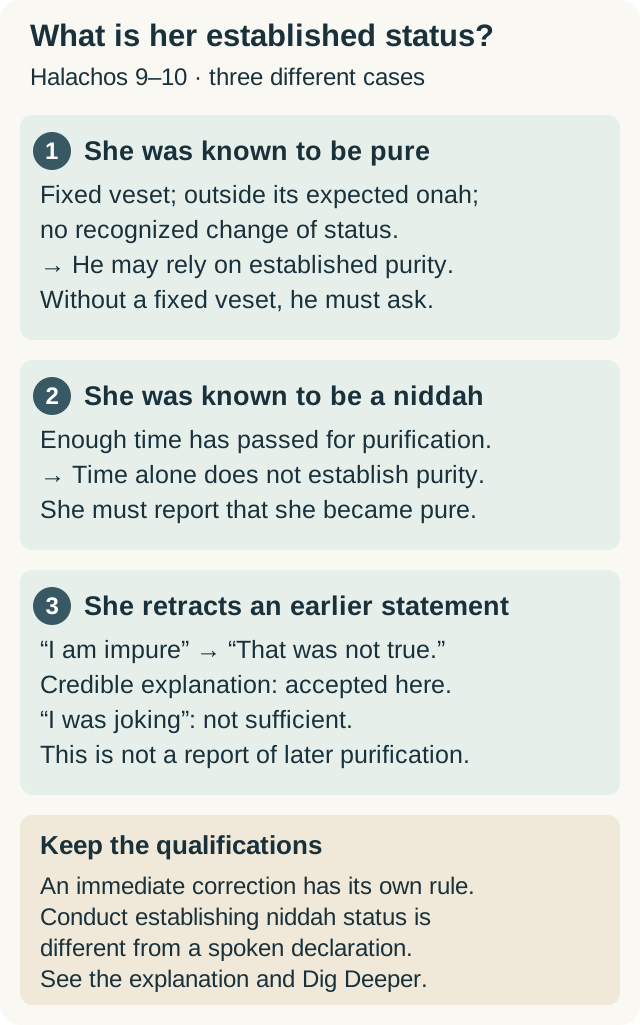
Three cases: established purity under Halachah 9’s conditions; known niddah status requiring her report of purification; and retraction of an earlier statement with a credible explanation. Immediate correction and established conduct have separate rules.
9–10: relying on established purity, hearing that purification was completed, and accepting a credible explanation for an earlier statement are three different situations. The purity presumption here requires a fixed and the stated conditions outside its . Without a fixed , he must ask. A later claim that she was joking does not suffice. Immediate correction and conduct establishing status are governed by the qualifications explained in the chapter and Dig Deeper.
Open full-size illustration
🔎Dig DeeperExplaining a Retraction of “I Am Impure”

Explaining a Retraction of “I Am Impure”

A Spoken Declaration and Established Conduct

The and distinguish the verbal declaration discussed here from conduct establishing a woman as a . In the case described, where she wore clothing designated for that status, a later explanation does not suffice to remove the established status. The allowance for an should therefore not be extended automatically from words to conduct.

Sources: Maggid Mishneh to 4:10; and , 185:3.

הלכה יא

When Bleeding Begins During Relations

If he was having relations with a woman who was pure,

-

and she told him, “I have become impure,”

he must not withdraw immediately while still erect,

because withdrawal gives him pleasure just as entry does.

Relations began while she was permitted to him, but she now reports that she has become a . Although he must stop, withdrawing while erect would itself constitute a further forbidden act. He must therefore follow the procedure described below.

If he withdrew while still erect,

he is liable for , like one who had relations with a .

The same rule applies to other .

The same procedure applies if, during relations, he discovers that the woman is forbidden to him under another prohibition. Even when the initial entry was inadvertent, withdrawing while erect can constitute a separate forbidden act.

As elsewhere, liability to concerns deliberate transgression. Inadvertent wrongdoing has its own rules of atonement.

What, then, should he do?

He presses his toenails into the ground,

waits, and does not move,

until his erection has fully subsided;

then he withdraws from her.

He must stop movement and wait until he can withdraw without an erection. The adds that awareness of the gravity of the situation should fill him with awe ( 185:4).

Synopsis

If a woman becomes a during relations, he must remain motionless until his erection fully subsides and then withdraw. Withdrawing while erect is itself prohibited.

הלכה יב

Refraining from Relations at the Expected Time of Menstruation

A man is forbidden to have relations with his wife near the time of her ,

lest she begin bleeding during relations,

as it says: “You shall keep the children of Israel apart from their impurity” ( 15:31).

A identifies when menstruation is expected. The restriction anticipates possible bleeding during relations; it does not mean that she has already become a .

The explains that this precaution is Rabbinic. The verse serves as an —Scriptural support for the enactment.

How long must they refrain?

If she ordinarily begins bleeding during the day,

relations are forbidden from the beginning of that day;

and if she ordinarily begins bleeding at night,

relations are forbidden from the beginning of that night.

The relevant unit is an : the daytime or nighttime period containing the expected onset. The restriction begins at the start of that period, even if bleeding usually begins several hours later.

The next explains when the restriction ends. Chapter 8 develops the detailed rules for determining which periods must be observed.

Synopsis

A couple must refrain from relations during the daytime or nighttime period in which menstruation is expected to begin.

🔎Dig DeeperRefraining from Relations at the Expected Time of Menstruation

Refraining from Relations at the Expected Time of Menstruation

The scope of abstention

The and distinguish abstention during the expected from the restrictions applying after a woman actually becomes a . The basic requirement here concerns marital relations; it does not automatically impose all the restrictions of .

The discusses permission for affectionate contact, while the and other authorities take a stricter approach. Their disagreement concerns the scope of the precaution before bleeding begins.

A separate qualification concerns a woman whose expected bleeding occurs at varying hours within the daytime or nighttime period. The Siftei Cohen discusses observing the preceding as well in that situation. This is an additional stringency discussed by later authorities, rather than the rule stated here by the .

Sources: Maggid Mishneh to 4:12; , 184:2; Siftei Cohen 184:6–7; Turei Zahav 184:3.

Live ItPrepare your boundary ahead of time

Prepare your boundary ahead of time

requires a couple to refrain from relations during the period when menstruation is expected, even before bleeding begins. The precaution responds to an anticipated concern. It teaches us to take an approaching challenge seriously while there is still time to prepare.

In our daily , preparation can make it easier to remain faithful to a good commitment. If you know that messages interrupt your learning, put your phone out of reach before opening the . You have arranged your surroundings to support the choice you want to make.

Try today

Before your next learning session, remove one predictable distraction.

Suggested reflection on , 4:12.

הלכה יג

Waiting Until the Entire Has Passed

If her passed and she did not bleed,

she may have relations once the of her has passed.

The expected hour passing is not enough. The entire daytime or nighttime period containing that hour must finish. The following examples clarify this distinction.

What is an example? She ordinarily begins bleeding six hours into the day.

She may not have relations from the beginning of that day.

If six hours of the day passed without her bleeding,

she remains forbidden to have relations until evening.

Although her usual hour has passed without bleeding, the daytime is still in progress. They must therefore continue refraining until it ends.

Similarly, if she ordinarily begins bleeding six hours into the night,

-

and that time passed without her bleeding,

she remains forbidden to have relations until sunrise.

The nighttime case follows the same principle: the restriction continues through the entire night, rather than ending when the usual hour passes.

A further qualification concerns checking that bleeding has not begun. The and require an examination in connection with the expected . For an established , the records the practice that she remains prohibited until she checks, even after the has ended ( 184:9).

Synopsis

The restriction lasts for the entire containing the expected onset of menstruation, even when the usual hour passes without bleeding.

Picture the CaseA concrete example + illustration

The expected hour has passed

Picture the case: A woman has an established pattern of beginning her period around midday. On the expected day, midday passes without bleeding.

May the couple resume relations that afternoon?

No. The restriction covers the entire daytime , not just the expected hour. Under the rule described here, they wait until the daytime has ended. The chapter’s qualifications about checking also apply.

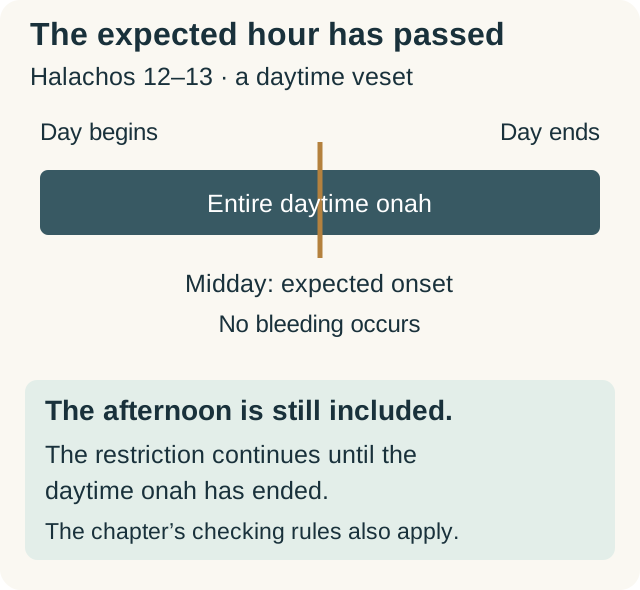
The whole daytime onah is shaded. Midday marks the expected onset; the afternoon remains restricted even without bleeding.
12–13: when the falls during the day, the restriction covers the entire daytime . Passing the expected hour without bleeding does not end it. The chapter’s qualifications about checking still apply.
Open full-size illustration
הלכה יד

Checking After Relations

It is the practice of Jewish men and women

always to check themselves after relations.

This describes the ’s position concerning routine checks. The records a different ruling for a woman with a fixed : she does not require routine checks before or after relations. The identifies that ruling as the accepted practice ( 186:1).

That exemption concerns routine checks surrounding relations. It does not remove examinations required for purification or those associated with an expected .

How? The man wipes himself with a cloth prepared for him,

and the woman wipes herself with a cloth prepared for her,

and they examine the cloths to see whether she bled during relations.

These are cloths prepared for checking, rather than ordinary washing. Examining both cloths can reveal blood that was present during relations. The next describes the cloths themselves.

The man may allow his wife

-

to examine his cloth,

since she is trusted concerning her own,

she is also trusted concerning his.

Her reliability concerning her own examination also permits him to rely on her examination of his cloth. He does not have to inspect it personally.

Synopsis

According to the , both spouses check after relations using separate cloths. The husband may rely on his wife to examine his cloth as well.

Picture the CaseA concrete example

Who checks his cloth?

Picture the case: Following the checking procedure describes, a husband and wife each use a separate cloth. His wife examines both cloths and tells him that neither has blood on it.

Must he personally examine his cloth too?

No. He may rely on her inspection. Just as she is trusted to examine her own cloth, she is trusted to examine his.

This case explains who may perform the inspection; the discussion of when these checks are required appears separately in the chapter.

🔎Dig DeeperChecking After Relations

Checking After Relations

Initial checks when there is no fixed

The distinguishes a woman with a fixed from one without one. For a woman without a fixed , it prescribes checks before and after the first three occasions of relations. If those checks establish that relations do not cause bleeding, routine checks are no longer required under that ruling.

It then records the ’s stricter position: without a fixed , the woman continues checking before and after relations, and the husband also checks afterward. This distinction helps explain why the Rambam’s presentation should not be read as a description of every authority’s practical ruling.

Sources: , 186:2.

Live ItGive trust room in your home

Give trust room in your home

allows a husband to rely on his wife to inspect his checking cloth, just as she is trusted regarding her own. Within the ’s conditions, her reliability carries real weight. Carefulness includes recognizing when another person’s word can be relied upon.

A practical reflection is to let appropriate trust shape the atmosphere at home. When your spouse has agreed to handle a household responsibility and tells you it is done, acknowledge the effort without automatically checking again. Respecting another person’s reliability can be a small, concrete expression of .

Try today

Thank someone for a responsibility they handled, and give their reliable word its proper weight.

Suggested reflection on , 4:14.

הלכה טו

The Cloths Called

-

These cloths used for wiping

must be made of linen,

worn and white.

Worn fabric is soft and pliable, making it suitable for checking. White fabric makes blood easier to notice. The cloth must also be clean, so that a preexisting stain does not create confusion.

The and explain that cotton may also be used ( 196:6).

In this context, they are called .

The cloth with which he wipes himself is called “his ,”

and the cloth with which she wipes herself is called “her .”

means “witness,” and is its plural. These cloths provide evidence of whether blood was present. In the following , “his ” and “her ” therefore refer to checking cloths, rather than human .

Synopsis

The checking cloths should be soft, clean, and white. They are called because they provide evidence of whether blood was present.

Picture the CaseA concrete example + illustration

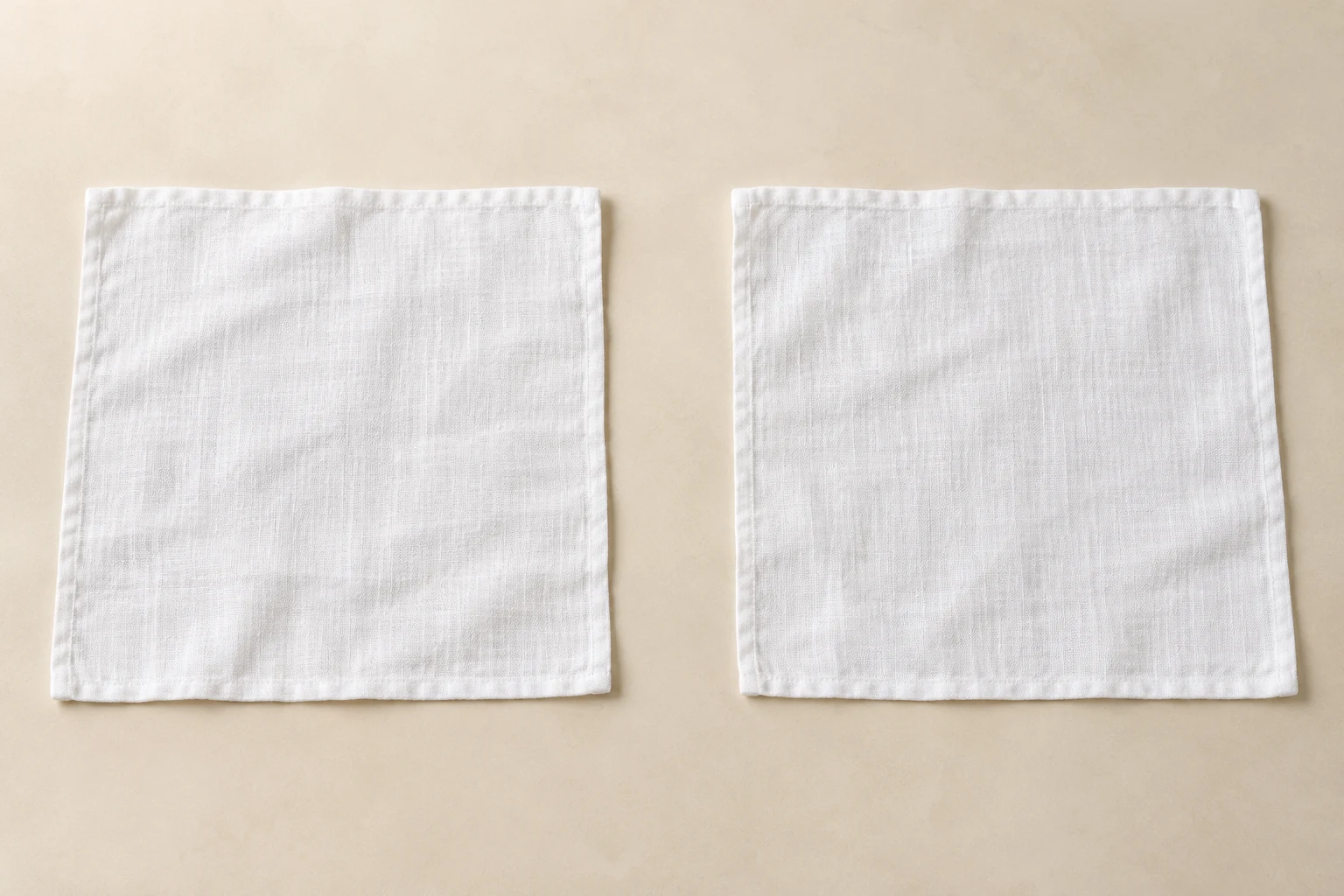
Two separate checking cloths

Picture the case: A couple prepares two separate, clean, soft white cloths for the checking procedure describes. One cloth is his ; the other is her .

The point

here means checking cloths. The illustration identifies the two cloths; the chapter separately explains when these inspections are required and how accepted practice differs.

Two separate clean white cloths lie side by side with a clear gap on a cream tabletop. Left: his ed. Right: her ed.
Left: his . Right: her . These are separate, clean, soft white checking cloths, as described in Halachah 15. Their appearance does not determine when an inspection is required; see the chapter’s explanations of ’s procedure and accepted practice.
Open full-size illustration
הלכה טז

Checks Before and After Relations

Modest women do not have relations

until they first examine themselves before relations.

A woman who has no

may not have relations until she examines herself.

She therefore uses two in connection with relations:

one before relations and one afterward.

The distinguishes an additional practice from a required examination. For a woman without a fixed , checking beforehand is obligatory according to his ruling.

Her two serve different purposes: one checks her status before relations, and the other checks for bleeding afterward. Her husband’s cloth after relations is additional to these.

But a woman who has a

does not need an before relations,

except as a practice of modesty.

Outside the time of her expected , the does not require this woman to check before relations. The examination described at the beginning of the is an additional practice in her case.

As explained in halachah 14, later authorities differ from the concerning routine examinations. His description here should be understood as his particular ruling.

-

After relations, however,

everyone requires two :

one for him and one for her.

-

Even a pregnant woman, a nursing woman, an elderly woman, or a minor

must have two when having relations:

one for him and one for her.

These women are generally less likely to experience menstrual bleeding. Nevertheless, according to the , that reduced likelihood does not remove the requirement to check afterward.

Here, “two ” means the two cloths used after relations—one by each spouse.

-

But a virgin, or a woman in the period of ,

does not need ,

since blood is already flowing from her.

The first exception concerns bleeding associated with the initial acts of marital relations. The second concerns , blood during the -defined days of purity after childbirth, discussed in halachah 5.

These cases involve blood that does not itself prohibit relations under the framework discussed here. With , the distinction is the blood’s legal classification, rather than a different physical source.

These exceptions belong to the legal framework being explained here. They do not mean that hymenal bleeding or postpartum bleeding is permitted under present practice; the additional restrictions are discussed later.

Synopsis

According to the , a woman without a fixed checks before and after relations. Both spouses ordinarily check afterward, even when menstrual bleeding is unlikely, with exceptions for the forms of bleeding specified here.

🔎Dig DeeperChecks Before and After Relations

Checks Before and After Relations

Why the authorities disagree about routine examinations

The and challenge the ’s requirement, understanding the Talmudic examination rules in the relevant passage as addressing women occupied with ritually pure foods, rather than establishing the same routine requirement for marital relations alone.

The Rambam’s also exists in differing versions on this point. His earlier wording follows the more lenient approach, while the revised wording accords with the position expressed in the . The distinction therefore reflects a substantive disagreement about the scope of the Talmudic requirement.

Sources: Ra’avad to 4:16; Rambam’s , 1:7, earlier and revised versions; , 186:1–2.

הלכה יז

Using the Throughout the Night

If a man has marital relations several times,

the couple need not inspect their two

after each act of relations.

Instead, he wipes himself with his ,

and she with hers,

after each act of relations throughout the night;

the following morning, they inspect the .

The distinguishes using the cloths from visually inspecting them. Each spouse uses the appropriate cloth after every act, but they may wait until morning to examine the cloths for blood.

This continues his ruling concerning checks after relations; it does not remove any separate examination required beforehand.

If blood was found on his

-

or on hers,

she is impure.

Blood on either spouse’s cloth can reveal that she bled. The following address circumstances in which blood might instead be attributed to another source.

If she had relations and wiped herself,

-

and the was lost,

she may not have relations again

until she first examines herself with another ,

lest there have been blood on the that was lost.

When the original cloth remains available, it can still be inspected. Once it is lost, the possible evidence cannot be recovered, so she must perform a fresh examination before further relations.

If that examination is clean, she may proceed under this ruling; the loss of the earlier cloth does not itself establish that she became impure.

Synopsis

The cloths must be used after each act of relations, but their inspection may wait until morning. If her cloth is lost, she must perform a fresh examination before further relations.

הלכה יח

A Stain Found After the Was Put Away

If she placed the beneath a pillow

or beneath a bolster,

and blood was found on it:

-

if the stain is elongated, she is impure,

because it is presumed to have come from wiping.

The explains that the was known to be clean before use. The question is therefore whether the blood came from her examination or reached the cloth afterward.

An elongated stain is consistent with blood being spread across the cloth during wiping. It is attributed to the examination and renders her impure even when small.

-

But if it is round, she is pure,

for this is attributed to the blood of a louse

that was killed beneath the pillow.

A round stain can be attributed to a louse crushed where the cloth was placed. The insect’s remains need not be found for this attribution to apply.

The qualifies this allowance: attribution to a louse applies when the round stain does not exceed a , a traditional measure of surface area. A larger stain cannot be explained by the blood of a louse alone ( 190:34).

This size allowance applies to the round stain that can be attributed to a louse. It is not a general minimum size below which every blood finding on a checking cloth is disregarded.

Location also matters. The explains that when the cloth was stored in a protected place where this explanation is not plausible, such as a box, a round shape alone does not establish purity.

Synopsis

On an initially clean placed beneath a pillow, an elongated stain is attributed to wiping even when small. A round stain may be attributed to a crushed louse, subject to the limits governing that explanation.

הלכה יט

A Checked and an Unchecked

If she wiped herself with an known to be clean,

then pressed it against her thigh,

-

and blood was found on it the next morning,

she is impure.

We do not suggest that perhaps, when she pressed it against her thigh,

a louse was killed.

After touching the cloth to her thigh, she put it in a safe place. Since it was initially clean, the blood is attributed to her examination. We do not introduce the possibility that contact with her thigh happened to crush a louse.

This differs from placing the cloth beneath a pillow, where the previous recognizes that explanation. The understands the ’s ruling here to apply even when the stain is round.

If she wiped herself with an that had not been checked,

and did not know whether there had been blood on it

before she wiped herself with it,

and blood was found on it:

-

if the blood covered more than a ,

she is a ;

-

if it was less than that amount, she is pure,

for it is attributed to a louse.

An unchecked cloth introduces a different uncertainty: the stain may already have been present before she used it. A stain no larger than a can be attributed to a louse. Once it exceeds that amount, this explanation is insufficient.

“Less than that amount” means less than the disqualifying amount of a plus something additional. A stain exactly the size of a is therefore included in the allowance.

An unchecked cloth means one whose previous condition is unknown. It is distinct from a cloth known to have already been stained, which the discusses separately ( 190:36).

Synopsis

Blood on a previously checked is attributed to the examination despite its later contact with her thigh. On an unchecked , a stain no larger than a may be attributed to a louse.

Picture the CaseA concrete example + illustration

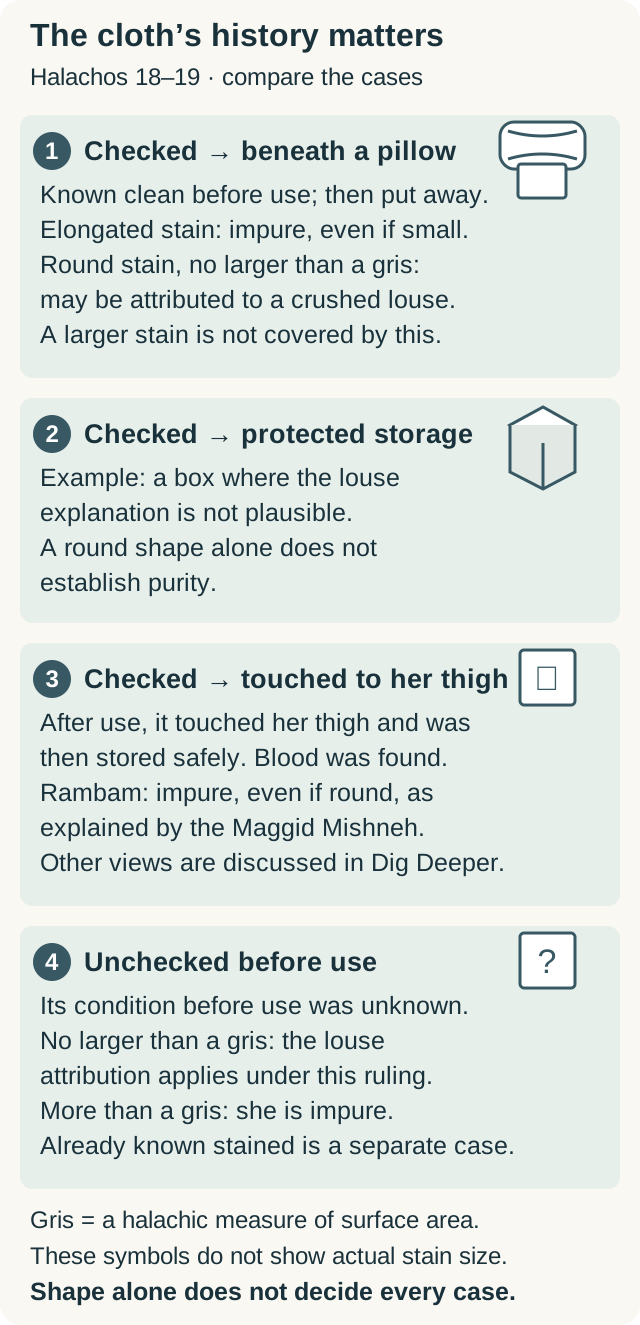
The same shape does not tell the whole story

Picture the case: Two cloths have similarly shaped stains, but their histories differ. One was checked before use and later placed beneath a pillow. The other was checked before use, touched to her thigh after wiping, and then stored safely.

Can the shape alone settle both cases?

No. The possibility of an external source depends on the cloth’s history. The chart compares ’s cases and the chapter’s qualifications concerning shape, size, storage and the cloth’s original condition. Dig Deeper explains the disagreement concerning the thigh-contact case.

Four cloth histories: checked before use and stored under a pillow; checked and stored in a protected box; checked, used, touched to her thigh and stored safely; or unchecked with its original condition unknown. Labels distinguish shape, size and Rambam’s ruling.
18–19: under a pillow, an elongated stain on a previously checked cloth renders her impure even when small; a round stain no larger than a can be attributed to a crushed louse where that explanation is plausible. Protected storage removes that explanation. In the thigh-contact case, the explains as ruling impure even for a round stain; Dig Deeper discusses the disagreement. An unchecked cloth has a different starting point: its previous condition is unknown, and the stated louse attribution applies up to and including a . The diagram does not depict actual stain sizes.
Open full-size illustration
🔎Dig DeeperA Checked and an Unchecked

A Checked and an Unchecked

Does a round stain change the first ruling?

The explains that the considers the woman impure in the thigh-contact case even when the stain is round. Other authorities distinguish between an elongated stain and a round one, extending the previous ’s allowance to a sufficiently small round stain here as well.

The records both approaches. The disagreement concerns whether the possible external source is sufficient to explain the stain despite the cloth having been known to be clean before use.

Sources: Maggid Mishneh to 4:19; , 190:35.

הלכה כ

Repeated Bleeding During Relations

If a woman experienced bleeding during relations,

she may have relations a second time once she becomes pure.

If she experienced bleeding the second time,

she may have relations a third time.

One or two occurrences do not yet establish the recurring pattern described here. After each occurrence, she must complete the necessary purification before relations may resume. The permission for a third occasion likewise applies only after purification.

These rules concern bleeding during relations or discovered immediately afterward within the relevant interval. A later discovery does not by itself establish this particular pattern of bleeding caused by relations.

If she experienced bleeding in this way a third time,

she is forbidden to have relations with this husband forever.

The three occurrences must be consecutive, without an intervening occasion of relations without such bleeding. Three qualifying occurrences establish a : a legal presumption that the pattern will continue.

Once that pattern is established, the couple may not simply continue after another purification. 21–22 discuss the resulting divorce requirements, subsequent marriages, and examination of the bleeding’s source. The conditions under which examination can permit continued marriage require separate explanation there.

This rule concerns the relevant uterine bleeding, rather than hymenal bleeding associated with the beginning of marriage, which is discussed separately in chapter 5.

When does this apply?

When there was no other factor to which the bleeding could be attributed.

But if she had relations near her ,

she attributes the bleeding to her .

The question is whether relations themselves have been established as causing the bleeding. When the bleeding can instead be explained by her expected menstruation, it does not establish that particular pattern.

This attribution does not make menstrual blood pure, nor does it permit relations during the prohibited discussed in 12–13.

If she had a wound,

she attributes the bleeding to the wound.

But if the blood from her wound differed

from the blood she experienced during relations,

she may not attribute it to the wound.

A bleeding wound provides another explanation for the blood. However, a known difference in color between the wound’s blood and the blood found during relations prevents that attribution.

The and explain that she need not establish through comparison that the colors match. Unless a difference is known, the wound may remain the explanation under this ruling.

A woman is trusted to say:

“I have a wound within the uterus

from which the blood comes.”

She is then permitted to her husband,

even though blood comes from the uterus

during relations.

In the case described by the , her statement identifies a wound from which blood actually emerges. Merely mentioning a wound does not convey the same information. The records her reliability in reporting this bleeding wound ( 187:6).

The distinction is the source of the blood. Blood attributable to a wound is treated differently from menstrual bleeding, even when the wound is within the uterus.

Synopsis

Three consecutive qualifying occurrences establish a pattern prohibiting further relations with this husband. The pattern is not established when the bleeding can be attributed to another recognized cause, such as the or a bleeding wound.

הלכה כא

When the Pattern Recurs with Different Husbands

If a woman experienced bleeding during relations

on a first, second, and third occasion,

-

and there was no other factor to which it could be attributed,

she must be divorced,

but she may marry a second husband.

This continues the preceding : three consecutive qualifying occurrences establish a recurring pattern with this husband. The requirements concerning the timing and source of the bleeding still apply, and purification is required before each otherwise permitted subsequent occasion.

The pattern established with her first husband does not yet establish that the same difficulty will occur with every husband. She may therefore marry another man.

If she married a second husband,

-

and experienced such bleeding during relations three times,

she must be divorced,

but she may marry a third husband.

Even after the pattern recurs with a second husband, the possibility remains that the difficulty is particular to those marital relationships. She is therefore permitted to marry a third husband.

The three consecutive qualifying occurrences are counted separately with each husband, rather than as one combined total across the marriages.

If she married a third husband,

and experienced such bleeding during relations

-

on a first, second, and third occasion,

she must be divorced,

and she may not marry until she recovers from this condition.

Once the pattern has been established with three different husbands, it is no longer treated as a difficulty particular to one couple. A broader —a legal presumption—is established that the bleeding will recur with another husband as well.

Another purification or the passage of time alone does not resolve that concern. The next explains an examination used to determine whether the bleeding comes from a source that permits marriage.

Synopsis

After the pattern is established with one or two husbands, she may marry another. Once three consecutive qualifying occurrences have taken place with each of three husbands, she may not marry again until the condition is resolved.

Picture the CaseA concrete example + illustration

Count the sequence within each marriage

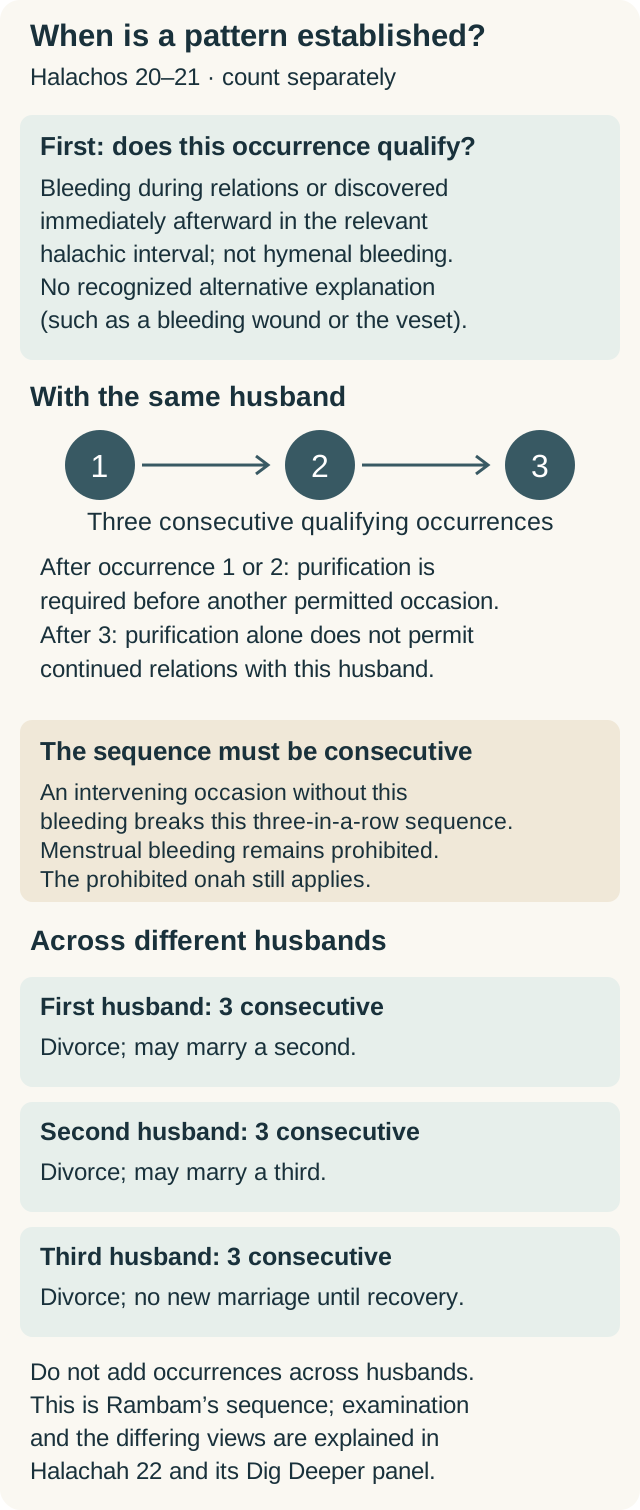
Picture the case: A learner reads that the pattern recurred with a second husband and wonders whether one occurrence with the first husband plus two with the second would make the three described here.

No. The three consecutive qualifying occurrences are counted separately with each husband. Purification is required before each otherwise permitted subsequent occasion, and the timing and source of the bleeding must meet the conditions in Halachah 20.

The point

This chart follows ’s sequence in 20–21. The role of examination and the differing views about remaining with the same husband are explained separately in Halachah 22 and Dig Deeper.

A qualifying occurrence requires the relevant timing and source. Three consecutive qualifying occurrences establish a pattern with one husband; the count is separate for each husband. The chart shows Rambam’s sequence of subsequent marriages and the separate recovery requirement.
20–21: the pattern concerns three consecutive qualifying occurrences with the same husband, not three accumulated across different marriages. Necessary purification precedes each otherwise permitted further occasion. Recognized alternative explanations, the timing of discovery and the distinction from hymenal bleeding matter. Attribution to an expected period does not permit menstrual bleeding or relations during the prohibited . The divorce sequence follows ’s presentation here; Halachah 22 and Dig Deeper explain examination and the differing views about remaining with the same husband.
Open full-size illustration
הלכה כב

Identifying the Source of the Bleeding

How does she examine herself

to determine whether she has recovered?

She brings a tube made of lead,

with its rim folded inward,

and inserts the tube as far as she can.

The folded rim provides a smooth edge to avoid scratching her and causing bleeding through the examination itself.

The tube also separates the cotton used in the examination from the vaginal walls. This allows the examination to distinguish blood coming from the uterus from blood caused by contact with the surrounding walls.

She inserts a slender rod into the tube,

with a wad of cotton placed at its tip,

and advances it until the cotton reaches the opening of the womb,

then removes the cotton.

The cotton is brought to the area being examined while shielded from contact with the vaginal walls. Its condition can therefore indicate whether the blood comes from the uterine source.

This describes the Talmudic examination. In contemporary practical cases, assessment of the bleeding’s source calls for medical evaluation coordinated with a .

If blood is found at the tip of the cotton,

it is established that the blood she experiences during relations

comes from the uterus.

Under the conditions of this examination, blood at the tip identifies the uterine source. The examination has therefore not provided a basis for removing the restriction established by the recurring bleeding.

-

But if nothing is found on the cotton,

it is established that the blood she experiences results from pressure against the vaginal walls,

and she is pure.

The bleeding is then attributed to pressure against the vaginal walls rather than to the uterine bleeding that creates the prohibition discussed here.

A favorable result does not necessarily mean that every form of bleeding has stopped. It establishes a different source for the bleeding. Nor does this examination replace the purification required for any independently established status.

She may marry other men,

as we explained in .

The words “other men” are significant. In 25:8, the rules that a husband who divorces her for this reason may not subsequently remarry her.

If he could remarry her after recovery, he might later claim that he would never have divorced her had he known she would recover. The restriction protects the finality of the original divorce. It does not mean that every divorce in these circumstances is automatically invalid.

Permission to marry another man therefore does not itself permit returning to the husband who divorced her for this reason.

Synopsis

The examination distinguishes uterine bleeding from bleeding caused by pressure against the vaginal walls. A result identifying the latter source permits marriage to another man, subject to the separate restriction concerning a former husband.

🔎Dig DeeperIdentifying the Source of the Bleeding

Identifying the Source of the Bleeding

Can examination allow her to remain with her husband?

The understands the ’s wording as requiring divorce once the recurring pattern is established with that husband. On this reading, the examination does not permit her to remain with him; it can establish permission for marriage to another man.

He contrasts this with the approach of the and , who allow the examination earlier in the process, including while she is still married to her first husband. If it establishes that the blood comes from the vaginal walls, she may remain with him. The Maggid Mishneh himself favors this latter approach.

The records both approaches concerning examination while she remains with her first husband, and the permits reliance on the lenient position. This is therefore an attributed dispute, rather than an unqualified explanation that the Rambam’s examination always permits continued relations with the same husband.

Sources: Maggid Mishneh to 4:22; and Rema, 187:3.

Sources & editorial method

Hebrew text: Mishneh Torah, Hilchos Issurei Biah, Chapter 4. The Hebrew is preserved as the primary text and divided into short learning units.

Translation and elucidation: Independently prepared for Rambam, Clearly in contemporary English. Translation follows the Rambam’s words; elucidation supplies only the context needed to understand them.

Word cards and glossary: Hebrew word cards distinguish a word’s basic meaning from its meaning in the particular phrase. Shared glossary entries explain recurring terms; biography entries identify the cited authorities.

Explain and Background: Explain provides context needed for the ruling. Optional Background panels provide additional context that can be skipped without losing the essential explanation.

Synopsis: A short summary follows each halachah. It is a guide to the central ruling, not a replacement for the full text and its qualifications.

Dig Deeper: Based on the classic commentaries named inside each panel. Editorial explanations are not presented as quotations.

Live It: Where present, these panels connect a particular halachah to a suggested personal reflection and an action to try. Original applications are labeled as suggested reflections. They are distinct from the ruling and are not attributed to the Rebbe merely because his guidance supports seeking a practical lesson.

Measurements: Modern equivalents draw on Chabad.org’s measurement glossary and cited halachic calculations. They show a range when major accepted calculations differ. Monetary equivalents fluctuate with the price of silver.

The Rebbe’s teachings and guidance: Source links accompany the completion teachings and the guidance inside Dig Deeper and Live It. Quotations, translations, and adaptations are identified; the general guidance is separate from the sources for a panel’s particular discussion.

Editorial responsibility: Created and prepared for this project by Levi Gelb. Corrections and suggestions can be submitted below. This presentation supports learning; practical halachic questions should be brought to a qualified rav.

Chapter 4 at a glance

Chapter Synopsis

This chapter explains the statuses that prohibit marital relations, the requirements for immersion, reliance on a woman’s established status, and the evaluation of bleeding. It presents the ’s underlying legal framework, with clarifications where accepted practice differs.

  • Intercourse with a carries even at its initial stage. and impurity can begin in infancy, but the age relevant to another participant’s liability is a separate matter.
  • The prohibition carrying applies throughout the prescribed , childbirth, and periods. The end of bleeding does not itself permit relations; the applicable counting and immersion requirements must be fulfilled.
  • A , , or woman after childbirth remains prohibited until the required immersion, even years after the relevant period has ended.
  • The -level liabilities for , , and childbirth impurity do not apply to non-Jewish women. A separate Rabbinic decree treats non-Jews as for matters of ritual purity.
  • Under the ’s basic law, blood during the thirty-three or sixty-six days following the initial childbirth-impurity period does not itself prohibit relations after the required immersion. An outstanding requirement must still be resolved, and present practice does not apply this permission for .
  • The full or childbirth period must end before immersion. Their regular immersion time therefore begins at night, subject to the other requirements for purification.
  • Even after the required period has long ended, immersion ordinarily remains at night, to prevent confusion with immersion on a ’s seventh day.
  • Illness or serious obstacles to nighttime travel can permit daytime immersion after the required period has fully ended. They do not permit immersion on a ’s seventh day.
  • Under the stated conditions, a husband may rely on his wife’s established purity outside the of her fixed . If he left her as a , she must tell him that she has become pure.
  • After declaring herself impure, a woman cannot simply retract by saying she was joking. A credible explanation for her original statement can allow the retraction to be accepted.
  • If a woman becomes a during relations, he must remain motionless until his erection fully subsides and then withdraw. Withdrawing while erect is itself prohibited.
  • A couple must refrain from relations during the daytime or nighttime period in which menstruation is expected to begin.
  • The restriction lasts for the entire containing the expected onset of menstruation, even when the usual hour passes without bleeding.
  • According to the , both spouses check after relations using separate cloths. The husband may rely on his wife to examine his cloth as well.
  • The checking cloths should be soft, clean, and white. They are called because they provide evidence of whether blood was present.
  • According to the , a woman without a fixed checks before and after relations. Both spouses ordinarily check afterward, even when menstrual bleeding is unlikely, with exceptions for the forms of bleeding specified here.
  • The cloths must be used after each act of relations, but their inspection may wait until morning. If her cloth is lost, she must perform a fresh examination before further relations.
  • On an initially clean placed beneath a pillow, an elongated stain is attributed to wiping even when small. A round stain may be attributed to a crushed louse, subject to the limits governing that explanation.
  • Blood on a previously checked is attributed to the examination despite its later contact with her thigh. On an unchecked , a stain no larger than a may be attributed to a louse.
  • Three consecutive qualifying occurrences establish a pattern prohibiting further relations with this husband. The pattern is not established when the bleeding can be attributed to another recognized cause, such as the or a bleeding wound.
  • After the pattern is established with one or two husbands, she may marry another. Once three consecutive qualifying occurrences have taken place with each of three husbands, she may not marry again until the condition is resolved.
  • The examination distinguishes uterine bleeding from bleeding caused by pressure against the vaginal walls. A result identifying the latter source permits marriage to another man, subject to the separate restriction concerning a former husband.
פרק ד

End of chapter.

You have reached the end of all twenty-two halachos.