This chapter identifies which deliveries create the ’s childbirth impurity, how fetal form and the timing of delivery establish that status, and how uncertainty changes the count. It distinguishes a definite birth, a doubtful birth, and uncertainty about whether the child was male or female. The original days-of-purity framework developed here differs from later practice and is not a guide for deciding an individual case today.
פרק י21 halachosThursday, October 29, 2026י״ח במרחשון תשפ״ז◷ Estimated study time: 65–85 min
אTap any Hebrew word to see its meaning and how it works in the phrase.
Chapter progress 0 of 21 completed🔎 0 learned in depth
Every woman who gives birth becomes impure like a ,
.
even when she has seen no blood.
Birth itself creates this status; it does not depend on a separate discharge of blood. This differs from the discharge of a piece of flesh that is not legally a birth, discussed in Chapter 5:13. These are categories of impurity, not judgments about a woman’s cleanliness or worth. The chapter develops the ’s original childbirth framework; the later rules discussed in Chapter 11 mean that its periods of permitted bleeding are not a practical guide for today.
,,
The rule is the same whether she delivers a living child or a dead one,
-,;
or even a miscarried fetus: if male, she observes the period for a male;
,.
if female, she observes the period for a female.
,.
This applies provided its form has developed.
The initial birth-impurity period is seven days for a male and fourteen for a female. In the original framework of Chapter 4, these are followed by thirty-three or sixty-six days, respectively, in which uterine bleeding does not itself create new impurity. The end of the counted period does not by itself remove her impurity; the required immersion is still necessary. The present chapter determines which deliveries qualify for these rules. A miscarriage qualifies only after the required human form has developed; its mere occurrence is not enough.
,
The fetus’s form does not become developed in fewer than forty days,
.
whether it is male or female.
Halachah 2 specifies that a miscarriage on day forty itself still does not create birth impurity. These descriptions establish the legal thresholds used in this chapter; they are not instructions for making a contemporary medical assessment.
Synopsis
A qualifying birth creates impurity even without bleeding, whether the child is living or dead. A miscarriage must have reached the required stage of formation.
does not acquire birth impurity, even on the fortieth day.
This excludes the special impurity of childbirth, not impurity from accompanying uterine blood. Such blood may still make her a or a under the applicable rules.
-
If she miscarries on the forty-first day after intercourse,
,
her status as a woman who has given birth is uncertain,
.
and she observes the requirements for a male, a female, and a .
The count begins with intercourse, not with a known moment of conception. Even when intercourse followed her immersion that night, conception is not established as having occurred then. There are therefore three possibilities: a qualifying male birth, a qualifying female birth, or a miscarriage too early to count as a birth. She must observe the stringencies arising from all three; Halachah 21 explains how these possibilities affect her counting.
,
If the human form is exceedingly faint
-
and is not plainly recognizable,
,
she observes the requirements for a male and a female.
״״.
This is what is called a .
Here a human form is discernible, although only faintly, so a qualifying birth is established. The remaining doubt concerns whether the fetus is male or female; the independent possibility of no birth is no longer included. Halachah 20 gives the resulting rules. The expression describes an embryonic sac with a developing form; evokes an embroidered pattern beginning to appear.
Synopsis
A miscarriage through day forty is not a birth for these laws. Later uncertainty may concern either whether a qualifying birth occurred at all or only whether the fetus was male or female.
At the beginning of human formation, its body is like a lentil;
its two eyes are like two specks of fly discharge,
,
spaced apart from one another;
its two nostrils are like two specks of fly discharge,
,
set close to one another;
,
its mouth has an opening as narrow as a hair;
.
and its hands and feet are not yet separately defined.
These are the signs of formation used for the legal distinction just stated. The image of tiny fly specks conveys the minute size of the features; the comparison is also understood as referring to a fly’s eyes.
,
If its form has become clearer than this,
-
but it is still not distinguishable as male or female,
,
it is examined in oil, not in water,
;
because the oil makes it clearer;
,
one brings a small wooden splinter with a smooth tip
:
and moves it over the genital area from top to bottom.
,;
If it catches, the fetus is known to be male;
,
if that area appears like a split barley grain,
.
the fetus is female and requires no examination.
The catching described here is a sign of the area from which the male organ develops. The split-grain appearance is itself the female sign, so the additional probe is unnecessary. This records the ’s diagnostic procedure within the chapter’s original framework, not a procedure for a reader to perform.
,
For all these developing forms found in miscarriages,
-
the woman is not granted days of purity
.
until the fetus has grown hair.
Recognizable formation can impose birth impurity without yet granting the corresponding leniency for later bleeding. The additional threshold here concerns the days of purity, not the initial finding of birth impurity.
Synopsis
The describes signs of early human formation and of male or female development. These early forms do not grant days of purity until the fetus has grown hair.
The bone establishes that the mass had developed sufficiently to possess the required features, even though those features are no longer recognizable. It is treated as a fetus whose form has been lost, rather than as an unformed discharge.
,
If she discharges a sac filled with water,
,,-
filled with blood, with wormlike pieces, or with flesh,
,
since it has no developed form,
.
she need not be concerned that it was a fetus.
A sac alone does not establish the human formation described in Halachah 3. In his , the explains the wormlike contents as pieces of flesh shaped like worms. Under his approach, when no blood is apparent on this discharge, it does not create separate impurity. The restricts reliance on the fine distinctions of fetal development because of insufficient expertise; the exemption stated here must therefore not be treated as a contemporary practical ruling.
Synopsis
A bone within a discharged mass establishes birth impurity. An undeveloped sac without the required human form does not establish a birth.
A child delivered through the abdominal wall does not cause its mother birth impurity,
,
and this delivery has neither days of impurity nor days of purity,
״״(,)-
as it says: “When a woman conceives and gives birth” (Leviticus 12:2)—
.
she must give birth through the place of conception.
The verse’s childbirth rules are limited here to delivery through the reproductive passage. Delivery through the abdominal wall therefore does not create either the special impurity of birth or its later days-of-purity leniency. Any separate bleeding must still be evaluated.
-
If a woman experiences labor and delivers through the abdominal wall,
the labor blood that emerges through the reproductive passage
,
has the status of or blood,
,.
and blood emerging through the abdominal wall is impure.
The classification as or depends on where she stands in the cycle defined in the preceding chapters. The exemption for certain blood associated with labor does not apply here. Blood leaving through the abdominal wall also carries ritual impurity of its own, although that does not by itself make the woman a .
-
If no blood emerged through the reproductive passage,
,
the woman remains pure,
;
even though the blood that left through her abdominal wall is impure;
for the woman does not become impure unless uterine blood emerges
.
through her vaginal opening.
The distinction is between the blood’s ritual status and the woman’s status from its discharge. The uterine source makes the blood impure; touching it after it emerges can convey impurity until evening, including to the woman herself. Its passage through the abdominal wall alone, however, does not create the woman’s impurity. The derives the requirement of emergence through the vaginal passage from Leviticus 20:18.
Synopsis
Delivery through the abdominal wall does not create the special childbirth periods. Blood emerging through the vaginal passage can still make the woman impure; blood emerging through the abdominal wall has its own distinct impurity.
Visual guideDelivery Through the Abdominal Wall
Two different questions about impurity
Halachah 5: the child was delivered through the abdominal wall. This delivery itself creates neither childbirth impurity nor days of purity. The comparison concerns the uterine blood described in this .
Blood’s route
Woman’s status from this discharge
Blood’s own ritual status
Through the vaginal passage
Woman’s status from this dischargeCreates or impurity according to the applicable count; the labor exemption does not apply here.
Blood’s own ritual statusImpure
Through the abdominal wall only, with no vaginal bleeding
Woman’s status from this dischargeDoes not itself create impurity.
Blood’s own ritual statusImpure
These columns concern the discharge itself, not every possible source of impurity. Touching the emerged impure blood can convey contact impurity until evening, including to the woman. This is a comparison of Halachah 5’s legal categories, not medical guidance or a ruling for an individual.
If the fetus was cut up within her womb and emerged limb by limb,
,
whether the limbs emerged in their anatomical order,
,
such as the foot, followed by the lower leg and then the thigh,
-
or whether they emerged out of order,
,.
she does not acquire birth impurity until most of it has emerged.
The case concerns a delivery that could not proceed and in which removal in parts was necessary to save the mother. The issue here is when the birth-impurity period begins, not whether this removal is permitted. The explains that the threshold stated here is the -level one; Rabbinic law imposes birth impurity as soon as one limb emerges.
,
If its entire head emerges at once,
.
this has the same effect as most of its body.
This is an alternative threshold in the dismembered-fetus case: the whole head emerging together establishes birth even before most of the body has emerged.
,-
If it was not cut up and emerges in the ordinary way,
,,
once most of its forehead emerges, it is regarded as born,
.
even if it is cut up afterward.
Here it is intact when it reaches the normal head-first birth threshold. Later complications requiring removal in parts do not undo the birth already established.
Synopsis
The -level onset of birth impurity depends on how the fetus emerges: most of the body, the whole head together in a dismembered delivery, or most of the forehead in an ordinary intact delivery.
🔎Dig DeeperThe Point at Which Birth Is Established
The Point at Which Birth Is Established
The Whole Head or Most of It
The in 3:5 gives the greater-part-of-the-head threshold for ordinary emergence. The also applies the emergence of the head as a majority in its discussion of a fetus emerging in parts. As the explains, the reads that latter rule as requiring the entire head to emerge together.
The two clauses therefore have different thresholds. In the case of a fetus already cut into parts, the whole head emerging together establishes birth. For an intact fetus emerging normally, the text here specifies most of the forehead.
its mother acquires birth impurity by Rabbinic law.
A hand’s emergence alone does not satisfy the -level birth threshold. 28a explains that the wording of Genesis 38:28, describing a hand put out during birth, does not establish otherwise. The impurity imposed at this earlier stage is Rabbinic.
,
She has no days of purity
,
until the fetus, or most of it, emerges,
.
as we have stated.
The earlier Rabbinic impurity does not move forward the ’s childbirth timetable so as to grant an earlier leniency for bleeding. The qualifying emergence described in Halachah 6 must occur before that timetable can be applied.
Synopsis
A hand that emerges and returns creates Rabbinic birth impurity, but does not begin the timetable that grants days of purity.
🔎Dig DeeperA Hand Emerges and Returns
A Hand Emerges and Returns
Does the Same Rule Apply to a Foot?
The records differing views about a foot that emerges and returns. One extends the Rabbinic rule to a foot; another confines it to a hand, connecting the enactment to the verse’s description of a hand emerging. The question is the scope of the Rabbinic rule, not whether one limb meets the ’s birth threshold.
The includes the foot. The , 194:11, repeats the ’s wording about a hand. That wording alone should not be presented as an explicit rejection of the Tur’s extension.
If a woman discharges a form resembling a domestic animal, a wild animal, or a bird:
,
if its face has a human appearance,
.
it is regarded as a fetus.
,,
If male, she observes the requirements for a male;
,,
if female, she observes the requirements for a female;
,
if it cannot be identified as male or female,
-
she observes the requirements for both a male and a female—
even though the rest of its body resembles a domestic animal,
.
a wild animal, or a bird.
The descriptions concern an abnormal form discharged in a miscarriage; they do not mean that a woman gave birth to an animal. In his , the treats such forms as exceptional cases. For this legal classification, the decisive features are those of the face, defined in Halachah 9, rather than the appearance of the rest of the body.
-
If its face does not have the form of a human face,
,
even though the rest of its body is a complete human body,
,
with human hands and feet,
-
and it is female or male,
,.
it is not regarded as a fetus, and its mother has no birth impurity.
The exclusion is from the particular laws of birth impurity. Accompanying blood can still create or impurity, as Halachah 17 states. Moreover, later authorities debate how these facial distinctions apply in later practice, particularly because sufficient expertise may be lacking; the ruling is not a practical exemption for an individual case today.
Synopsis
For the unusual forms described here, the specified human facial features determine birth status even when the rest of the body looks different.
🔎Dig DeeperHuman Facial Form Determines Birth Status
Human Facial Form Determines Birth Status
Can the Facial Distinction Still Be Applied?
The understands the to permit reliance on the facial distinction in later practice, reading Chapter 11:12 as support. The challenges that reading of the disagreement. In his understanding, the Rambam’s permission itself addresses someone genuinely expert in identifying these forms; the and require stringency because that expertise is lacking.
On this reading, the later stringency need not overturn the Rambam’s definition or create a new decree. It limits reliance on a judgment that cannot confidently be made. The likewise states the lack of expertise as the reason for stringent treatment; it does not identify every doubtful form as certainly human.
The reads this as requiring genuine expertise in identifying the relevant forms. In his explanation, later authorities refrain from relying on those distinctions because that expertise is lacking.
When a friend asks about a difficult passage, we may recognize the words without being ready to explain every detail. We can share what we understand and say, “I’m not sure about this part; let’s ask someone who knows it well.” Checking with a qualified teacher can turn an uncertain answer into a useful opportunity to learn together. We do not have to settle every question on the spot.
Try today
Write down one specific question from today’s learning to bring to a qualified teacher.
and the cheeks and contours of the jaw must have a human form.
-
The mouth, ears, and nose, however,
,
may resemble those of a domestic or wild animal,
.
and it is still regarded as a fetus.
“Human facial form” in the preceding does not require every facial feature to be human in appearance. The identifies the particular features on which this legal classification depends.
Synopsis
The required human facial form depends on the specified upper-face and jaw features; an unusual mouth, ears, or nose does not by itself exclude birth status.
because the round shape of its eye is like that of a human.
If she discharges a human form
,
that has wings of flesh,
.
its mother acquires birth impurity.
These are further legal classifications of unusual forms in a miscarriage. The first ruling singles out the eye’s form; the second does not treat the additional winglike flesh as removing the human form.
:
If it was formed with one eye and one thigh:
,
if they are on one side,
-
so that it is like half of a human,
;
its mother acquires birth impurity;
-,
but if they are in the middle, its mother is pure,
.
for this is a different kind of creature.
The location of the features changes the classification: on one side they retain the arrangement of half a human form, while a centrally arranged single eye and thigh do not. “Pure” here excludes birth impurity from this form; it does not disregard any accompanying blood.
Synopsis
The listed unusual forms can create birth impurity. With a single eye and thigh, their placement on one side or in the center determines the classification.
or she discharged a head-shaped formation without defined features,
-
or a hand without defined features—
,
none of these miscarried forms is regarded as a fetus,
.
and its mother does not acquire birth impurity.
The exclusion concerns forms that do not meet the chapter’s criteria for a human birth. The underlying rule in 23b concerns formation that was not capable of living; it is not a rule excluding every stillbirth, since Halachah 1 expressly includes a developed fetus that died. The questions details of some of these examples. They should not be turned into a general medical test for viability.
-
But if she discharges a distinctly formed hand and a distinctly formed foot,
,
they are presumed to have come from a complete fetus,
.
and they combine toward the majority of its limbs.
Recognizable articulation, such as distinct fingers or toes, supports the presumption that the part belonged to a complete fetus. The hand and foot are examples of such parts; both need not emerge together for this distinction to matter. The includes these parts in the calculation of the greater part described in Halachah 6. The understands the wording to require combination with other limbs, but expressly leaves the ’s precise intention in need of further study; the details of that interpretation should not be presented as settled.
Synopsis
The listed deficient forms do not establish birth impurity. A distinctly formed hand or foot, by contrast, is presumed to come from a complete fetus and counts toward the majority of its limbs.
A mass that forms by itself without a fetus, however,
.
is not called a .
,.
Most fetuses do not have a with them.
is the technical name of the flattened mass described here, not every discharged piece of tissue. The distinction matters because a similar-looking mass formed on its own does not receive this classification. The passage presents the physical account underlying the ’s legal discussion, not a contemporary account of embryology.
,
Sometimes something strikes a pregnant woman’s abdomen,
.
and the fetus is damaged and becomes like this .
,
Sometimes recognizable facial features remain in it;
sometimes the fetus dries and changes
and blood congeals over it
.
until no recognizable facial features remain.
The absence of a recognizable face can therefore leave a doubt: this mass may once have been a fetus whose features were lost.
-
Therefore, if a woman discharges a male fetus with a ,
-
even though the has no recognizable facial features,
,
she observes the requirements for both a male and a female,
.
because this may have been female.
,
They imposed the stringency of impurity from it as from a fetus,
,
even though it has no facial form,
since she already has birth impurity
.
because of the fetus accompanying it.
The male fetus already establishes a birth. The additional doubt is whether there was also a female fetus, so the Sages require the longer initial impurity associated with a female without granting the longer period of permitted bleeding. This is a stringency arising from doubt, not a definite identification of the as female.
Synopsis
A accompanying a male fetus may have been female even when its face is no longer recognizable. The mother therefore observes the stringencies of both male and female births.
The thick wrapping, which is like a leather bottle,
,
within which the fetus is formed
,
and which surrounds it and the ,
,
if a accompanies it,
and which, when its time to emerge arrives,
-
the fetus tears through and leaves—
״״.
is called the .
is the afterbirth described here, including the enclosing membrane. The term is retained so that the legal description is not mistaken for a precise identification with one modern anatomical structure.
,
At the beginning of its formation it resembles a crosswise weaving thread,
,
is hollow like a trumpet,
.
and is thick like a chicken’s gizzard.
.
A is no smaller than a handbreadth.
In the ’s classification, something smaller does not establish birth impurity as a . Later authorities caution against relying on this minimum without reliable identification; the next explains why an identified is evidence of a birth.
Synopsis
The is the enclosing afterbirth described by the . Its defined minimum size is a handbreadth.
🔎Dig DeeperIdentifying the
Identifying the
A Minimum Size That Requires Reliable Judgment
The minimum of a handbreadth could allow a smaller discharge to be excluded from the category. The cites the and , however, who require stringent treatment in later practice even below that measurement, out of concern for error.
The stricter practice does not redefine the ’s measurement. It limits reliance on an assessment of the discharge, because a mistaken exclusion would remove the birth-impurity consequences that a otherwise establishes.
Sources: Maggid Mishneh on 10:13, citing Ramban and Rashba
A woman who discharges a observes the requirements for a male and a female.
,
This is not because the is itself a fetus,
.
but because there is no without a fetus.
The is evidence of a fetus even when the fetus itself is not recognizable. Since its sex is unknown, she must account for both male and female birth. Halachah 17 withholds days of purity in the cases that remain matters of concern.
-
If she discharges a miscarried fetus and afterward a ,
,
we take account of the
,
as indicating another fetus,
:,
and do not say that it is the miscarried fetus’s ,
because we attribute a
.
only to a viable child.
The earlier miscarriage does not provide the basis for dismissing the later as belonging to that same fetus. A further birth remains possible, with its own effect on the counting.
,
Therefore, if she gives birth to a viable child
-
and discharges a even after twenty-three days,
,
we attribute it to that child
;
and do not suspect another fetus,
.
for the child tore through the and emerged.
A viable birth allows the later afterbirth to be connected with the child already delivered, rather than treating it as evidence of another birth. The explains the limit as twenty-three days apart from the day the emerges, or twenty-four when that emergence day is included. The rule does not allow attribution indefinitely.
Synopsis
A establishes that there was a fetus. After a miscarriage it raises concern for another fetus; after a viable birth, within the stated interval, it may be attributed to that child.
🔎Dig DeeperWhen Afterbirth Indicates Another Fetus
When Afterbirth Indicates Another Fetus
How the Twenty-Three Days Are Counted
The asks why the writes “after twenty-three days” when the first reports attribution of a “up to twenty-three days.” He points to the continuation, which recalls the report as twenty-four days, and explains the two figures by whether the day of the ’s emergence is included.
On his reading, the Rambam’s wording adds that emergence day to the twenty-three days, not an open-ended interval. The confirms the count, and the records the rule in 194:4. The apparently small wording difference therefore fixes the last day on which the can be attributed to the earlier viable birth.
we are concerned that the indicates another fetus,
;
and do not attribute it to the child born afterward,
because a does not ordinarily
.
emerge before the child.
The order is decisive. The later viable child cannot account for a that emerged before it, so the earlier discharge raises concern for an additional fetus that was no longer recognizable.
If part of the emerges on the first day
-
and part on the second,
,
her count begins from the first day,
but she is not granted days of purity
.
except by counting from the second day, as a stringency.
The uncertainty must not produce a leniency at either end. She is impure from the first emergence. The required seven- or fourteen-day initial period is counted from the second day before any days of purity can begin, while the forty- or eighty-day outer limit is counted from the first day. “From the second day” does not mean that bleeding becomes permitted immediately on that day.
Synopsis
A that precedes a viable child is treated as evidence of another possible birth. When it emerges over two days, both dates are used stringently so that the permitted period is not enlarged.
Visual guideEarlier Afterbirth and Divided Emergence
Which birth can account for the ?
Compare the event order in 14–15. is the afterbirth described in Halachah 13, including the enclosing membrane; the term is not a precise identification with one modern anatomical structure.
FirstViable child born
→
Later emerges within the stated interval
Attributed to the already-born child; no additional fetus is suspected on that basis. : twenty-three days apart from the -emergence day; twenty-four including that day.
FirstMiscarried fetus discharged
→
Later emerges
Not attributed to that miscarriage; another fetus remains a concern.
First emerges
→
LaterViable child born
The earlier is not attributed to the later child; another fetus remains a concern.
A concern for another fetus is not proof of two fetuses. This chart explains attribution only, not entitlement to days of purity or a current practical ruling. Halachah 17 withholds days of purity in the cases that remain matters of concern. It does not chart the divided-emergence case in Halachah 15.
If she discharges a form resembling a domestic animal, a wild animal, or a bird,
-
with a attached to it,
.
we are not concerned that there was a fetus.
This concerns a form that does not qualify as a human fetus under Halachah 8. Its attachment to the identifies it as the contents of that , so the latter does not independently establish a human birth. This is the ’s stated classification; the extends the later lack-of-expertise stringency to this case as well.
,
If the is not attached to it,
.
we apply the stringency of two fetuses.
:
For I say: perhaps a formed embryo disintegrated—
,
the one that was inside this —
and perhaps the of this embryonic form disintegrated,
.
the one resembling a domestic or wild animal.
Without an attachment, the two things found need not belong together. The recognizable unusual form may have lost its own , while the separate may have contained a human fetus whose form has disappeared. That possibility is sufficient to impose birth-impurity stringencies; two fetuses have not been established as a certainty.
Synopsis
An attached is attributed to the unusual form it encloses. An unattached raises concern for a second, human fetus that is no longer recognizable.
In all these cases where the gives rise to concern,
.
the women are not granted days of purity.
The concern is enough to impose a restriction, but not to grant the leniency for later bleeding. Since a qualifying birth is not certain in these cases, its days of purity cannot be assumed.
Whenever a woman discharges something that is not a fetus,
,,
or an embryonic sac within forty days,
:
whose form has not yet developed:
,
if blood emerges with it,
;
she is a or a ;
,
if it emerges dry, without blood,
.
she is pure.
The first case includes the excluded forms of Halachah 8; the second includes the early miscarriage of Halachah 2. Neither creates birth impurity, so the remaining issue is blood. Under the ’s ruling here, no blood means no impurity from this discharge, while accompanying blood is classified according to the relevant or days. This no-blood ruling is not the later practical rule: the requires concern for bleeding even when none was noticed.
Synopsis
Concern for a birth does not itself grant days of purity. When the discharge is not a qualifying birth, the distinguishes accompanying blood from a dry discharge; later practice treats the latter more stringently.
🔎Dig DeeperDoubtful Birth and Independent Bleeding
Doubtful Birth and Independent Bleeding
Can the Womb Open Without Bleeding?
The ruling that a dry discharge leaves the woman pure follows the view that the womb can open without blood emerging. 21a records a disagreement on this point, and the ’s ruling here allows for that possibility.
The , 194:2, follows the stringent position: the absence of noticed blood is not enough to establish that none emerged. Thus the same discharge can fail to qualify as a birth yet still require impurity because of presumed bleeding. Birth status and the separate question of blood must not be collapsed into one issue.
she observes the requirements for a male and a female.
A known female birth establishes fourteen initial days of impurity and the female birth’s subsequent sixty-six-day period; a male twin does not shorten that period. A has sexual organs covered by tissue, so male or female anatomy cannot be identified; an has both male and female sexual organs. For these childbirth laws, their classification is uncertain, so neither the shorter initial impurity of a male nor the longer days of purity of a female may be assumed.
-
If she gives birth to twins, one male
,
and the other a or an ,
;
she observes the requirements for a male and a female;
,
if one is female and the other a or an ,
.
she observes only the requirements for a female.
,
For the and the have uncertain status:
.
perhaps they are male, or perhaps female.
With a known male twin, a possible female co-twin adds the longer initial impurity, but does not establish the female leniency. With a known female twin, either possibility for the other twin leaves the female-birth timetable unchanged. The underlying doubts differ: a ’s sexual anatomy cannot be identified, whereas an presents a question of classification.
Synopsis
A definite female birth determines the female timetable even with another twin. Where no female birth is certain and the child’s classification is doubtful, the stringencies of male and female birth both apply.
If a woman whose pregnancy was established delivers,
,
but it is not known what she delivered,
,
such as when she miscarried while crossing a river,
,
or miscarried into a pit,
-
or miscarried and a wild animal dragged it away,
,
she is presumed to have discharged a fetus,
.
and observes the requirements for a male and a female.
The established pregnancy supports the presumption of a qualifying human fetus, rather than one of the excluded forms. The loss of the discharge leaves its sex unknown, so both possibilities must be considered.
,
But if her pregnancy was not established,
,-
and she miscarries without it being known what she discharged,
,
it is uncertain whether she has given birth,
.
and she observes the requirements for a male, a female, and a .
There is now an additional possibility: the pregnancy may have been within the first forty days, before the discharge counts as a birth. Her counting must therefore also accommodate the ordinary bleeding framework, rather than assuming that a birth interrupted it. Halachah 21 explains the consequences.
Synopsis
An established pregnancy supports a presumption of a qualifying birth even when the discharge is lost. Without that presumption, the possibility of no qualifying birth must also be included.
Combining the Stringencies of Male and Female Birth
״״,
Whenever we said that she observes the requirements for a male and a female,
?
what are the rules governing her?
,
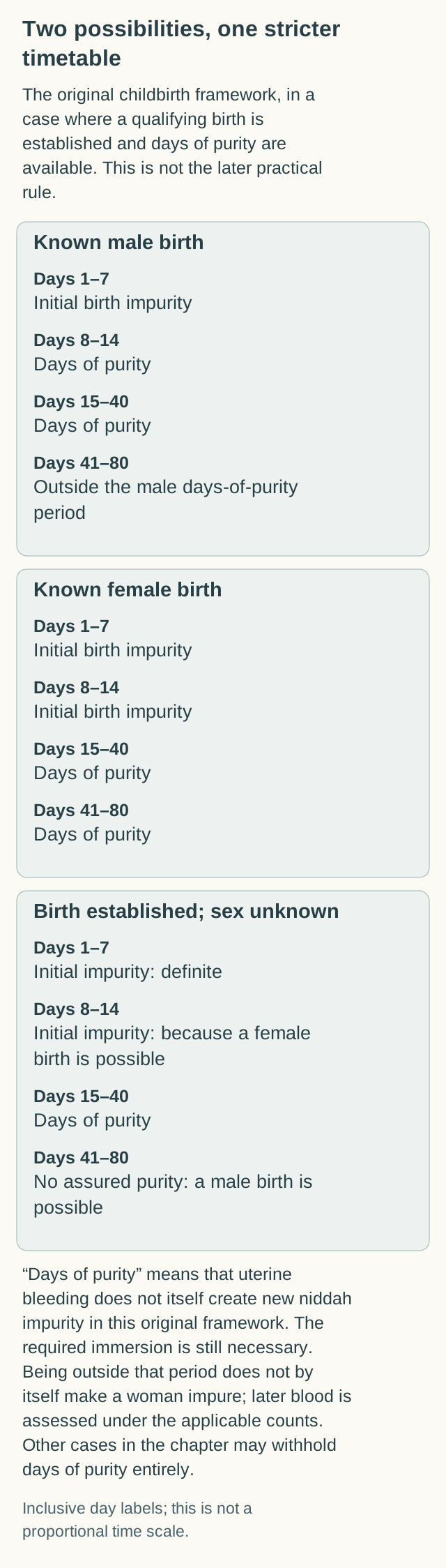
She is forbidden to her husband for fourteen days,
,
as after the birth of a female:
,
the first seven are definite,
.
and the second seven are due to doubt.
A qualifying birth is established, so the first seven days apply whether the child was male or female. Days eight through fourteen are required because the child may have been female; they are not treated as certainly required on that basis.
She is not granted days of purity
,.
beyond forty days, as after the birth of a male.
The doubt cannot be used to gain the longer female-birth leniency. Thus the initial restriction lasts as for a female, while the outer limit of permitted bleeding is that of a male. In his , the explains that the -law doubt requires the stringent approach. This is the original days-of-purity framework; Chapter 11:6 explains why later practice does not permit bleeding during these days.
-
If she sees blood after the fortieth day, through the eightieth,
,
it is not treated as blood of purity,
,
but as possible blood,
,
or possible blood if it occurs during the days,
.
as we have explained.
If the child was female, this bleeding would still fall within the original days of purity. If male, that period has ended. Under Chapter 7:12, the first bleeding after the childbirth period begins the count; subsequent bleeding may fall in the days. The possible male-birth count therefore determines which impurity must be considered, while the female possibility leaves its status doubtful.
Likewise, if she sees blood
-
on the eighty-first day alone,
,
she is a possible ,
,
and must observe seven days,
,
because she may have given birth to a female,
for her cycle does not begin
,.
until after the full period has ended, as we have explained.
The word “alone” raises a difficulty: if there had been no earlier bleeding, why would the status on day eighty-one be only doubtful? In his modern commentary on this , Rabbi Adin Steinsaltz (Commentary on 10:20, comments 4–5) resolves this by reading “alone” as one day of bleeding on this occasion, not as excluding an earlier sighting. He explains that she previously saw blood after day forty, at a time that places day eighty-one among the days if the birth was male. If the birth was female, that earlier blood was within the original days of purity, and day eighty-one begins . On this interpretation, the female-birth possibility requires seven days rather than only the shorter requirement of a .
Synopsis
When the birth is certain but the child’s sex is unknown, the initial prohibition lasts fourteen days, while days of purity extend only through day forty. Later bleeding is treated stringently according to the possible counts.
Visual guideCombining the Stringencies of Male and Female Birth
The original childbirth framework, in a case where a qualifying birth is established and days of purity are available. This is not the later practical rule. “Days of purity” means that uterine bleeding does not itself create new impurity in this original framework. The required immersion is still necessary. Being outside that period does not by itself make a woman impure; later blood is assessed under the applicable counts. Other cases in the chapter may withhold days of purity entirely.Open full-size illustration
Whenever we said that she observes the requirements for a male, a female, and a ,
?
what are the rules governing her?
,
She is forbidden to her husband for fourteen days,
.
as after the birth of a female.
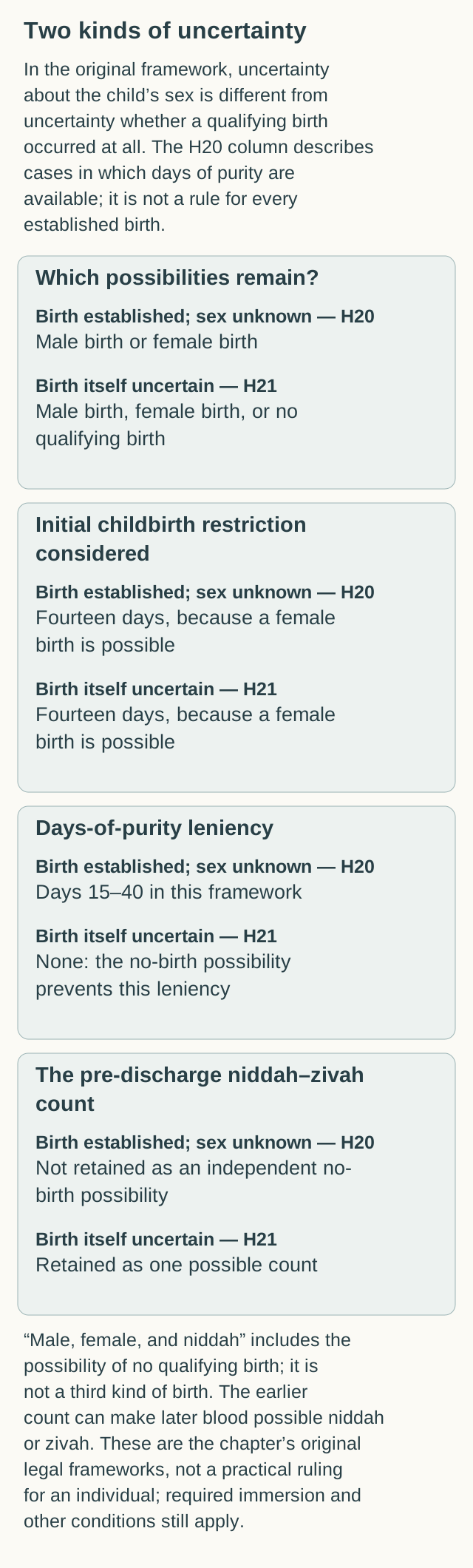
The possible female birth requires fourteen initial days. Unlike Halachah 20, however, a qualifying birth is not established at all: the discharge might have been too early or otherwise not have been a birth. Her earlier – count must therefore remain among the possibilities.
,
If she sees blood on the eighty-first day,
.
she is a possible .
If there was a birth, the first bleeding after its full period begins a new count. If there was no qualifying birth, her earlier count was not interrupted and may place this bleeding in a different part of the cycle. The first post-miscarriage bleeding cannot simply be assumed to start a new count.
Likewise, if she sees blood
,
on the seventy-fourth day and on the eighty-first day,
.
she is a possible .
If the birth was male, bleeding on day seventy-four starts seven days, placing day eighty-one in the days. If the birth was female, day seventy-four is still within the original days of purity, and day eighty-one begins instead. The possible female birth therefore requires seven days; she cannot rely on the shorter requirement of a .
-
Likewise, if she sees blood on the forty-first day,
,
even though she saw blood on the thirty-fourth day,
,
she is a possible ,
,
and is forbidden to her husband until the night of the forty-eighth day,
.
as after the birth of a male.
A male birth would make the blood on day thirty-four part of the original days of purity, and the blood on day forty-one the start of seven days. The earlier sighting therefore does not remove that possibility. If there was no qualifying birth, either sighting must instead be assessed within her continuing cycle. The stated endpoint follows the possible male-birth count; the required immersion is still necessary.
,;
She is granted no days of purity at all, as with a ;
.
in this respect, she is like a woman who has not given birth.
The possibility of no birth prevents every childbirth-based leniency for blood. She must observe possible birth restrictions without treating any later bleeding as certainly permitted.
For any blood she sees from the day of the miscarriage
:
through eighty days:
,
if it comes during her days,
she is a possible
;
after the first seven days from the miscarriage;
,
and if it comes during her days,
;
she is a possible ;
,.
for throughout the full childbirth period, the cycle count does not apply.
Two incompatible counts remain in play. If there was no birth, her prior and days continue; if there was a birth, its full period interrupts that count. Consequently the previous cycle can impose a possible or status, but does not establish it as definite during the potentially applicable childbirth period. The special certainty of the first seven days is explained at the end of this .
-
Likewise, if she sees blood on the eighty-first day,
,
her count is still unsettled,
,,
and she is a possible , as we have explained,
.
even though she saw blood on only one day.
,
When her cycle becomes established after the eighty days,
,
the uncertainty in her count is removed,
and she again becomes a definite
.
or a definite .
Reaching day eighty-one does not by itself reconcile the competing counts. Once her cycle is established after that period, later bleeding can again be assigned to or with certainty according to its place in the cycle. “Unsettled” describes the count, not a personal defect.
Similarly, from the day of the miscarriage through seven days,
,
she has definite status,
,
if she miscarried during her days,
.
as we have explained.
In the case of accompanying bleeding during her days, both possibilities require the initial seven-day impurity: either there was a birth, which creates at least seven days, or there was no birth and the blood makes her a . The uncertainty about the birth therefore does not make those first seven days doubtful.
Synopsis
When the birth itself is uncertain, she observes possible male- and female-birth restrictions but receives no days-of-purity leniency. Her prior cycle remains a competing possibility until her count is established again.
Picture the CaseA concrete example
An earlier sighting may not begin the count
In the original childbirth framework, Emma has a discharge that might or might not be a qualifying birth. She then sees blood on day thirty-four and again on day forty-one. The earlier sighting does not establish that day forty-one is already beyond her seven days: if she gave birth to a male, day thirty-four was still within the days of purity, and day forty-one begins . She must therefore account for seven days beginning on day forty-one, through day forty-seven. Reaching the following night does not replace the required immersion.
Visual guideWhen Even the Birth Itself Is Uncertain
In the original framework, uncertainty about the child’s sex is different from uncertainty whether a qualifying birth occurred at all. The H20 column describes cases in which days of purity are available; it is not a rule for every established birth. “Male, female, and ” includes the possibility of no qualifying birth; it is not a third kind of birth. The earlier count can make later blood possible or . These are the chapter’s original legal frameworks, not a practical ruling for an individual; required immersion and other conditions still apply.Open full-size illustration
Translation and elucidation: Independently prepared for Rambam, Clearly in contemporary English. Translation follows the Rambam’s words; elucidation supplies only the context needed to understand them.
Word cards and glossary: Hebrew word cards distinguish a word’s basic meaning from its meaning in the particular phrase. Shared glossary entries explain recurring terms; biography entries identify the cited authorities.
Explain and Background: Explain provides context needed for the ruling. Optional Background panels provide additional context that can be skipped without losing the essential explanation.
Synopsis: A short summary follows each halachah. It is a guide to the central ruling, not a replacement for the full text and its qualifications.
Dig Deeper: Based on the classic commentaries named inside each panel. Editorial explanations are not presented as quotations.
Live It: Where present, these panels connect a particular halachah to a suggested personal reflection and an action to try. Original applications are labeled as suggested reflections. They are distinct from the ruling and are not attributed to the Rebbe merely because his guidance supports seeking a practical lesson.
Measurements: Modern equivalents draw on Chabad.org’s measurement glossary and cited halachic calculations. They show a range when major accepted calculations differ. Monetary equivalents fluctuate with the price of silver.
The Rebbe’s teachings and guidance: Source links accompany the completion teachings and the guidance inside Dig Deeper and Live It. Quotations, translations, and adaptations are identified; the general guidance is separate from the sources for a panel’s particular discussion.
Editorial responsibility: Created and prepared for this project by Levi Gelb. Corrections and suggestions can be submitted below. This presentation supports learning; practical halachic questions should be brought to a qualified rav.
Chapter 10 at a glance
Chapter Synopsis
Birth creates its own impurity only when the delivery meets the chapter’s criteria. Fetal form, the extent of emergence, and the can establish or leave doubt about that status. When a birth is established but the child’s sex is unknown, the male and female stringencies are combined. Uncertainty whether any qualifying birth occurred also preserves the earlier – count and prevents days-of-purity leniencies.
A qualifying birth creates impurity even without bleeding, whether the child is living or dead. A miscarriage must have reached the required stage of formation.
A miscarriage through day forty is not a birth for these laws. Later uncertainty may concern either whether a qualifying birth occurred at all or only whether the fetus was male or female.
The describes signs of early human formation and of male or female development. These early forms do not grant days of purity until the fetus has grown hair.
A bone within a discharged mass establishes birth impurity. An undeveloped sac without the required human form does not establish a birth.
Delivery through the abdominal wall does not create the special childbirth periods. Blood emerging through the vaginal passage can still make the woman impure; blood emerging through the abdominal wall has its own distinct impurity.
The -level onset of birth impurity depends on how the fetus emerges: most of the body, the whole head together in a dismembered delivery, or most of the forehead in an ordinary intact delivery.
A hand that emerges and returns creates Rabbinic birth impurity, but does not begin the timetable that grants days of purity.
For the unusual forms described here, the specified human facial features determine birth status even when the rest of the body looks different.
The required human facial form depends on the specified upper-face and jaw features; an unusual mouth, ears, or nose does not by itself exclude birth status.
The listed unusual forms can create birth impurity. With a single eye and thigh, their placement on one side or in the center determines the classification.
The listed deficient forms do not establish birth impurity. A distinctly formed hand or foot, by contrast, is presumed to come from a complete fetus and counts toward the majority of its limbs.
A accompanying a male fetus may have been female even when its face is no longer recognizable. The mother therefore observes the stringencies of both male and female births.
The is the enclosing afterbirth described by the . Its defined minimum size is a handbreadth.
A establishes that there was a fetus. After a miscarriage it raises concern for another fetus; after a viable birth, within the stated interval, it may be attributed to that child.
A that precedes a viable child is treated as evidence of another possible birth. When it emerges over two days, both dates are used stringently so that the permitted period is not enlarged.
An attached is attributed to the unusual form it encloses. An unattached raises concern for a second, human fetus that is no longer recognizable.
Concern for a birth does not itself grant days of purity. When the discharge is not a qualifying birth, the distinguishes accompanying blood from a dry discharge; later practice treats the latter more stringently.
A definite female birth determines the female timetable even with another twin. Where no female birth is certain and the child’s classification is doubtful, the stringencies of male and female birth both apply.
An established pregnancy supports a presumption of a qualifying birth even when the discharge is lost. Without that presumption, the possibility of no qualifying birth must also be included.
When the birth is certain but the child’s sex is unknown, the initial prohibition lasts fourteen days, while days of purity extend only through day forty. Later bleeding is treated stringently according to the possible counts.
When the birth itself is uncertain, she observes possible male- and female-birth restrictions but receives no days-of-purity leniency. Her prior cycle remains a competing possibility until her count is established again.
פרק י
End of chapter.
You have reached the end of all twenty-one halachos.