This chapter distinguishes observed bleeding from a bloodstain whose origin is uncertain. It explains when stains create Rabbinic impurity, when another source may account for them, how shared clothing and beds are assessed, and how stains affect the reckoning of and .
פרק ט39 halachosWednesday, October 28, 2026י״ז במרחשון תשפ״ז◷ Estimated study time: 100–130 min
אTap any Hebrew word to see its meaning and how it works in the phrase.
Chapter progress 0 of 39 completed🔎 0 learned in depth
that has emerged within her body, as we have explained.
This concerns blood from the uterus reaching the internal passage defined in Chapter 5:2; it need not emerge outside her body. The sensation meant here is the significant awareness accompanying the discharge, not simply discomfort or the bodily signs that may predict a period. In the framework of these chapters, bleeding in the designated days and bleeding in the following days have different counting rules, as explained in Chapter 6. These terms do not describe a woman’s cleanliness or personal worth. The chapter explains the ’s legal framework, including laws of ritual purity; it is not a guide for deciding an individual case today.
.
Her impurity begins when she sees the blood and extends only forward.
law does not assign this impurity to an earlier time. The following distinguish the Sages’ rules about stains and retroactive impurity.
,
If she did not notice a sensation but examined herself
-
and found the blood inside the vaginal passage,
,
the discharge is presumed to have occurred with a sensation,
.
as we have explained.
Not recalling a sensation does not negate this presumption. The examination itself may have prevented her from distinguishing the sensation of the discharge. Chapter 5:5 supplies the preceding discussion of blood found internally.
Synopsis
-level impurity requires the qualifying discharge and sensation. Blood found internally carries a presumption of sensation even when she did not notice it; law does not make her impure retroactively.
The Sages ruled that a woman who finds a bloodstain
-
on her body or her clothing
,
even though she felt no sensation,
and even though she examined herself
-
and found no blood,
,
is impure,
.
as though she had found blood within her body.
A clean internal examination now does not prove that the stain did not come from an earlier uterine discharge. This general rule is limited by the chapter’s later conditions, including the stain’s location, size where relevant, surface, and possible external source. Not every mark on the body or clothing creates impurity.
,
This impurity is a matter of doubt:
.
perhaps this stain came from blood of the uterus.
The stain does not establish that uterine bleeding certainly occurred. The Sages nevertheless assigned impurity to this doubt within the limits of their enactment. Those limits explain the leniencies developed below.
Synopsis
A qualifying bloodstain creates Rabbinic impurity because it may have come from the uterus, even without a noticed sensation and despite a clean examination afterward.
🔎Dig DeeperA Stain Creates Rabbinic Doubt
A Stain Creates Rabbinic Doubt
Why two possible doubts do not remove the decree
The asks why the stain is not permitted because of two layers of doubt: perhaps the blood did not come from her body at all; even if it did, perhaps it came from the upper chamber described in Chapter 5 rather than from the uterus. These are different possible origins, not a definite uterine discharge.
He offers two answers. The Sages may have imposed their stain decree despite the combined doubts because of the seriousness of the underlying prohibition. Alternatively, when there is no identifiable outside source to which the stain can be attributed, they treated its bodily origin as established for this enactment. On that approach, only the question of its internal source remains. These are two explanations of the decree, not instructions to disregard the chapter’s specific leniencies.
Sources: Kesef Mishneh on 9:2; anatomical terminology in 5:3–5.
that a woman who sees blood outside her established time
-
or finds a stain
,.
is impure retroactively, for up to twenty-four hours.
A is an established pattern for the onset of bleeding. When blood is discovered outside that expected time, it may have begun earlier. This retroactive ruling concerns ritual purity, including the status of susceptible articles she touched; it does not mean that the full twenty-four hours are certainly known to have involved bleeding.
If she examined herself during that period
-
and found herself clear of blood,
.
her retroactive impurity reaches only as far back as that examination.
A clean examination within the preceding twenty-four hours shortens the period. An examination further back does not extend it beyond twenty-four hours.
,
Although their enactment makes her impure retroactively,
she does not retroactively impart impurity to the man who had relations with her,
.
as we have stated.
She begins the count for her status or her stain
only when she saw the blood
.
or found the stain.
The exclusion concerns the special, more severe impurity of a man who has relations with a . It does not exclude impurity from touching her, as 3:8 clarifies. Nor may the earlier period be credited toward her purification count: that count starts with the discovery, not with the retroactive concern.
,-
Finding a stain also leaves her reckoning unsettled:
perhaps it came from the uterus
.
and disrupted her established reckoning.
She cannot confidently treat the stain either as a new uterine discharge or as unrelated to her cycle. That uncertainty affects the reckoning discussed in Chapter 8; it does not prove that her previous pattern has certainly been replaced.
Synopsis
Rabbinic retroactive impurity reaches back at most twenty-four hours, or only to a later clean examination. The count begins at discovery, and a stain may leave the cycle reckoning uncertain.
Picture the CaseA concrete example + illustration
Which earlier hours are affected
At 9 on Tuesday morning, a woman discovers blood outside her established time, and none of Halachah 4’s exceptions applies. If she had no clean examination during the preceding twenty-four hours, the Rabbinic concern reaches back to 9 on Monday morning. If she examined herself at 8 on Monday evening and found herself clear, it reaches back only to that examination, thirteen hours earlier. This affects the ritual-purity assessment of susceptible articles she touched; it does not move the beginning of her count back from Tuesday’s discovery.
Halachah 3: the clean examination shortens the retroactive concern from 24 hours to 13 hours in this case. Neither window moves the start of the count before discovery; the approved case’s conditions remain essential.Open full-size illustration
Similarly, a pregnant woman, a nursing woman, a virgin, and an elderly woman
,.
are subject to impurity only from the time of discovery, not retroactively.
At an established time, the onset is attributed to that expected time rather than to an earlier one. The four other categories are treated as unlikely to bleed earlier. “Virgin” here is a technical category concerning prior menstrual bleeding, defined in the next ; it does not mean simply that she has never had relations.
?,
Who qualifies as pregnant here? One whose pregnancy is recognizable,
.
at three months.
Knowing of a pregnancy earlier does not by itself bring her within this category for the retroactive-impurity rule.
-,
A nursing woman means one within the full twenty-four months after birth,
even if her child died or she weaned the child
.
or entrusted the child to a wet nurse.
The category follows the period after childbirth, not whether she is actually nursing at that moment. Conversely, continuing to nurse beyond twenty-four months does not extend this particular leniency, as 4:1 states.
Synopsis
Bleeding at an established time and bleeding in the four defined categories generally create impurity only from discovery. The pregnancy and nursing categories have specific time limits.
A virgin here means one who has never had menstrual bleeding,
even if she has seen blood caused by marriage
.
or by childbirth.
Blood associated with first marital relations does not count as prior menstruation for this definition. Neither does bleeding associated with childbirth. The term therefore does not establish her marital history. The first two menstrual episodes receive this exemption from retroactive impurity only for a girl who has not yet reached the age of menstruation. Once she has reached that stage, only her first episode does; 4:3–4 makes this distinction.
-
An elderly woman here means one who has gone
.
ninety days without bleeding near her old age.
?
And who is considered elderly?
.
One who is called elderly and does not take offense.
The ninety-day absence of menstrual bleeding is part of the definition, not merely her age. The second statement describes the life stage to which that interval must belong.
-
For a pregnant, nursing, or elderly woman,
,
a stain follows the same rule as a sighting of blood:
.
it does not create retroactive impurity.
These women can still acquire impurity from a qualifying stain. The exemption here removes retroactivity, not the stain’s effect from discovery onward.
,
A virgin who has never had menstrual bleeding
-
and is still a minor
,
is pure with respect to her stain
.
until she has seen blood in three distinct menstrual episodes.
This is a separate and stronger leniency for a minor who has not yet acquired the stated bleeding history: the stain does not make her impure at all. It must not be confused with the preceding rule, which merely prevents impurity from reaching backward. Actual uterine bleeding is a different question.
Synopsis
The exceptions depend on defined bleeding histories and life stages. Pregnant, nursing, and elderly women’s stains do not act retroactively; a qualifying minor’s stain creates no impurity at all.
This is a qualifying stain in a relevant location, not any mark anywhere on the body. The location rules follow in Halachah 8. The ordinary allowance for a small garment stain does not automatically apply to a stain on the body. explains the stricter body rule by treating the body as clear of louse blood; the ordinary small-stain attribution is therefore not applied there.
-
A stain found on a garment, however,
,
does not impart impurity unless it reaches the size of a Cilician ,
,
a square area
large enough for nine lentils,
.
arranged three by three.
,.
If it is smaller than this measure, it is pure.
A is a traditional area measure based on half a large bean. The comparison concerns area, not the shape of the actual stain. Small garment stains can be attributed to a crushed louse.
distinguishes the size at which a stain comes within the decree from whether it can still be attributed to a louse. On this approach, reaching a does not by itself establish impurity: the louse-attribution rule in Halachah 23 still applies ( on 4:19).
,;
Separate small spots are not added together;
,.
an elongated stain is measured as one whole.
For a garment, several distinct spots do not become one qualifying stain merely because their combined area is large. A single continuous streak is different: its full area is counted, even though it is not square.
Synopsis
Body stains have no minimum size under the applicable conditions. Garment stains require the stated minimum area; separate spots are not combined, while a continuous streak is. Later attribution rules still apply.
A stain found on something not susceptible to ritual impurity
,.
is pure, and she need not be concerned about it.
The Sages’ stain decree is limited by the type of surface on which the stain is found. These exemptions concern the stain decree; they do not override the -level rule stated in Halachah 1.
?,
For example, she sat on vessels made of stone,
,,
of earth, or of dung,
,
or on fish skin,
,
or on the outside of an earthenware vessel,
or on a piece of cloth smaller than
,
three fingerbreadths by three fingerbreadths,
-.
and blood was found on them: she is pure.
The listed surfaces do not receive ritual impurity in the manner relevant here. An earthenware vessel receives impurity through its interior, not its outer surface. The small cloth lacks the minimum dimensions required for the garment status under discussion. These are legal categories of receptivity, not claims about whether a surface can physically absorb blood.
,
Even if she checked the ground and then sat on it,
-
and a stain was found there when she stood up,
.
she is pure.
,
For anything not susceptible to ritual impurity
.
was excluded from their decree about stains found on it.
The initial inspection established that no stain was there before she sat. Even so, the enactment does not cover a stain on this surface. The result follows from the decree’s limits, rather than from certainty that the blood came from elsewhere.
,
Even on something susceptible to ritual impurity, the decree applies
;
only if it was white.
,
With colored articles, however,
.
a stain found on them does not create concern.
,
The Sages therefore instituted wearing colored garments
.
to spare a woman the legal consequences of stains.
This allowance does not replace the requirements for examinations or for the seven clean days. The recommendation for colored clothing here concerns times outside that clean-day procedure. These allowances do not remove -level impurity from a discharge meeting the conditions in Halachah 1.
Synopsis
The stain decree does not cover surfaces that are not susceptible to ritual impurity or colored articles. These limits apply even when a previously checked surface acquires a stain.
it must be found in a position corresponding to her genital area.
The issue is whether uterine blood could have reached that location. The following cases include dripping, movement, and contact, not only a spot directly below the source.
?-,
For example, a stain on her heel makes her impure:
.
the heel may have touched her genital area while she was sitting.
A seated posture with the legs folded beneath the body can bring the heel into contact with that area. The ruling does not assume that blood must have dripped onto the heel from above.
,
Likewise, if it was found on her lower leg
,
or her feet, on their inner surfaces,
meaning the places that touch each other
when she stands and brings together
-
one foot with the other and one lower leg with the other,
.
she is impure.
-,
A stain on the tip of her big toe also makes her impure:
blood may have dripped from the uterus onto her foot
.
as she walked.
The inner surfaces are defined by the posture in which the feet and lower legs are together. The big toe is included because walking can bring it into the path of a drop.
The same applies to any place where it is possible
,
for her menstrual blood to spatter as she walks:
-.
if blood is found there, she is impure.
,
Likewise, blood found on her hands,
-,
even on her knuckles, makes her impure,
.
because hands are continually active.
A hand can touch a place bearing menstrual blood without the person noticing. Its location above the lower body therefore does not exclude such a source.
But if the blood is found on her lower leg
,,
or feet on their outer surfaces or sides,
and certainly if it is found
-
from the thighs upward,
,
she is pure,
for this is blood that spattered onto her
.
from another source.
These locations are assessed in an ordinary bodily posture. The ruling does not disregard a known movement that could carry uterine blood higher; Halachah 21 addresses inversion. Under the conditions here, an external source is presumed rather than an unusual upward movement of uterine blood.
Synopsis
A body stain is assessed by whether uterine blood could reach its location through dripping, walking, or contact. Ordinary outer and upper locations are treated differently, subject to relevant movement.
Since it lies in a position corresponding to her genital area,
;
she is impure.
:,
We do not argue that, had it dripped from the body,
.
it would not look like this.
Shape alone does not establish an external origin when the location leaves uterine blood as a possibility. The separate-spot allowance of Halachah 6 concerns the minimum area of garment stains; body stains do not have that minimum.
-
For blood found in these locations
,.
is treated stringently, even though its origin is uncertain.
The ruling preserves the doubt. It does not convert the unusual shape into proof that the blood certainly came from the uterus.
Synopsis
For a body stain in a relevant location, an unusual outline or apparent direction does not remove the concern that it came from uterine blood.
The lower portion can receive blood from the body. The ruling remains subject to the size, fabric, color, and external-attribution conditions elsewhere in the chapter. A stain on the garment’s outside is not automatically exempt merely because it is not on the inward-facing surface.
:
If it is found on her sleeve:
,;
if that part can reach her genital area, she is impure;
,.
otherwise, she is pure.
The sleeve is judged by where the stained portion can reach, including when she bends. Its position while she stands straight is not the only relevant position.
Synopsis
A qualifying garment stain below the belt creates concern; one above it does not under these conditions. A sleeve stain depends on whether that part can reach the genital area.
If she would remove the garment and cover herself with it at night,
,.
blood found anywhere on it makes her impure.
A garment used as a covering can shift while she sleeps. A portion normally above the belt when worn can then come into contact with the genital area, so its usual wearing position cannot exclude uterine blood.
-
The same applies to her belt:
,.
blood found anywhere on it makes her impure.
The fixed upper-versus-lower division of the preceding does not provide an exemption for these movable items. The chapter’s other requirements for a qualifying stain remain in force.
Synopsis
A garment used as a night covering, and a belt, do not have the ordinary garment’s exempt upper zone. Their position can change.
because a stain may have dripped from her on each day.
In the original framework, seven designated days are followed by eleven days of . Qualifying bleeding on one or two consecutive days produces minor ; three consecutive days establish major . “Minor” and “major” describe the bleeding pattern, not the woman’s age. Three stains do not prove three separate bleeding days: they could have appeared on one day. They nevertheless raise the possibility of three days, requiring the stringent treatment of doubtful major , including seven clean days. In the Temple framework, she brings an offering because of the doubt, but her sin-offering is not eaten. “The area of three stains” here means three times the stated measure, not any three tiny marks.
,
Likewise, if she wore three previously checked garments
,
for three days during her days of
-
and found a stain on each one,
,
even if the stains lie opposite one another,
.
she is possibly a major .
The three garments in this case were worn together in layers, rather than one garment per day. Aligned stains might have resulted from one discharge passing through the layers, but that is not certain. The possibility that they arose on three successive days remains.
Synopsis
Stains found after three days during can create doubtful major- status without proving when each stain appeared, even when stains on layered garments line up.
and she examined herself throughout the twilight period
,
at the end of the first day and found herself clear of blood,
,
but did not examine her garment,
and on the third day found this stain
-
whose area is less than that of three stains,
.
she need not be concerned about major .
This continues the three-day garment case. is the twilight interval whose day-or-night status is uncertain. The examination described here keeps a checking cloth in place throughout that interval, rather than relying on one momentary check. Its clean result excludes bleeding spanning the uncertain boundary between the first and second days; it does not prove that she had no bleeding at any time on the first day. For this smaller single stain, that boundary check removes the particular three-day concern described here. It does not make a qualifying stain entirely pure.
,
If she did not examine herself throughout twilight,
,
then, since she did not examine the garment
-
and wore it for three days during her days of ,
,
she must be concerned about major ,
even though the stain is smaller
.
than the area of three stains.
Without that check, the uncertainty about timing remains. A discharge around a day boundary can contribute to more than one day’s count, and deposits may overlap on the garment. The stain’s small area alone therefore does not establish that fewer than three days were involved.
Synopsis
For the smaller single stain described here, a clean examination spanning the first twilight removes concern for major . Without it, the three-day concern remains despite the stain’s size.
These are consecutive days within the days of . Two days are established by actual bleeding; the remaining day is supported only by a stain. The possible third day therefore creates doubtful, not definite, major- status. The following qualify when a preceding stain is associated with later bleeding rather than counted as a separate day. A stain establishes Rabbinic impurity, not definite -level bleeding for that day.
Synopsis
A stain on one of three consecutive days can join actual bleeding on the other two to create doubtful major- status, subject to the following timing rules.
she associates the stain with that bleeding within a twenty-four-hour period,
whether she examined herself when she found the stain
,.
and found herself clear, or did not examine herself.
For the count under discussion, the earlier stain is associated with the actual bleeding discovered within twenty-four hours. It does not supply an additional day of . A clean examination when the stain was found does not prevent this association. Halachah 16 shows how this changes the count across Friday and .
,
But if she finds one stain after another
-
within twenty-four hours,
,
she does not associate one stain with the other
;
unless she examined herself between them.
,
For if a clear interval separated the stains,
.
they do not combine toward the count.
A later stain is itself uncertain, unlike actual observed bleeding. To avoid counting the two stains as separate days under this rule, there must also be a clean internal examination between them. “They do not combine” means that they do not supply separate successive days toward major ; it does not mean that all impurity from the stains disappears. 17–18 illustrate both the examination condition and the twenty-four-hour limit.
Synopsis
A stain can be associated with actual bleeding seen within twenty-four hours. Two stains require a clean examination between them as well before they cease to supply separate days toward major .
🔎Dig DeeperWhen Two Discoveries Are Counted Together
When Two Discoveries Are Counted Together
Why actual bleeding differs from another stain
explains that actual bleeding establishes its own count, while the preceding stain is Rabbinic. Within twenty-four hours, the stain does not add another day. Two stains have equal, uncertain standing, so timing alone is insufficient: a clean examination between them is also needed.
reads the Talmudic discussion differently, as concerning the examination required for purification. Maggid Mishneh defends the ’s reading as a rule about associating discoveries for the count.
but associates the stain with the observed bleeding.
,
If she also sees blood on Sunday and Monday,
.
she becomes a major .
Within the twenty-four-hour window, the Friday stain does not contribute its own day to the major- count. In the example of actual bleeding on followed by Sunday and Monday, those three actual bleeding days establish major . Without Monday’s bleeding, Friday’s associated stain does not supply a substitute third day. The example assumes that the relevant days fall within the days of .
,
If she saw the blood during the second hour of day,
-
she is impure for two distinct days:
,
Friday, when she found the stain,
;
and , when she saw blood.
.
The two discoveries are not within twenty-four hours.
,
If she then sees blood on Sunday,
.
she must be concerned about major .
The longer interval prevents associating Friday’s stain with ’s bleeding. Friday can now supply a possible first day, followed by actual bleeding on and Sunday. The result is doubtful major , not definite major , because Friday is supported only by a stain.
Synopsis
Actual bleeding within twenty-four hours absorbs the earlier stain into its count. Beyond that window, the stain can supply a separate possible day and create doubtful major sooner.
Picture the CaseA concrete example + illustration
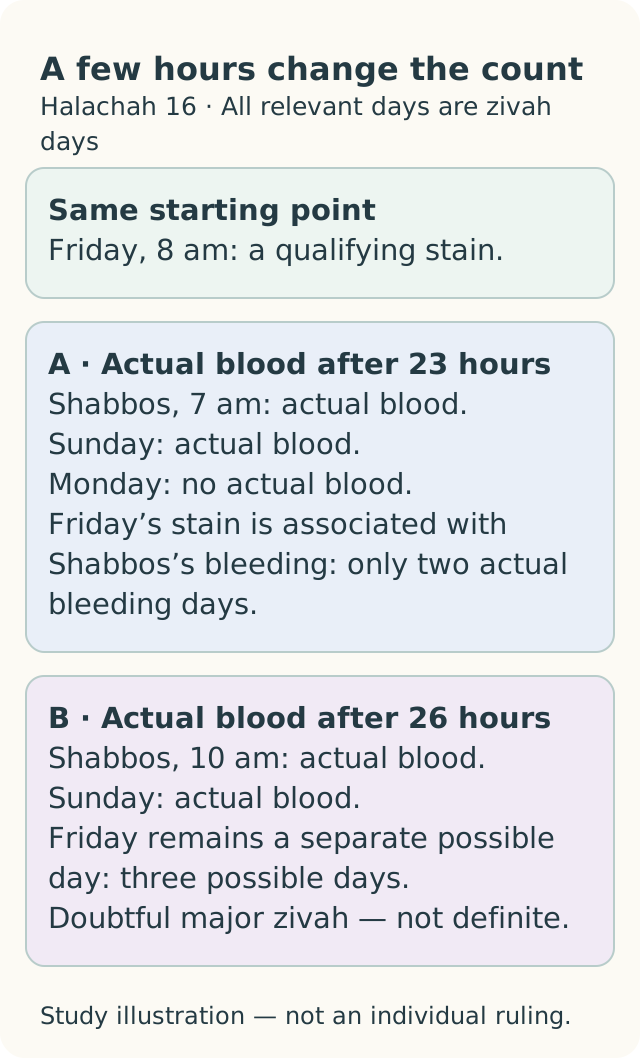
A few hours change the three-day count
During the designated days of , a woman finds a qualifying stain at 8 on Friday morning and sees actual blood at 7 on morning, twenty-three hours later. Friday’s stain is associated with that bleeding and does not supply its own day toward major . If she also bleeds on Sunday but not Monday, those are only two actual bleeding days. Now change just the first actual bleeding to 10 on morning, twenty-six hours after the stain. Friday now remains a separate possible day; with and Sunday’s bleeding, she is possibly a major , not definitely one.
Halachah 16: this comparison assumes the designated days of . The stain is not proof of actual bleeding on Friday. Keeping it as a separate possible day changes the concern, not the degree of certainty.Open full-size illustration
This continues the Friday-first-hour stain in Halachah 16. The clean examination takes place after that stain and before the second one. Together with the twenty-four-hour proximity, it prevents Friday and from supplying two distinct days toward major under this rule. The count is assigned to the later stain.
,
If she did not examine herself,
and does not know whether a clear interval separated them
-
or not,
;
she also counts Friday.
,
If she sees blood on Sunday,
.
she must be concerned about major .
Unlike actual bleeding within twenty-four hours, a second stain does not on its own absorb the earlier stain into a single count. Without the intervening clean examination, Friday’s stain, ’s stain, and Sunday’s bleeding can supply three successive days, making major doubtful. This three-day outcome assumes that Sunday’s bleeding does not absorb ’s stain under the twenty-four-hour rule of Halachah 15; Halachah 18 spells out that timing.
Synopsis
Two stains within twenty-four hours count from the later stain only when a clean examination intervenes. Without it, both days remain relevant to a possible three-day sequence.
because the two stains are not within twenty-four hours.
If she sees blood on Sunday
,
after a further twenty-four hours,
.
she must be concerned about major .
The first stain remains the Friday-first-hour stain. The second is beyond its twenty-four-hour window, so even a clean examination cannot merge those two days. Sunday’s actual bleeding in this clause is also more than twenty-four hours after the second stain; the association rule therefore does not remove as a separate possible day. Three consecutive days remain possible.
If, during the first hour of Sunday,
-
she finds a third stain,
,
then, if a clear interval separated them,
;
they do not combine, and she need not have that concern.
,.
If she did not examine herself, she must be concerned about major .
This Sunday stain is within twenty-four hours of the second-hour stain. A clean examination between those two allows them to be treated together for the count, leaving no three-day sequence. Without that examination, each stain can supply its own day. The interval must be assessed between the relevant discoveries, not merely by asking whether the entire series lasted more than twenty-four hours.
Synopsis
A clean examination cannot join stains more than twenty-four hours apart. A later stain within twenty-four hours of the second can join it if a clean examination intervenes, preventing a three-day count.
Picture the CaseA concrete example + illustration
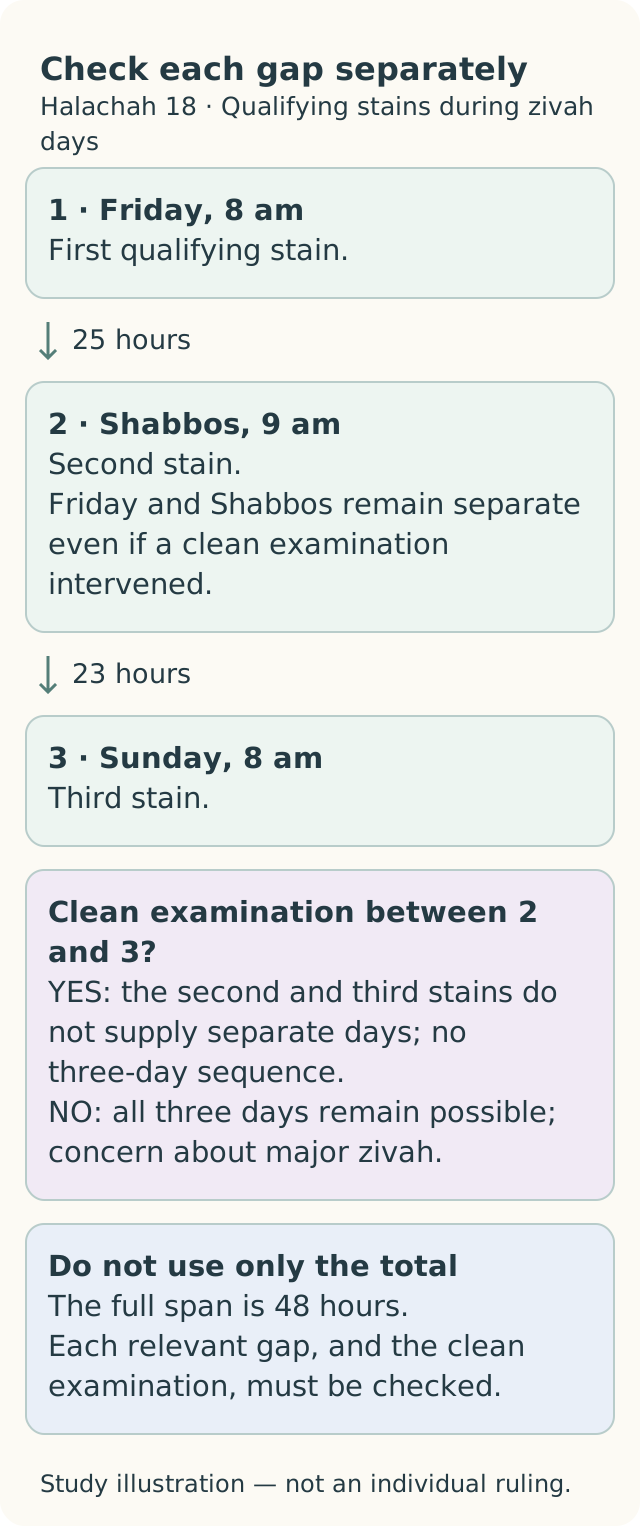
Check each gap rather than the whole span
A woman finds qualifying stains at 8 on Friday morning, 9 on morning, and 8 on Sunday morning, all during the days of . The first gap is twenty-five hours, so the Friday and stains remain separate for the count even if a clean examination intervened. The second gap is only twenty-three hours. If she examined herself between the and Sunday stains and found herself clear, those two do not supply separate days toward major . Without that examination, all three days remain possible, so she must be concerned about major . The forty-eight-hour span of the whole series does not replace checking the two individual gaps.
Halachah 18: the two intervals have different consequences. A clean examination matters for the second-to-third stain link but cannot overcome the first interval’s greater-than 24 hour gap. This illustrates the approved stain case, not the separate actual-bleeding clause.Open full-size illustration
A Plausible External Source Can Account for a Stain
For any stain that we have said
-
makes her impure,
:
if there is something to which she can attribute it, saying,
-
“Perhaps this stain came from that source,”
,
then, if it was found on her garment,
;
she is pure.
,
For the Sages did not establish this matter to impose stringency,
.
but to allow leniency.
The stain decree itself is Rabbinic. When a known circumstance can plausibly account for a garment stain, the doubt is treated leniently. The following examples identify the kind of actual source that can support this attribution; merely imagining an unknown source is not enough.
,
If it was found on her body,
.
the doubtful stain is impure, and she may not make that attribution.
Where the stain is on the body but not the garment, an external source that would ordinarily stain the garment does not account for it in the same way. Halachah 21 develops this distinction.
But if there is more reason to attribute a stain on her body to that source
-
than a stain on her garment,
,
she may make the attribution even for her body,
.
and the doubtful stain is pure.
A wound on her own body is an example of a source that can explain blood on the body directly. Its position and ability to supply the stain still matter, as 22 and 25 explain.
Synopsis
A plausible external source can clear a garment stain. A body-only stain needs a source that accounts for its location on the body, rather than an unsupported transfer from elsewhere.
For example, she slaughtered livestock, a wild animal, or a bird,
,
or worked with staining materials,
,
or sat beside people working with them,
,
or passed through a butchers’ market,
-,
and blood was found on her garment: she is pure,
because she attributes it to these circumstances,
.
from which the stain came.
These cases supply an identifiable opportunity for external staining. She need not have watched the particular drop land, but the activity must be capable of accounting for the stain. The next distinguishes a stain found only on her body, and 26–27 limit attribution by amount, color, and known exposure.
Synopsis
Known involvement with blood or staining materials, or proximity to such activity, can account for a garment stain without a witnessed splash.
(Alternate reading: If the stain is from the belt downward, she is impure. If she turned over and jumped,)
-;
even from the belt upward, she is impure.
The parenthesis is an alternate textual reading printed in the Hebrew source, not an added . It explicitly supplies the condition for the upper-body case: she turned her body into a position in which uterine blood could reach that area. In an ordinary posture, an upper-body stain does not create this concern, as Halachah 8 explains. For the lower body too, the stain must lie in a location to which uterine blood could reach. The discussion continues the external exposure described in Halachah 20.
For if this blood had come
,
from the slaughtering or from the market,
;
it should have been found on her clothing.
Since it was found on her body
,.
but not on her garment, she is impure.
The known external activity explains a garment stain more readily than a stain found only beneath the clothing. It therefore does not automatically clear this body-only stain. A wound on the body is a different kind of explanation, addressed next.
Synopsis
External exposure does not automatically clear a stain found only on the body. A relevant location is required; the upper-body case depends on a movement that could bring uterine blood there.
🔎Dig DeeperA Body-Only Stain Needs Its Own Explanation
A Body-Only Stain Needs Its Own Explanation
A missing condition changes the reading
insists that an upper-body stain here requires a known inversion; otherwise this ruling would conflict with Halachah 8. reports copies that expressly contain the missing condition: she turned over and jumped. He explains that and Maggid Mishneh had a text lacking those words.
The variant is therefore not a second law: it makes explicit the condition needed for the upper-body case.
Sources: Maggid Mishneh on 9:19 (discussing 9:19–21); Kesef Mishneh on 9:21.
“Healed” here does not mean incapable of bleeding: a scabbed wound may reopen, for example if scratched. Unlike the distant external exposure in Halachah 21, this source is on the body itself. It must still be able to account for the blood at the place where it was found; Halachah 25 excludes an unsupported chain of transfer from a distant wound.
Synopsis
A wound that could reopen and bleed can account for a body stain when it can plausibly supply blood at that location.
If the stain was found on both her garment and her body,
.
she may attribute it to any available plausible source.
The blood on the clothing supports an external route: it could have reached the garment first and then the body. The fact that the body is also stained therefore does not rule out the external sources described earlier.
,
She may also attribute it to a louse,
,
since a louse may have been crushed when she sat down,
.
and this may be the louse’s blood.
?.
Up to what size? Up to a .
This allowance does not require that she saw the louse being crushed. The stated limit includes a stain exactly the size of a . distinguishes this attribution from the general size threshold stated in Halachah 6, as explained there.
,
But if the stain is larger than a ,
.
she may not attribute it to a louse.
,
Even if a crushed louse is present in the stain,
,
since the stain exceeds a ,
.
she may not attribute it to the louse.
The louse allowance has a defined maximum. Seeing a louse in the stain does not establish that it supplied the entire larger stain. A separately known external source must be assessed on its own ability to account for the amount; the mere presence of a louse does not remove the excess. A different case is a known insect she killed whose blood could account for a larger stain; the ’s Commentary to 8:2 allows attribution according to that actual source’s capacity. This is not the presumed-louse allowance.
Synopsis
A stain on both clothing and body can be attributed to a plausible external source. Attribution to a louse extends through a , but not beyond it, even when a crushed louse is visible.
She may likewise attribute the stain to her child or her husband.
,
If they were handling blood,
,
or their hands were soiled with it,
-
or they had a wound,
:
she attributes it to them, reasoning that they touched her
,
without her noticing,
.
and that this blood came from them.
Ordinary close contact with a child or husband can occur without a remembered touch. Their having worked with blood is not enough if no blood was seen on them, unless the activity could have splashed blood onto her. The rule supplies a plausible unnoticed contact, not an unlimited assumption that any earlier activity caused the stain.
Synopsis
A child’s or husband’s blood-soiled hands or wound can account for a stain through plausible unnoticed contact; an actual possible route of transfer is still needed.
We do not presume that blood traveled from one place to another
.
in order to attribute a stain to it.
A known source must be capable of accounting for the stain where it was found. Its existence somewhere on the body is not enough.
?
For example, she had a wound on her shoulder
-
and a stain was found on her lower leg.
:
We do not say that perhaps her hands touched the wound
.
and then touched this other place.
The proposed explanation needs an unobserved sequence carrying blood from the distant wound to the leg. The law does not supply that sequence to clear the stain. This differs from a wound that can directly account for blood at the relevant location.
-
In all comparable cases,
,
no such attribution is made,
.
whether the stain is on her body or her garment.
Halachah 8 uses the activity of hands as a reason to take a possible uterine source seriously. It does not follow that the same possibility can always be invented as a reason for leniency. Here, a hypothetical hand-to-wound-to-stain transfer is insufficient. , citing and , distinguishes a garment removed and used as a covering at night: its shifting position can allow attribution to the wound.
Synopsis
A distant wound does not clear a stain through an assumed chain of unnoticed hand movements. The source must plausibly account for the actual location.
✦Live ItCheck the story you are filling in
Check the story you are filling in
A wound somewhere on the body does not by itself explain a stain elsewhere. The does not supply an unseen chain of hand movements to connect the two. The proposed explanation needs a real basis.
We can notice the stories we add to incomplete information. A friend has not answered a message, and we begin imagining that they are upset with us. Before reacting, we can separate what happened from what we have supplied ourselves. Leaving room for what we do not know can help us respond patiently and give another person the benefit of the doubt.
Try today
When an unanswered message troubles you, name what you know and leave the imagined explanation open.
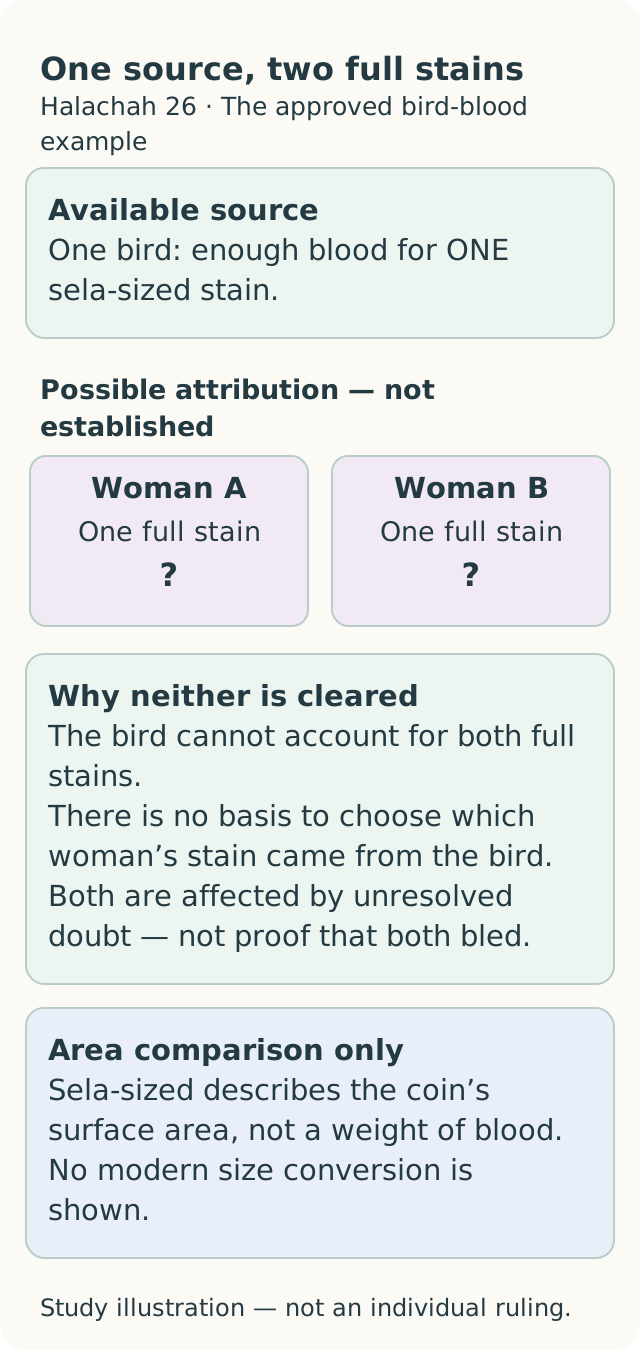
A is a coin used here as an area comparison. The bird cannot account for both full stains. Since there is no basis to identify which woman’s stain it supplied, neither woman can be cleared by assigning the bird’s limited blood exclusively to her. Their impurity is based on the unresolved doubt, not proof that both had uterine bleeding.
If she handled blood that could not possibly
,
produce a stain larger than a ,
-
and a stain of two was found on her,
she attributes one
,
to the blood she handled
.
and one to a louse.
Here, the stain can be accounted for by combining the known blood source with the separate louse allowance. This is a defined combination of two possible sources, not permission to assign an unlimited amount to either one.
,.
If the stain exceeds two , she is impure.
The combined explanation no longer accounts for the full stain. The amount of blood available from the known activity limits what can be attributed to it.
Synopsis
An external source must account for the stain’s amount. One limited source cannot clear two full stains, while a known blood source and the permitted louse allowance can be combined within their limits.
Visual guideThe Source Must Account for the Amount
Halachah 26: this diagram isolates the first approved example. It does not turn the separate known-source-plus-louse allowance into an unlimited allowance, and it gives no modern size conversion.Open full-size illustration
If she handled a bird containing several kinds of coloration,
-
and one of those colors was found on her,
.
she may attribute it to the bird.
The known source must be capable of producing the color found. A source with several relevant colors can account for a matching one; exposure to a different color alone does not suffice.
-
If she was wearing three garments,
,
then, when an attribution is available,
;
she may make it even for the innermost garment.
,
When no attribution is available,
.
she may not make one even for the outermost garment.
The layer on which a stain appears does not replace the need for an identifiable source. An outside stain can reach an inner layer if an outer garment moved or was lifted; conversely, an outer-layer stain alone does not prove an external origin.
?-
For example, she passed through a butchers’ market.
Even if the stain was found
,
only on the innermost garment,
;
she attributes it to the butchers’ blood.
If she did not pass through a butchers’ market
-
or a comparable place,
,
then, even if the stain was found only on the outermost garment,
.
she is impure.
,
If she is unsure whether she passed through such a place,
-
or unsure whether she handled the staining material,
.
she may not make the attribution.
The leniency accepts doubt about whether a known exposure actually caused the stain. It does not ordinarily supply the exposure itself when that too is uncertain. The distinction is between a known possible source and a merely imagined one. , 190:22, distinguishes a place where blood-handling activities occur in many locations rather than at fixed sites: there, attribution may be made even without remembering passage through a particular site.
Synopsis
Attribution requires a source capable of producing the stain’s color and a sufficient basis for exposure. The outer or inner clothing layer alone neither creates nor defeats that basis.
🔎Dig DeeperColor, Clothing Layers, and Known Exposure
Color, Clothing Layers, and Known Exposure
When uncertainty about exposure is different
In a town with a fixed slaughtering area, not knowing whether she went there leaves the exposure itself unestablished. , 190:22, distinguishes a place where such work happens in many locations: she may have encountered it without noticing, so lack of a remembered visit does not rule out attribution.
The distinction concerns the basis for exposure, not a rule that every unexplained stain is lenient. An uncertain result of an established circumstance differs from simply inventing a circumstance that might have happened.
The case concerns roaming animals that can become blood-soiled and transfer blood to clothing. Their regular presence supplies an external explanation without identifying a particular encounter. It is not a blanket rule for every modern town in which a pig exists somewhere; the circumstances that provide this source of staining must be present. If she knows that no relevant contact occurred, their presence does not supply an attribution for her stain.
Synopsis
Where roaming pigs regularly provide an external source of blood on clothing, garment stains may be attributed to that circumstance.
and afterward wore it again without first checking it,
-
then found a stain on it,
.
she attributes it to the who wore it.
The previous wearer supplies a basis for attribution: assigning the stain to her does not newly impair her existing impure status. The laws of -level do not apply to a non-Jewish woman in the same way; the Sages assigned the relevant impurity status discussed here. The garment was known to be clear before the use now under discussion; failure to check it again after the loan leaves the borrower as a possible source. More generally, the stain rule for clothing presupposes that the garment was checked clear before the relevant wearing; otherwise a discovered mark may have been there already.
If she lent it to a
,
on her day of impurity,
,
or to a woman in the period of blood of purity after childbirth,
-
or to a bride whose virginal blood is pure,
.
she may attribute the stain to that wearer.
A is one whose bleeding in the days of has not established major ; here the loan is on her bleeding day, not the following guarded day. The other two cases use the original laws of postpartum blood of purity and virginal bleeding. In that framework, assigning the stain to these wearers does not newly change their status. Chapter 11 explains the later practice; these words do not authorize treating postpartum or virginal bleeding as permitted today. , 190:42, nevertheless retains the attribution to the postpartum or virginal-bleeding wearer under its stated conditions. That attribution does not mean that the wearer herself is permitted to have relations.
But if she lent it
,
to a on her guarded day,
,
or to a major during her seven clean days,
,
and afterward wore it again without checking it,
-
and a stain was found on it,
:
both have their status impaired:
,
the borrower and the woman who lent it,
.
because it may have come from either one.
The borrower is now observing a period intended to be free of disqualifying bleeding. Assigning the stain to her would impair that count, just as assigning it to the lender would impair the lender’s status. Without a basis to prefer one source, the doubt affects both.
-
If she lent it to a woman observing impurity because of a stain,
,
she may not attribute this stain to her,
.
because one stain is not attributed to another stain.
The borrower’s earlier stain is not definite evidence of uterine bleeding. Her resulting Rabbinic status therefore does not provide the same basis as an established bleeding condition for assigning another stain to her alone.
Synopsis
A previous wearer can sometimes account for a garment stain without newly impairing her status. When both wearers’ status or clean-day count would be harmed, or the other woman’s status rests only on a stain, that attribution is unavailable.
🔎Dig DeeperAttributing a Stain to a Previous Wearer
Attributing a Stain to a Previous Wearer
Attributing a stain is not permission for relations
retains the attribution to the postpartum or virginal-bleeding wearer even though present practice does not permit treating her own bleeding as pure for marital relations. distinguishes two reasons. For hymeneal bleeding, blood is commonly present.
For postpartum blood of purity, the underlying law treats that blood as pure; the later stringency governing the woman herself was not extended to prevent her from serving as a source of attribution for another woman. Thus the attribution question and the woman’s own permission for relations are not identical.
An Examination Before the Loan Identifies the Relevant Wearer
She examined her garment and herself
,
and found them clear,
,
then lent the garment to another woman,
,
who wore it.
-
If a stain was found when it was returned,
,
the borrower is impure,
,
and cannot attribute it to the garment’s owner,
.
because the owner checked it before lending it to her.
Unlike the case in which the garment was not inspected between the two women’s wearings, here the inspection establishes that the stain was not already present before the loan. The owner does not wear it again before the discovery. The borrower therefore cannot invoke the owner’s earlier use as an equally possible source.
Synopsis
When the garment was checked clear before being lent and the stain was found on its return, the borrower cannot attribute the stain to the owner’s earlier wearing.
✦Live ItMake the handoff clear
Make the handoff clear
The garment was checked before it was lent. That examination establishes its condition at the handoff, so a later stain cannot be attributed to the owner’s earlier wearing. A clear starting point changes how the uncertainty is assessed.
A little care before lending something can spare both people an awkward conversation. If you lend a useful tool, take a moment together to notice its condition and explain any existing problem. This is a way to protect the relationship, not to announce that you expect carelessness. Clear, kind communication lets both people know what they are taking responsibility for.
Try today
Before your next handoff, mention one detail the other person would find helpful to know.
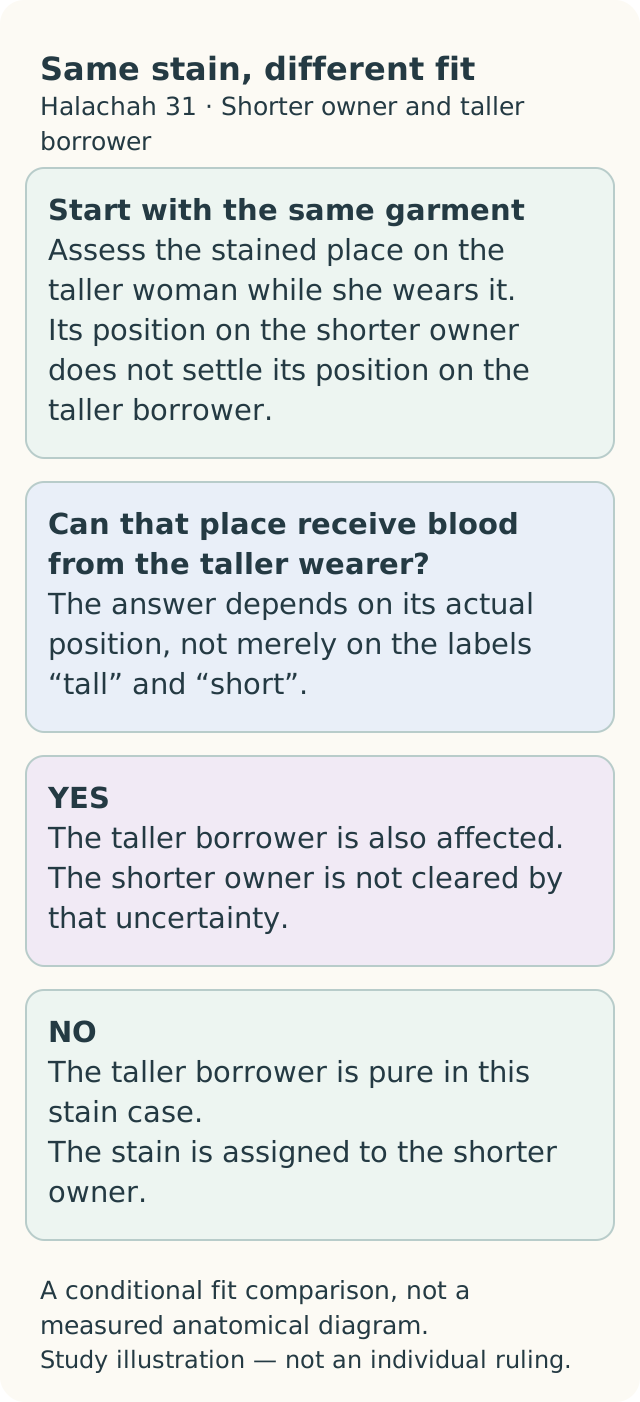
A Borrowed Garment Fits Different Bodies Differently
,
If a tall woman wore a short woman’s garment
:
and a stain was found on it,
-;
she is impure if its position reaches her genital area.
-,
If not, she is pure,
.
because this stain belongs to the short woman.
The stained place must be assessed relative to the tall woman while she wears the garment. A place that could receive uterine blood from the shorter owner may lie too high on the taller borrower. If it could receive blood from either woman, the borrower is also affected; the owner is not cleared by that uncertainty. If it could not receive blood from the taller woman, the stain is assigned to the shorter owner.
Synopsis
The same stained place on a borrowed garment may be relevant for a shorter wearer but not a taller one. Attribution depends on its position on each woman.
Visual guideA Borrowed Garment Fits Different Bodies Differently
Halachah 31: height alone does not determine the result. The actual garment position matters for each wearer. This schematic does not supply measurements or a practical ruling.Open full-size illustration
A Shared Garment or Bed Leaves Several Possible Sources
If three women wore one garment
,
one after another,
,
and afterward a stain was found on it,
,
or if they slept together in one bed
-
and blood was found beneath one of them,
.
all are impure.
With no distinguishing evidence among wearers of equal relevant status, each remains a possible source. In the bed case, this includes circumstances in which their bodies were intermingled or their entry route took them across one another’s places. Finding the stain under one woman does not then identify her alone. Halachah 34 distinguishes ordered positions and entry from the foot of the bed.
,
If one of them immediately examined herself
-
and found herself impure,
.
the other two are pure.
The immediate finding of blood supplies a basis to assign the stain to that woman. The other two are no longer left with the same undifferentiated doubt. “Immediately” is a real timing condition; a later examination must not automatically be treated as equivalent.
Synopsis
When several women are equally possible sources of a shared stain, all are affected. An immediate examination finding one woman impure can identify a source and clear the others under the stated rule.
🔎Dig DeeperA Shared Garment or Bed Leaves Several Possible Sources
A Shared Garment or Bed Leaves Several Possible Sources
How immediate must the examination be
reads the ’s word “immediately” as the brief interval called , not an entire day or night. The examination must be close enough to the discovery to connect its result with that stain.
There is also a dispute about successive garment wearers. reads the Rambam broadly, like the shared-bed case. Kesef Mishneh supports the narrower interpretation that, for a blood-finding to clear earlier wearers, it is the last wearer who checks immediately after removing the garment. This is a limit within the garment case, not a claim that examinations never help with garments.
Different Bleeding Presumptions Can Distinguish the Women
-
If all examined themselves and found themselves clear,
a woman who is not expected to see blood may attribute the stain
,
to one who is expected to see it.
,
The one not expected to bleed is pure,
.
and the one expected to bleed is impure.
A clean examination now does not establish who caused the earlier stain. A relevant difference in their ordinary bleeding presumptions can nevertheless distinguish them. “Not expected” is a legal category here, not a claim that bleeding is physically impossible.
?
For example, one woman is pregnant
-
and the other is not:
,
the pregnant woman is pure,
;
and the other is impure.
,
If one is nursing and the other is not,
;
the nursing woman is pure.
,
If one is elderly and the other is not,
;
the elderly woman is pure.
,
If one has not begun menstrual bleeding and the other has,
.
the one who has not is pure.
The categories retain the definitions in 4–5: pregnancy is recognizable at three months; the nursing category extends twenty-four months after childbirth; elderly status includes the required nonbleeding interval; and “virgin” here concerns menstrual history, not marital history. In each comparison, the ordinary bleeding category bears the stain’s consequence.
,,
If all are pregnant, or all elderly,
,-
or all nursing, or all without prior menstrual bleeding,
.
all are impure.
An exemption cannot be assigned to every woman merely because each is ordinarily less likely to bleed. With no relevant difference among them, there is no basis for selecting one as the source and clearing the others.
Synopsis
A defined difference in bleeding presumptions can assign a shared stain to the more likely source. If all have the same protected category, the difference disappears and all remain affected.
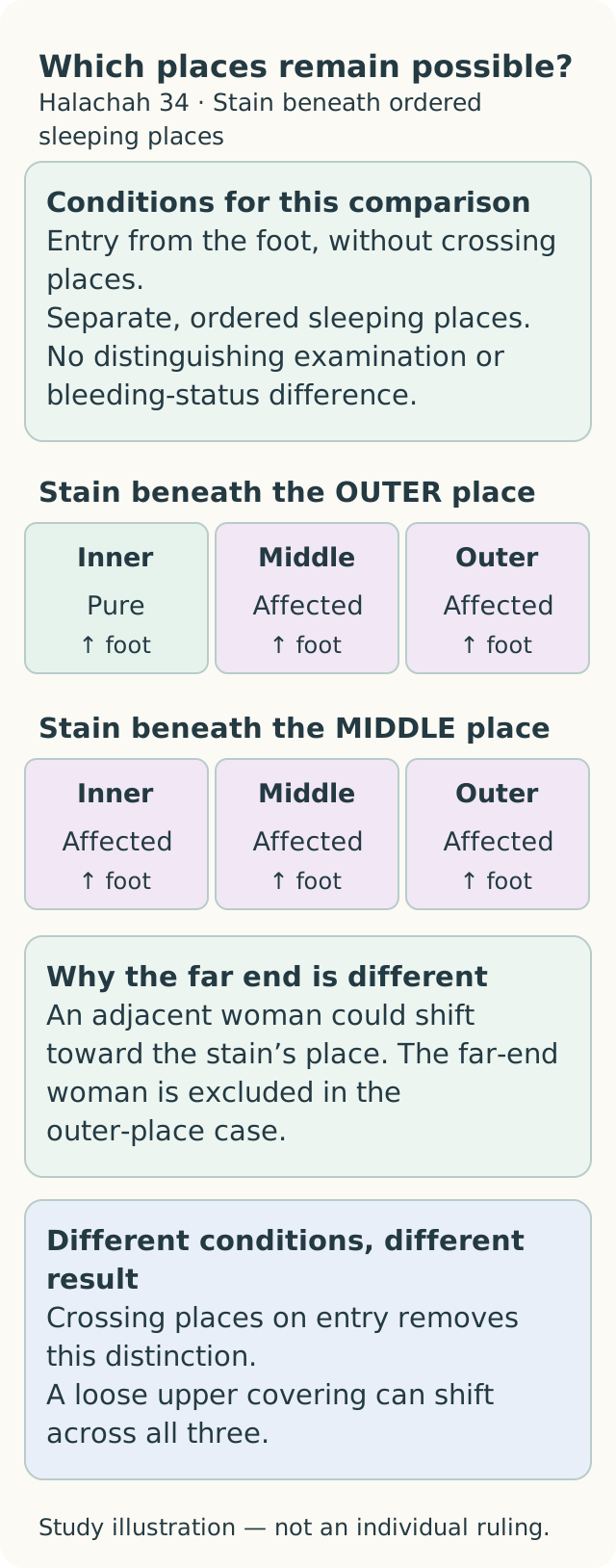
They occupy three ordered positions across the bed, and entry from the foot avoids crossing one another’s sleeping places. A woman could move enough to affect her neighbor’s area, so a middle stain leaves all three possible. A stain beneath an end position leaves that woman and her immediate neighbor possible, but not the woman at the far end. This assumes distinct sleeping positions rather than intermingled bodies.
,
If they did not enter from the foot of the bed,
,
so that their movements were not confined to that order,
-
and blood was found beneath one of them,
.
all are impure.
Passing through another woman’s place when entering prevents the final sleeping position from excluding her as a source. A loose upper covering is also different from a stain located beneath a fixed sleeping place: the covering can shift across them all, so its position does not provide the same limitation.
Synopsis
With ordered positions and entry from the foot, a stain affects its occupant and adjacent possible sources. A route crossing other places, or a shifting upper covering, removes that positional distinction.
Picture the CaseA concrete example + illustration
The far end is different from the next place
Picture three separate sleeping places across one bed: inner, middle, and outer. The women entered from the foot without crossing one another’s places, slept in ordered places rather than lying intermingled, and have no distinguishing examination or bleeding-status difference. A qualifying stain beneath the outer place affects the outer woman and the middle woman beside her; the inner woman at the far end is pure. Move the stain to the middle place, and all three are affected, because either neighbor could have shifted toward it. This comparison concerns a stain beneath the sleeping places, not a loose upper covering that could move across all three.
Halachah 34: the diagram concerns a stain beneath fixed sleeping places. It does not apply the same positional distinction to crossed entry routes, intermingled sleepers or a loose upper covering. “Affected” describes the stain rule in this case, not proof of who produced the blood.Open full-size illustration
When all examined themselves and found themselves clear,
and none can attribute the stain to another
.
as we have explained.
The positional rules address women who cannot otherwise be distinguished by an examination or a relevant difference in bleeding status. An equal clean finding for everyone does not identify the source of the earlier stain.
But if one examined herself
,
and found herself clear,
-
while the other did not examine herself,
the woman who found herself clear attributes the stain
,
to the woman who did not examine herself,
.
and the woman who did not examine herself is impure.
The examinations no longer leave them on equal footing. The clear result provides the distinction needed for attribution in this case. It is not proof that the unchecked woman certainly had uterine bleeding; it determines how the shared doubt is assigned. This distinguishing examination must be immediate, as in Halachah 32; a later clean result does not automatically clear her of the shared stain.
Synopsis
Equal clean examinations leave the shared stain unresolved. An immediate clean result for one woman, when the other remains unchecked, can permit attribution to the unchecked woman.
does not impart impurity until it is identified as blood.
This does not allow an apparently bloody stain to be ignored until a test has proved it is blood. explains that a stain appearing to be blood is treated as impure; when competent assessment leaves a doubt between blood and dye, the following test can establish its nature. Without a valid test clearing that doubt, the woman is not simply assumed pure.
If they are uncertain
-
whether it is blood or red dye,
,
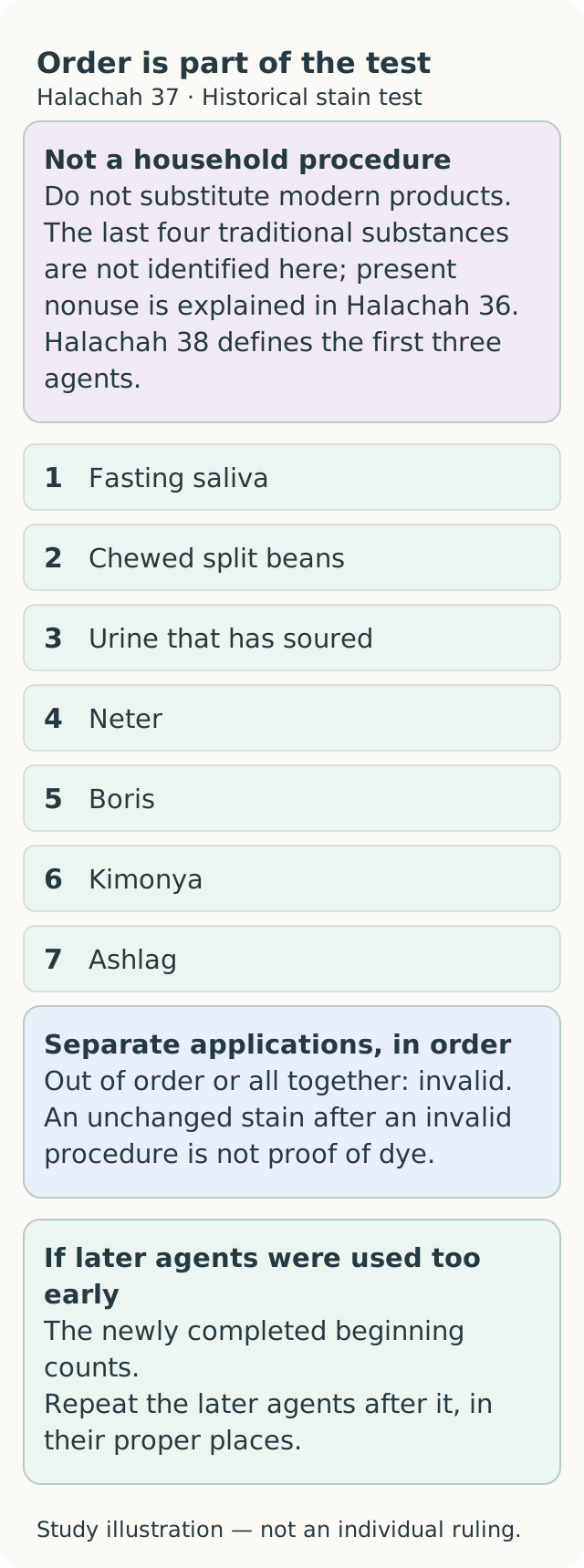
they apply these seven cleansing agents to it
:
in the prescribed order.
,
If the stain disappears or its color fades,
;
it is a bloodstain, and she is impure.
,
If it remains unchanged,
.
it is dye, and she is pure.
“They” refers to those assessing the stain. The result depends on the complete prescribed procedure, not on ordinary laundering or a modern detergent experiment. 37–38 define the agents and procedure. The uncertainty about identifying some agents is also why this test is not used in present practice, as , 190:31, records.
Synopsis
The prescribed test distinguishes a doubtful blood-or-dye stain by its response to seven agents in order. An apparently bloody stain is not presumed pure merely because it has not been tested.
🔎Dig DeeperDetermining Whether a Stain Is Blood or Dye
Determining Whether a Stain Is Blood or Dye
Must every stain be tested first
reads the as requiring impurity at once when the mark is known to be blood. The seven-agent procedure addresses uncertainty between blood and dye. An unresolved mark is not automatically permitted while a clarifying test remains available.
objects to using this procedure to clear the woman; he understands its role as concerning the garment. Maggid Mishneh defends the Rambam’s use of an unchanged stain to identify dye and clear the woman as well.
The last four are names of traditional cleansing substances. Their names are retained rather than equated confidently with modern products. The following defines the first three. This historical test should not be reconstructed with household substitutes; its present nonuse is explained in Halachah 36.
One must rub three times
,
with each individual agent,
.
moving back and forth with each rubbing.
,
If the agents were applied out of order
-
or all together,
.
the procedure has accomplished nothing.
An unchanged stain after an invalid procedure is not evidence that the stain is dye. Both the order and separate applications are part of the test.
-
If later agents were applied before earlier ones,
those applied last,
,
which should have come first, count toward the procedure.
He then applies after them again
,
the later agents that he had used prematurely,
.
until all seven have been applied in order.
The useful portion is the newly completed beginning of the required sequence. The agents that belong later must be repeated after it. Earlier, out-of-order applications do not take the place of their proper position in the sequence.
Synopsis
The historical stain test requires seven specified agents, separate applications, and the proper order. A misplaced later agent must be repeated after the earlier agents that properly precede it.
Visual guideThe Seven Agents Must Be Applied in Order
Halachah 37: a historical sequence aid, not instructions for a present-day test. Preparation conditions and rubbing requirements remain in the approved text; modern identities or substitutes are not supplied.Open full-size illustration
When a person has tasted nothing since the night began
,
and slept throughout the second half of the night,
,
the saliva the next morning, before eating,
;
is called fasting saliva.
This requires that he has not spoken extensively
.
during the first three hours of the day.
The term describes saliva prepared under these particular conditions, not simply saliva collected whenever someone happens to feel hungry. Both the overnight conditions and the restriction on extensive speech matter to this procedure.
,
If he arose early and recited his lesson
-
before three hours had passed,
,
this is not fasting saliva,
because speaking weakens the saliva’s strength
.
and makes it like water.
Reciting the lesson is the example of extended speech. The statement concerns the saliva’s suitability for this cleansing test, not a criticism of early study.
?
What are chewed split beans?
The beans are chewed
until the bean is mixed
.
with plentiful saliva from the mouth.
?
And what is urine that has soured?
.
Urine after three days or more.
These are the specified preparations of agents two and three. Merely using dry beans or fresh urine would not fulfill the descriptions given here.
Synopsis
The first three agents have defined preparation conditions: qualifying overnight saliva, beans mixed thoroughly with saliva, and urine aged at least three days.
This summarizes the original framework being studied. The count begins with discovery, as Halachah 3 states; the retroactive purity concern does not supply earlier days toward it. The seven days here are not the same as the seven clean days required in present practice. Chapter 11 explains that later practice, so this passage must not be used as a stand-alone instruction to resume relations today.
-
If she found it during her days of ,
,
she is possibly a major or ,
,
as explained in this chapter.
,
She observes one day if her possible status is minor ,
or seven clean days
,.
if her possible status is major , because of the doubt.
The number and timing of possible bleeding days determine the category, as 12–18 explain. The single day is the guarded, nonbleeding day required for minor in this framework. Counting alone does not replace the required immersion.
,.
All this is Rabbinic, as we have explained.
,-
Therefore, a man who deliberately has relations with her
,
is given disciplinary lashes,
.
and they are exempt from an offering.
The deliberate violation incurs the disciplinary punishment for violating Rabbinic law. The exemption from an offering concerns an inadvertent violation: the stain decree does not establish the definite -level offense that would obligate a sin-offering. The distinction in legal level does not make the Rabbinic prohibition optional.
Synopsis
A qualifying stain requires the count appropriate to doubtful or in the ’s framework. Its impurity is Rabbinic, with corresponding consequences for deliberate and inadvertent violations.
Translation and elucidation: Independently prepared for Rambam, Clearly in contemporary English. Translation follows the Rambam’s words; elucidation supplies only the context needed to understand them.
Word cards and glossary: Hebrew word cards distinguish a word’s basic meaning from its meaning in the particular phrase. Shared glossary entries explain recurring terms; biography entries identify the cited authorities.
Explain and Background: Explain provides context needed for the ruling. Optional Background panels provide additional context that can be skipped without losing the essential explanation.
Synopsis: A short summary follows each halachah. It is a guide to the central ruling, not a replacement for the full text and its qualifications.
Dig Deeper: Based on the classic commentaries named inside each panel. Editorial explanations are not presented as quotations.
Live It: Where present, these panels connect a particular halachah to a suggested personal reflection and an action to try. Original applications are labeled as suggested reflections. They are distinct from the ruling and are not attributed to the Rebbe merely because his guidance supports seeking a practical lesson.
Measurements: Modern equivalents draw on Chabad.org’s measurement glossary and cited halachic calculations. They show a range when major accepted calculations differ. Monetary equivalents fluctuate with the price of silver.
The Rebbe’s teachings and guidance: Source links accompany the completion teachings and the guidance inside Dig Deeper and Live It. Quotations, translations, and adaptations are identified; the general guidance is separate from the sources for a panel’s particular discussion.
Editorial responsibility: Created and prepared for this project by Levi Gelb. Corrections and suggestions can be submitted below. This presentation supports learning; practical halachic questions should be brought to a qualified rav.
Chapter 9 at a glance
Chapter Synopsis
A qualifying bloodstain creates Rabbinic doubt rather than establishing definite -level bleeding. Its consequences depend on the surface, location, size, available source, timing, and the women involved; these distinctions also determine the appropriate count within the ’s– framework.
-level impurity requires the qualifying discharge and sensation. Blood found internally carries a presumption of sensation even when she did not notice it; law does not make her impure retroactively.
A qualifying bloodstain creates Rabbinic impurity because it may have come from the uterus, even without a noticed sensation and despite a clean examination afterward.
Rabbinic retroactive impurity reaches back at most twenty-four hours, or only to a later clean examination. The count begins at discovery, and a stain may leave the cycle reckoning uncertain.
Bleeding at an established time and bleeding in the four defined categories generally create impurity only from discovery. The pregnancy and nursing categories have specific time limits.
The exceptions depend on defined bleeding histories and life stages. Pregnant, nursing, and elderly women’s stains do not act retroactively; a qualifying minor’s stain creates no impurity at all.
Body stains have no minimum size under the applicable conditions. Garment stains require the stated minimum area; separate spots are not combined, while a continuous streak is. Later attribution rules still apply.
The stain decree does not cover surfaces that are not susceptible to ritual impurity or colored articles. These limits apply even when a previously checked surface acquires a stain.
A body stain is assessed by whether uterine blood could reach its location through dripping, walking, or contact. Ordinary outer and upper locations are treated differently, subject to relevant movement.
For a body stain in a relevant location, an unusual outline or apparent direction does not remove the concern that it came from uterine blood.
A qualifying garment stain below the belt creates concern; one above it does not under these conditions. A sleeve stain depends on whether that part can reach the genital area.
A garment used as a night covering, and a belt, do not have the ordinary garment’s exempt upper zone. Their position can change.
Stains found after three days during can create doubtful major- status without proving when each stain appeared, even when stains on layered garments line up.
For the smaller single stain described here, a clean examination spanning the first twilight removes concern for major . Without it, the three-day concern remains despite the stain’s size.
A stain on one of three consecutive days can join actual bleeding on the other two to create doubtful major- status, subject to the following timing rules.
A stain can be associated with actual bleeding seen within twenty-four hours. Two stains require a clean examination between them as well before they cease to supply separate days toward major .
Actual bleeding within twenty-four hours absorbs the earlier stain into its count. Beyond that window, the stain can supply a separate possible day and create doubtful major sooner.
Two stains within twenty-four hours count from the later stain only when a clean examination intervenes. Without it, both days remain relevant to a possible three-day sequence.
A clean examination cannot join stains more than twenty-four hours apart. A later stain within twenty-four hours of the second can join it if a clean examination intervenes, preventing a three-day count.
A plausible external source can clear a garment stain. A body-only stain needs a source that accounts for its location on the body, rather than an unsupported transfer from elsewhere.
Known involvement with blood or staining materials, or proximity to such activity, can account for a garment stain without a witnessed splash.
External exposure does not automatically clear a stain found only on the body. A relevant location is required; the upper-body case depends on a movement that could bring uterine blood there.
A wound that could reopen and bleed can account for a body stain when it can plausibly supply blood at that location.
A stain on both clothing and body can be attributed to a plausible external source. Attribution to a louse extends through a , but not beyond it, even when a crushed louse is visible.
A child’s or husband’s blood-soiled hands or wound can account for a stain through plausible unnoticed contact; an actual possible route of transfer is still needed.
A distant wound does not clear a stain through an assumed chain of unnoticed hand movements. The source must plausibly account for the actual location.
An external source must account for the stain’s amount. One limited source cannot clear two full stains, while a known blood source and the permitted louse allowance can be combined within their limits.
Attribution requires a source capable of producing the stain’s color and a sufficient basis for exposure. The outer or inner clothing layer alone neither creates nor defeats that basis.
Where roaming pigs regularly provide an external source of blood on clothing, garment stains may be attributed to that circumstance.
A previous wearer can sometimes account for a garment stain without newly impairing her status. When both wearers’ status or clean-day count would be harmed, or the other woman’s status rests only on a stain, that attribution is unavailable.
When the garment was checked clear before being lent and the stain was found on its return, the borrower cannot attribute the stain to the owner’s earlier wearing.
The same stained place on a borrowed garment may be relevant for a shorter wearer but not a taller one. Attribution depends on its position on each woman.
When several women are equally possible sources of a shared stain, all are affected. An immediate examination finding one woman impure can identify a source and clear the others under the stated rule.
A defined difference in bleeding presumptions can assign a shared stain to the more likely source. If all have the same protected category, the difference disappears and all remain affected.
With ordered positions and entry from the foot, a stain affects its occupant and adjacent possible sources. A route crossing other places, or a shifting upper covering, removes that positional distinction.
Equal clean examinations leave the shared stain unresolved. An immediate clean result for one woman, when the other remains unchecked, can permit attribution to the unchecked woman.
The prescribed test distinguishes a doubtful blood-or-dye stain by its response to seven agents in order. An apparently bloody stain is not presumed pure merely because it has not been tested.
The historical stain test requires seven specified agents, separate applications, and the proper order. A misplaced later agent must be repeated after the earlier agents that properly precede it.
The first three agents have defined preparation conditions: qualifying overnight saliva, beans mixed thoroughly with saliva, and urine aged at least three days.
A qualifying stain requires the count appropriate to doubtful or in the ’s framework. Its impurity is Rabbinic, with corresponding consequences for deliberate and inadvertent violations.
פרק ט
End of chapter.
You have reached the end of all thirty-nine halachos.