Returning to your place…

רRambam, Clearly
Aa
Hilchos Issurei Biah · Perek 8Issurei Biah · Ch. 8
22 left0% read22 halachos left

·

Menstrual Patterns and Restoring the – Reckoning

This chapter explains how recurring menstrual patterns are established, changed, or uprooted, and how uncertainty affects the reckoning of and . The presentation follows the ’s framework, identifying relevant disagreements where they arise.

A is a recurring pattern used to anticipate bleeding. Before bleeding begins, the expected period can require refraining from marital relations without making the woman a .

This chapter also uses the ’s reckoning of seven designated days of followed by eleven designated days of . A designated period is a classification of days; its arrival alone does not create impurity.

The underlying purification requirements discussed here differ from present practice, which requires seven clean days after qualifying uterine bleeding and immersion before relations are permitted.

פרק ח22 halachosTuesday, October 27, 2026ט״ז במרחשון תשפ״ז◷ Estimated study time: 60–80 min

אTap any Hebrew word to see its meaning and how it works in the phrase.

Chapter progress 0 of 22 completed🔎 0 learned in depth
Halachah 10% through
הלכה א

A Fixed Pattern for the Onset of Bleeding

Some women have an established menstrual pattern,

while others have no established pattern;

rather, a woman of the latter category experiences no warning sensation before the blood emerges,

and she has no fixed day for the onset of bleeding.

A is a recurring pattern associated with the onset of menstrual bleeding. Here, the absence of a warning sensation means that bleeding is not preceded by a recognizable bodily sign of the kind described in the next . It does not mean that the bleeding itself necessarily occurs without any sensation.

A woman who has an established pattern

-

is one whose bleeding begins on a fixed day—

whether at recurring twenty-day intervals,

at recurring twenty-four-day intervals,

or at shorter or longer intervals.

The examples describe a recurring schedule, rather than requiring every woman to follow the same cycle.

A pattern acquires established status through the repetitions explained below. Nevertheless, an occurrence may already require concern before a fixed pattern has been established. Halachah 4 distinguishes between retaining an established pattern and taking account of a new, unestablished one.

Synopsis

A is a recurring pattern associated with the onset of menstrual bleeding. The description here distinguishes a woman with a fixed schedule from one without a fixed day or recognizable warning sign.
הלכה ב

Bodily Signs That Precede Bleeding

-

Before the blood appears, she experiences bodily signs—

she yawns or sneezes,

feels discomfort at the opening of her stomach and in her lower abdomen,

the hair on her body stands on end,

or her body becomes warm,

or she experiences similar bodily occurrences.

These are examples of bodily signs associated with the approaching onset of bleeding. An isolated yawn, sneeze, or feeling of warmth does not by itself establish a menstrual pattern. Established status requires the relevant sign’s association with bleeding to recur three times.

“Yawning” and “sneezing” follow ’s rendering of the ’s . Other commentators interpret these expressions differently.

These signs, or one of them, occur

at her established time on the day of her .

The description combines a recurring day with a bodily sign appearing at a regular time on that day. It does not require every sign in the list to occur.

The requirement of three repetitions concerns establishing a fixed pattern. It does not mean that an earlier occurrence can always be disregarded.

Synopsis

Bodily signs can regularly precede menstrual bleeding. Their association with bleeding must recur three times to acquire established status; the description here connects these signs with a fixed day and time.

🔎Dig DeeperBodily Signs That Precede Bleeding

Bodily Signs That Precede Bleeding

The observes that the ’s wording appears to describe the bodily signs as accompanying a fixed by days, rather than presenting an independent bodily-sign .

Other authorities recognize two distinct forms: a pattern established by recurring times and a pattern established by recurring bodily signs even without fixed days. They also recognize a combined pattern involving both elements. The and follow this broader classification.

This distinction matters when reading the opening . Their description should not be understood as a universally accepted requirement that a fixed schedule and warning signs must always occur together.

Sources: Maggid Mishneh to 8:1, discussing 1–2; Tur, 189; , 189:19.

הלכה ג

Refraining During the Expected Period

We have already explained that a woman without an established

may not have marital relations until she first examines herself.

This refers to an internal examination for blood, as discussed in Chapter 4, Halachah 16. According to the , the absence of a fixed requires this examination before marital relations. Other authorities disagree with that requirement, as discussed there.

A woman who has an established

-

may not have marital relations throughout the entire of that —

if her occurs during the daytime,

marital relations are forbidden throughout that day;

and if her occurs during the night,

marital relations are forbidden throughout that night.

An here means the daytime or nighttime period in which bleeding is expected. The restriction covers that entire period, rather than only the particular hour at which bleeding usually begins.

This is a precaution before bleeding has actually appeared. The arrival of the expected time does not itself establish that she has become a .

Beginning with the day of the ,

she continually reckons her days of and her days of .

These are the seven designated days of and eleven designated days of discussed in Chapter 6.

The relationship between an established menstrual interval and the repeating eighteen-day reckoning is a difficulty discussed by the commentaries. This passage does not establish a simple rule that every new onset of bleeding automatically restarts the – reckoning.

Synopsis

The requires an examination before marital relations when a woman has no fixed . When she has a fixed , marital relations are forbidden throughout the daytime or nighttime period in which bleeding is expected.

Picture the CaseA concrete example + illustration

The expected hour and the whole

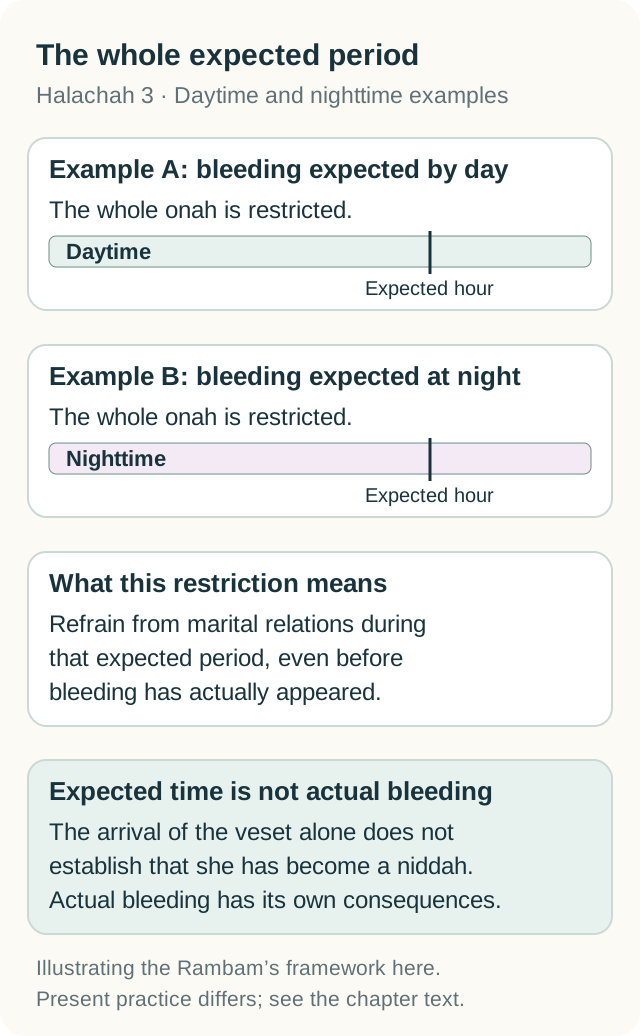
has an established during the daytime. She expects bleeding in the afternoon, but the restriction on marital relations covers that entire daytime , not just the expected afternoon hour. If her established were at night, the restriction would cover that entire nighttime . The expected time alone does not establish that she has become a .

When bleeding is expected during daytime, the restriction on marital relations covers that entire daytime onah. When expected at night, it covers that entire nighttime onah. The expected hour alone is too narrow; arrival of the expected period does not itself establish niddah status.
Halachah 3: these examples illustrate the restriction during the of an established . They do not say that relations are otherwise permitted without considering other applicable requirements.
Open full-size illustration
🔎Dig DeeperRefraining During the Expected Period

Refraining During the Expected Period

In 3:6, the distinguishes recurring bodily signs from bleeding itself. If a woman normally begins bleeding at the end of the symptom period, ritually pure items she handled during that period remain pure.

, 189:97, explains a concern regarding marital relations during the expected : they may bring on bleeding earlier. Even when bleeding normally begins toward evening, the restriction covers the entire relevant .

These passages help distinguish precautions concerning anticipated bleeding from the ritual-purity consequences of bleeding that has actually occurred.

Sources: 3:6; , 189:97.

הלכה ד

Establishing a New Pattern and Uprooting the Old One

Women must therefore take care to track their ,

until a woman knows the day and time

at which her has become established.

A is a pattern that has acquired established status. Such a pattern remains significant even when bleeding fails to occur on one or two expected occasions.

If she ordinarily began bleeding on the twentieth day,

and the twentieth day arrived without bleeding,

-

but she began bleeding when the twenty-third day arrived—

then the twentieth and the twenty-third days

are both prohibited.

The understands the numbered days here as intervals between onsets of bleeding, rather than necessarily dates of the month. This is called a , an interval-based pattern. Each interval is measured from the relevant preceding onset of bleeding.

These numbers describe intervals between onsets, rather than dates of the Jewish month.

The two intervals require concern for different reasons. The twentieth remains significant because the established pattern has not yet been uprooted. The twenty-third requires concern because the new interval may recur, even though it has not yet become established.

These restrictions apply during the relevant expected periods. They do not mean that the absence of bleeding itself makes her a .

Similarly, if she began bleeding a second time

on the twenty-third day,

-

without bleeding on the twentieth—

both remain prohibited.

The second deviation still does not uproot the original established pattern. Meanwhile, the repeated twenty-third-day interval continues to require concern.

If she began bleeding a third time on the twenty-third day,

-

without bleeding on the twentieth—

the twentieth day is released from its restriction,

and the shifts to the twenty-third day;

for a woman does not establish a

until it has occurred three times,

and she is not released from an established

until it has failed to occur three times.

Two changes have now been completed: the old interval has passed three times without bleeding, and the new interval has produced bleeding three times. The old established pattern is therefore uprooted, and the new one becomes established.

For an interval-based pattern, three repetitions mean three completed intervals, which require four onsets of bleeding to mark their beginning and end. Here, the three new intervals are measured from the preceding onset and then between the subsequent onsets.

“Released” refers to the restriction arising from the old expected interval. It does not remove impurity caused by actual bleeding.

Synopsis

An established is not uprooted by one or two deviations. Three missed occurrences of the old interval, together with three occurrences of the new interval, replace the old pattern with the new one.

Picture the CaseA concrete example + illustration

The old pattern and the new one

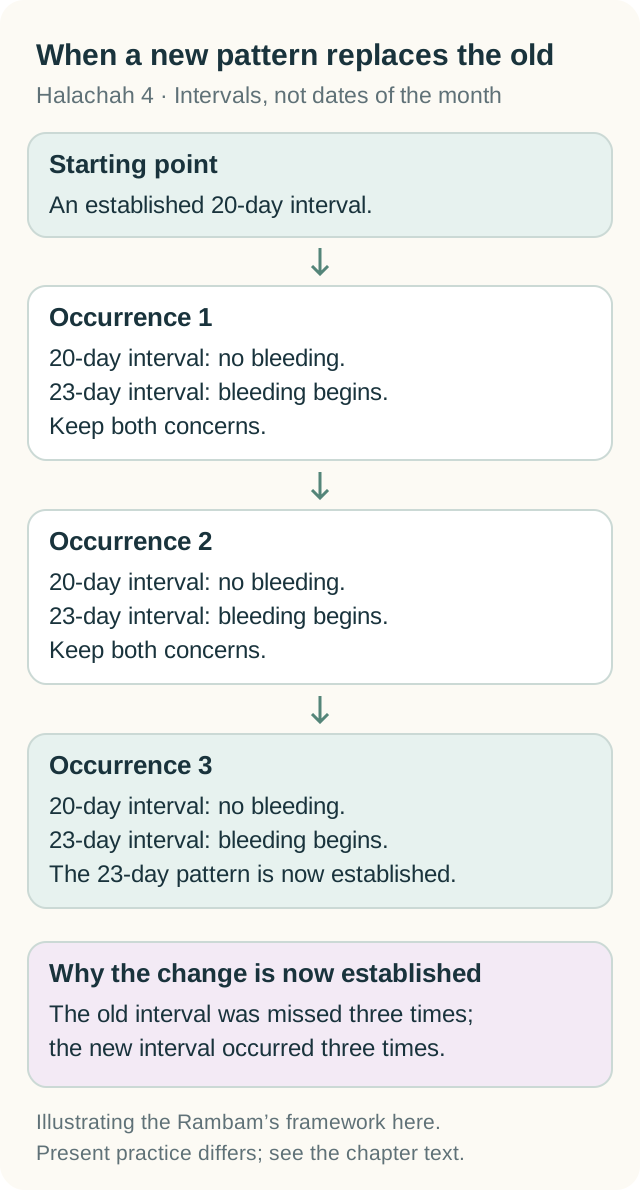
has an established pattern of bleeding at twenty-day intervals. Her next interval is twenty-three days instead. When planning ahead, she must still take the established twenty-day interval into account, while also accounting for the new twenty-three-day interval. One change has not erased the old pattern. If the twenty-day interval passes without bleeding three times, and the twenty-three-day interval occurs three times, the new pattern replaces the old one.

Three successive occurrences miss the established 20-day interval and begin bleeding at 23-day intervals. Both concerns remain after the first and second changes; after the third, the 23-day pattern replaces the old one.
Halachah 4: each record represents the next interval in the case, not the twentieth or twenty-third of a Jewish month. These are expected-time concerns; the chart does not replace purification after actual bleeding.
Open full-size illustration
Live ItGive growth time to become steady

Give growth time to become steady

An established is not uprooted by one or two missed occurrences. The distinguishes between a temporary departure and a change that has become established through repetition.

In our , one difficult morning need not make us dismiss the good habits we have built. If you missed your regular learning session, the next step can be to return at the next opportunity. Likewise, one inspired day is a beginning to nurture. Chassidic growth includes bringing inspiration into ordinary days, when the excitement has faded and we choose again to do what wants.

Try today

Keep one small learning commitment at its usual time, even if today feels less inspiring.

Suggested reflection on 8:4.

הלכה ה

Distinguishing an External Trigger from a Fixed Schedule

Any pattern produced by an external circumstance,

-

even if bleeding occurred under those circumstances repeatedly—

is not an established ,

because the external circumstance caused the bleeding.

Here, ones means an externally induced occurrence, rather than a recurring sign arising from her internal bodily pattern. The example below is jumping. According to the , repeated bleeding associated with jumping alone does not establish a fixed .

This concerns the establishment of a pattern. It does not mean that bleeding caused by exertion is itself exempt from the laws of or .

-

If she jumped and saw blood, and again jumped and saw blood—

she establishes a for the days, independently of jumping.

The complete circumstances follow below. They include a third onset of bleeding without jumping on that day. The introductory mention of two episodes does not mean that two occurrences alone establish a fixed .

What is the case? She jumped on a Sunday

and saw blood;

after twenty days, she again jumped on a Sunday

and saw blood;

after nineteen days, she jumped on

but saw no blood;

-

then, after , she saw blood without jumping—

Sunday after twenty days is thereby established as her ;

The explains that the twenty days are the intervening days between the Sunday sightings, excluding the sighting days themselves. The example therefore does not mean simply adding twenty calendar dates to a Sunday.

The Sunday sightings are three weeks apart, with twenty intervening days. On the third occasion, she jumps on but begins bleeding on Sunday without jumping that day.

On the first two occasions, the recurring day and the jumping accompanied the bleeding together. The third occasion separates them: she jumped on without bleeding, then bled on Sunday without jumping that day.

For it has become clear that the day caused the bleeding,

rather than the jumping,

and that day has now been established three times.

The same applies to all comparable cases.

The third occurrence identifies the recurring day as the determining factor. Although she jumped on the preceding day, the does not attribute Sunday’s bleeding to that earlier activity in this example. The established concern therefore does not depend on her jumping when that day arrives.

Synopsis

Repeated bleeding associated with jumping alone does not establish a fixed according to the . When the complete sequence identifies the recurring day as the determining factor, a day-based is established independently of jumping.

🔎Dig DeeperDistinguishing an External Trigger from a Fixed Schedule

Distinguishing an External Trigger from a Fixed Schedule

The explains that jumping is an external trigger, distinct from a recurring bodily sign. The rules that repeated bleeding brought on by jumping alone does not establish a fixed .

The , citing , adds that this does not eliminate all concern. The activity can create the lesser concern associated with an irregular , even though it has not established a fixed one.

The recognizes a established through three occurrences of bleeding associated with jumping, even without a fixed day. This differs from the ’s rejection of jumping alone as a fixed .

The discussion therefore involves two separate questions: whether a fixed has been established, and whether an activity still requires concern despite the absence of fixed status.

Sources: Maggid Mishneh to 8:5; Tur, 189; and Rama, 189:17; Hagahot Maimoniot, cited by the Rama.

הלכה ו

Establishing a Pattern That Advances Each Month

If she began bleeding on the fifteenth of this month,

on the sixteenth of the following month,

on the seventeenth of the next month,

-

and on the eighteenth of the month after that—

she has established an advancing .

A is a pattern in which the expected onset moves according to a recurring progression. Here, the date advances by one day each month.

Four monthly onsets demonstrate three advances: fifteenth to sixteenth, sixteenth to seventeenth, and seventeenth to eighteenth. The first onset supplies the starting point; it is not itself an advance. Once the pattern is established, the expected date in the fifth month is the nineteenth.

These are dates of the Jewish month. The progression concerns the monthly date, rather than necessarily an equal number of elapsed days between onsets.

If, when the fourth month arrived, she began bleeding on the seventeenth,

she has still not established a .

This is an alternative fourth-month outcome. Instead of advancing to the eighteenth, she repeats the seventeenth. The progression has therefore not been established through three advances.

The two seventeenth-day onsets also do not establish a fixed monthly-date , which requires three occurrences.

Any day on which she began bleeding

must be taken into account when it next occurs.

Even before a pattern becomes established, the actual onset creates concern that bleeding may recur on the corresponding date. In the alternative case just described, she must therefore take account of the seventeenth in the following month.

The earlier fifteenth and sixteenth do not remain concerns indefinitely: each passed in the following month without an onset on that date. This discussion addresses the monthly-date concern. Other calendar concerns, including those based on intervals, are separate.

Once that day arrives without her seeing blood,

that day is released from the concern;

for three missed occurrences are required to uproot

only a day that became established through three occurrences.

An unestablished monthly-date concern is removed when its expected recurrence passes once without bleeding. A fixed is stronger: one or two missed occurrences do not uproot it.

“Released” concerns the restriction associated with the expected date. It does not remove impurity resulting from actual bleeding.

Synopsis

Onsets on the fifteenth, sixteenth, seventeenth, and eighteenth of successive months establish a one-day advancing pattern. An unestablished monthly-date concern, unlike a fixed , is uprooted by one missed recurrence.

Picture the CaseA concrete example + illustration

Watch the dates move

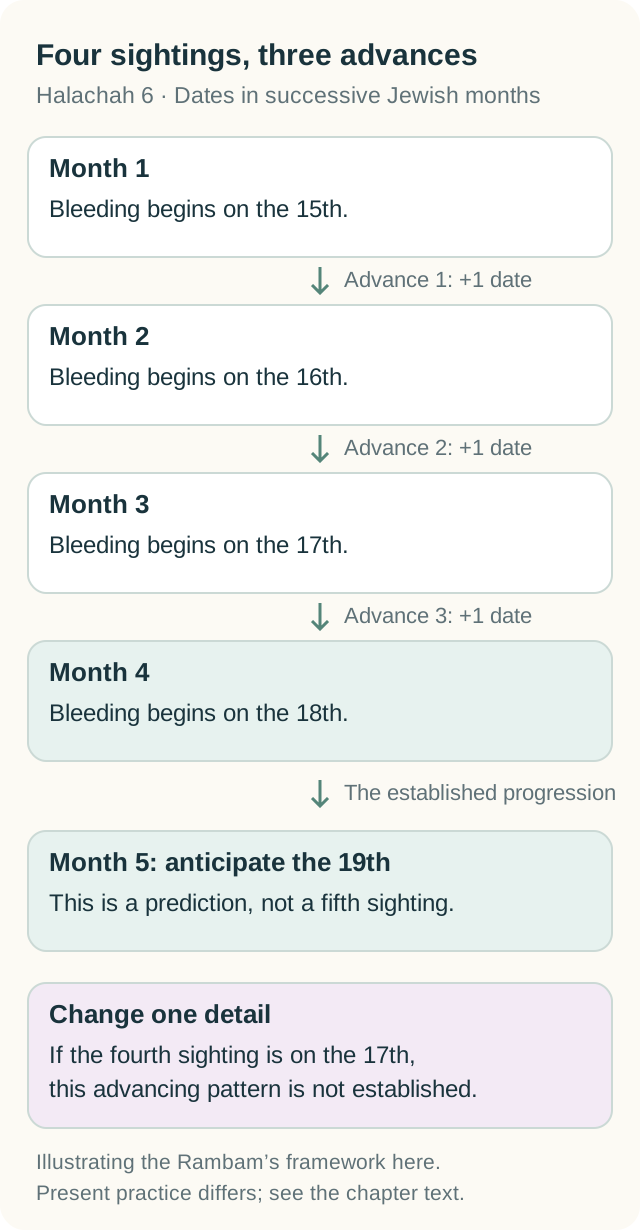
records the beginning of bleeding on the fifteenth of one Jewish month, the sixteenth of the next, the seventeenth of the following month, and then the eighteenth. Looking down her calendar, she notices that the date advances by one each month. There have now been three advances, so the established progression points to the nineteenth in the fifth month. If the fourth onset had occurred on the seventeenth again, that advancing pattern would not have been established.

Bleeding begins on the 15th, 16th, 17th and 18th of four successive Jewish months. Three one-date advances establish the progression, pointing to the 19th in month five. A fourth sighting on the 17th would not establish this advancing pattern.
Halachah 6: these are Jewish-calendar dates, not equal-length intervals. The four sightings establish three advances. The fifth-month date is the expected next occurrence under the stated conditions.
Open full-size illustration
הלכה ז

Departing from an Established Monthly Date

If her established practice was to begin bleeding on the fifteenth,

-

and she changed to the sixteenth—

both dates are prohibited;

The fifteenth remains significant because the established has been missed only once. The sixteenth requires concern because bleeding actually began on that new date, although it has not yet acquired established status.

The restrictions concern the relevant expected periods for marital relations. Merely reaching either date does not itself establish impurity.

-

If she then changed to the seventeenth—

the sixteenth is released,

the seventeenth becomes prohibited,

and the fifteenth remains prohibited.

The sixteenth was only an unestablished concern. When it passes without bleeding, that concern is removed, and the new seventeenth-day onset creates its own concern.

The fifteenth is different. Because it was already established, the second missed occurrence still does not uproot it.

-

If she then changed to the eighteenth—

the eighteenth becomes prohibited,

and all the others are released.

The original fifteenth-day has now been missed three times and is uprooted. The unestablished seventeenth-day concern is removed when that date passes without bleeding, while the actual eighteenth-day onset requires concern.

The sequence also raises the advancing-pattern issue discussed in Halachah 6. The progression points to the nineteenth in the following month. The discusses why the nevertheless mentions concern for the eighteenth.

Synopsis

When a woman departs from a fixed monthly date, the original date remains a concern until it has been missed three times. Each new, unestablished date can be removed by one missed recurrence.

🔎Dig DeeperDeparting from an Established Monthly Date

Departing from an Established Monthly Date

The asks why the mentions the eighteenth. The sequence has advanced from the established fifteenth to the sixteenth, seventeenth, and eighteenth. This appears to establish the progression described in Halachah 6, making the nineteenth the next expected date.

He suggests that concern for the eighteenth remains in addition to concern for the nineteenth. The eighteenth requires concern because bleeding actually began on that date; the nineteenth is indicated by the advancing pattern. The additional eighteenth-day concern would remain until that date passes once without bleeding.

The ’s treatment of the advancing pattern does not state this additional eighteenth-day concern. The explanation should therefore be understood as the Kessef Mishneh’s suggested resolution of the Rambam’s wording, rather than an undisputed rule.

Sources: Kessef Mishneh to 8:7; , 189:7.

הלכה ח

Returning to the Original Established Pattern

If her established practice was to begin bleeding on the twentieth day,

-

and she changed to the twenty-second—

both are prohibited.

The twentieth remains a concern because the established has not been uprooted. The twenty-second requires concern because of the new onset, although it is not yet an established .

As in the interval-based example in Halachah 4, the numbered days here identify expected intervals from the relevant preceding onset, rather than dates of the Jewish month.

If the twentieth day arrived without bleeding,

-

and she began bleeding on the twenty-second—

both remain prohibited.

The original pattern has now been missed twice, which is still insufficient to uproot it. The twenty-second has occurred twice, which is insufficient to give it established status.

-

If the twentieth day then arrived and she began bleeding—

the twenty-second is released from its restriction;

for she has returned to her established ,

and the twenty-second is uprooted

because it had not been established through three occurrences.

The twentieth-day pattern never lost its established status: it had been missed only twice. Its recurrence therefore reaffirms the existing without requiring three new occurrences.

The twenty-second, by contrast, never became established. Her return to the original pattern removes that competing concern. To uproot the reaffirmed twentieth-day , three new missed occurrences would be required.

Synopsis

If the original established returns before it has been missed three times, it is reaffirmed immediately. The competing pattern described here is removed because it never acquired established status.

Picture the CaseA concrete example + illustration

Returning before the old pattern disappears

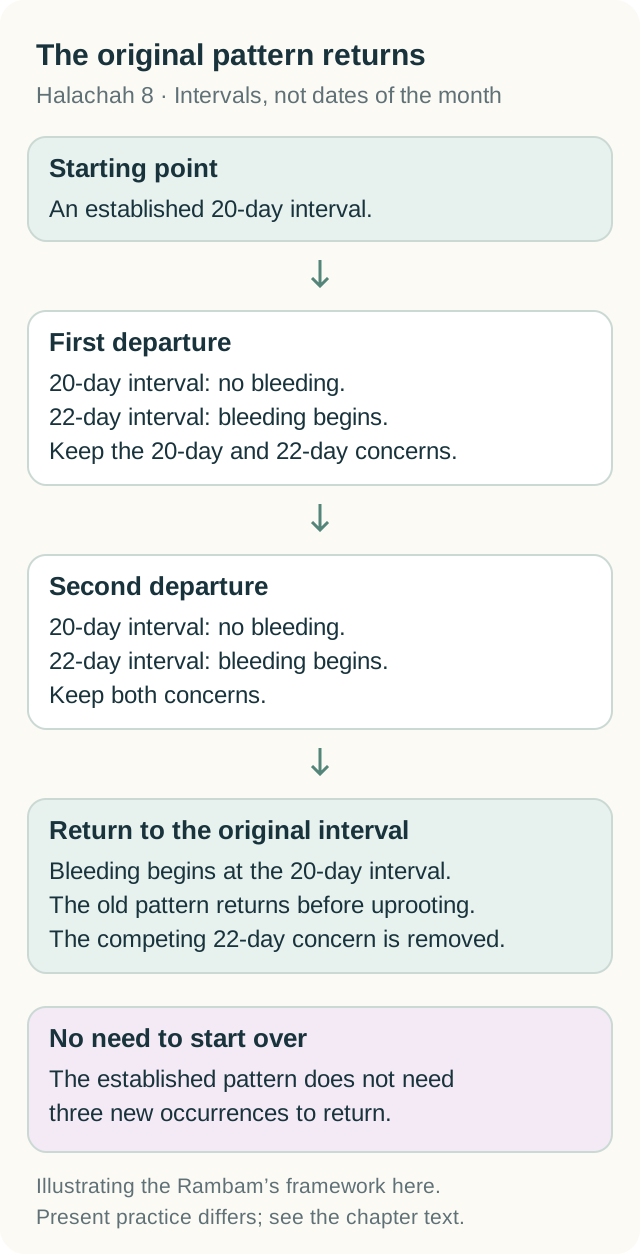
has an established twenty-day interval. Twice, bleeding begins at a twenty-two-day interval instead, so she takes both intervals into account. On the next occasion, bleeding begins at the original twenty-day interval. Her established pattern has returned before it was uprooted. She does not need three new twenty-day intervals to establish it again, and the competing twenty-two-day concern described here is removed because it never became established.

An established 20-day interval is followed twice by 22-day intervals, then bleeding returns at the 20-day interval. The original pattern returns before it was uprooted; three new occurrences are unnecessary.
Halachah 8: the two missed 20-day occurrences did not uproot that established pattern. The 22-day interval never became established. The chart follows this specific return case.
Open full-size illustration
הלכה ט

Patterns Formed During and Days

A woman does not establish a

within days of in which she has already experienced bleeding;

-

once she has experienced bleeding on one day,

she does not establish a during any of those seven days.

This follows the ’s distinction between designated days and designated days. Once bleeding has occurred within a particular seven-day period, further bleeding during that period does not establish a new .

Similarly, a woman does not establish a during her days of ,

which are the eleven days.

She can, however, establish a during her designated days of

in which she has not been experiencing bleeding.

The designated period does not itself mean that bleeding has occurred. If no bleeding has yet occurred in that period, an onset within it can contribute to establishing a .

This does not mean that a is established without bleeding. It distinguishes a new onset in a previously nonbleeding period from further bleeding after that period’s flow has already begun.

These distinctions belong to the ’s reckoning being studied here. They should not be treated as a complete account of how are established in present practice.

If a has formed during her days of ,

she must nevertheless take that into account.

Although such a pattern does not acquire the full established status described above, it cannot simply be ignored. Even a single occurrence during these days requires concern.

The wording also covers repeated occurrences: repetition does not give this pattern the ordinary strength of a fixed . The following clause explains how readily the concern can be removed.

Any formed during her days of ,

-

is uprooted if it fails to occur even once,

and need not fail to occur three times;

for during these days the presumption is that menstrual bleeding is absent.

Within this framework, bleeding during the designated days is treated as an exceptional occurrence. Its recurrence must be considered, but the resulting concern is removed more readily than an ordinary established .

The presumption does not make actual bleeding harmless. It explains the limited strength of a pattern formed during these days.

Synopsis

Further bleeding within an already bleeding period does not establish a new . A pattern arising during days requires concern, but even repeated occurrences are uprooted by one missed recurrence.

הלכה י

The Concern Created by a During Days

What does taking this into account involve?

If she experiences bleeding at this ,

-

even for only one day—

she must observe the restrictions of because of the doubt,

The explains that two possible reckonings must be considered. According to her earlier , this bleeding falls during the designated days of . However, the new may mark the beginning of a changed reckoning of .

She therefore cannot rely only on the shorter requirement ordinarily associated with minor . Even after one bleeding day, she must observe the seven-day restriction because that day may begin a new period.

This means completing the period; it does not, by itself, impose seven clean days after a single bleeding day.

and marital relations are forbidden on that day,

even if she did not experience bleeding on the other days.

The wording of this sentence varies between versions. The translation above follows the Hebrew reproduced here.

A manuscript-based reading understands the sentence to mean that she must refrain during the expected recurrence even if no bleeding appears, just as with other periods. The restriction anticipates possible bleeding; it does not mean that the arrival of the expected time itself makes her impure.

If she experiences bleeding for three days,

she is a .

Three consecutive bleeding days require seven clean days because, under the earlier reckoning, they may be qualifying days.

The uncertainty therefore produces both relevant stringencies: the restriction after even one bleeding day, and the seven-clean-day requirement after three consecutive bleeding days. Neither possible reckoning may be used to avoid the requirement arising from the other.

Synopsis

A arising during days requires concern despite its limited established status. Because the bleeding may belong to a changed reckoning or to the earlier reckoning, she observes the relevant stringencies of both.

🔎Dig DeeperThe Concern Created by a During Days

The Concern Created by a During Days

The explains this ruling through the ’s position that a change of can change the starting point of the – reckoning. The new occurrence is therefore considered against both the earlier reckoning and the possible new one.

He also notes textual difficulties in this passage. An emended reading proposed by the understands the middle sentence as requiring refraining at the expected recurrence even without actual bleeding, as with other periods.

This reading makes the distinction clear: actual bleeding affects her classification and purification requirements, while an expected recurrence creates a precautionary restriction before bleeding is discovered.

Sources: Maggid Mishneh to 8:10; Noda BiYehudah, second collection, , responsum 93.

הלכה יא

Examinations Outside the Expected Time

-

Any woman who regularly examines herself

acts praiseworthily, even if she has an established ,

because bleeding can occur outside her expected time.

A is an established pattern for the onset of menstrual bleeding. Although that pattern indicates when bleeding is expected, it does not rule out bleeding at another time. The therefore praises examinations that help establish her actual status.

This should not be understood as an instruction to independently add frequent examinations in present practice. Later guidance cautions against unnecessary examinations, which can themselves cause bleeding. The required examinations and their timing follow the applicable guidance.

-

Throughout all eleven days of her days of ,

she is presumed pure and does not require an examination;

-

after her days of , however, she must examine herself.

Here the follows the framework explained in Chapter 6: seven designated days of followed by eleven designated days of .

During the eleven days of , she has a presumption of purity, so the examinations discussed here are not required. This does not mean that blood discovered during those days is pure. Actual bleeding is governed by the laws of . After those eleven days, the examination requirement resumes.

Synopsis

The praises examinations even when a woman has an established . During the eleven designated days of , however, she is presumed pure and does not require the examinations discussed here.

🔎Dig DeeperExaminations Outside the Expected Time

Examinations Outside the Expected Time

The explains that the praise for examinations does not apply to an examination immediately before relations in the circumstances discussed there: her husband might interpret it as evidence that she noticed something concerning. Thus, a general statement praising examinations must be understood together with the laws governing their timing.

Sources: , 184:1; see also Chapter 4, Halachah 16.

הלכה יב

When an Examination Was Missed

-

If she went without examining herself, whether because of circumstances beyond her control or by choice,

she retains her presumption of purity

until she examines herself and discovers impurity.

When she was previously established as pure, missing an examination does not, by itself, establish that bleeding occurred.

Two separate questions are involved: whether she fulfilled an examination requirement, and whether there is evidence that she became impure. Failing to perform an examination does not automatically provide that evidence.

This does not cancel a required examination or permit relations during the prohibited period associated with her expected . The following addresses an examination delayed beyond that expected time.

Synopsis

Missing an examination does not itself establish impurity. Her previous presumption of purity remains, subject to the separate requirements associated with her .

הלכה יג

A Delayed Examination After the

If a woman did not examine herself at the time of her ,

and several days later examined herself and discovered impurity,

although she is considered impure retroactively from the time of her ,

-

as will be explained regarding ritual impurity and purity,

When the expected time passes without observed bleeding, the preferred course is to examine herself to confirm that bleeding did not begin.

If she delays that examination and subsequently discovers blood, the laws of ritual purity take account of the possibility that bleeding began at the expected time. This can affect the status of ritually pure items she handled during the intervening period.

This retroactive ruling has limits, as the now explains.

she does not retroactively render a man who had relations with her impure,

and she begins counting only from when she actually discovered blood.

A man who has relations with a acquires a particular form of ritual impurity. Here, that status is not imposed retroactively, because it is uncertain whether she was already bleeding when the relations occurred.

Likewise, her seven-day count is not backdated to the expected . It begins with the actual discovery of blood. These are the underlying laws being explained in this chapter, distinct from the present practice of counting seven clean days.

None of this permits relations during the prohibited period of the expected .

If she found herself pure,

she retains her presumption of purity.

If the delayed examination is clean, the expected date alone does not establish that bleeding occurred. Without evidence of bleeding, we do not assume that she became impure merely because her passed.

Synopsis

Blood discovered after a delayed examination can produce retroactive consequences for ritual purity. However, the special impurity of a man who has relations with a is not imposed retroactively, and her count begins with the actual discovery. A clean examination preserves her presumption of purity.

Picture the CaseA concrete example + illustration

The examination happened later

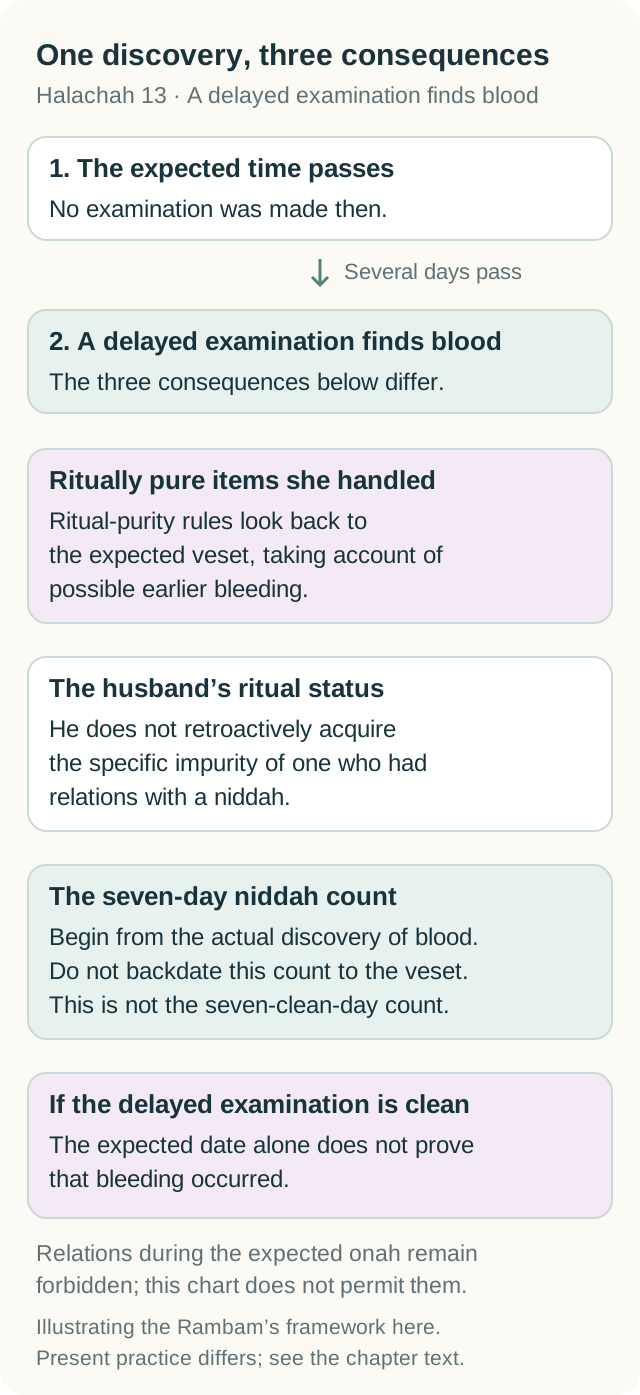
’s expected passes without an examination. Several days later she examines herself and finds blood. For the ritual-purity rules discussed here, the possibility of earlier bleeding affects ritually pure items she handled. Her husband does not retroactively acquire the specific impurity of relations with a , and her seven-day count begins with the actual discovery of blood. These are different consequences of the same delayed discovery.

The key distinction

The underlying seven-day count here is distinct from the seven clean days required in present practice. None of this permits relations during the prohibited expected . If the delayed examination instead finds her clean, the expected date alone does not establish that bleeding occurred.

Expected time passes without examination; several days later an examination finds blood. Ritual-purity rules look back to the expected time, but the husband does not retroactively acquire the specific impurity of relations with a niddah, and her seven-day niddah count begins only with actual discovery. A clean examination instead preserves the presumption of purity.
Halachah 13: the main timeline assumes that the delayed examination finds blood. Its retroactive rules concern ritual purity; they do not establish with certainty when bleeding began. The count shown is the underlying count discussed by the , distinct from present practice requiring seven clean days.
Open full-size illustration
הלכה יד

Wound Blood at the Expected Time

Similarly, if a woman experienced bleeding from a wound in her uterus,

-

even if she experienced it at the time of her ,

she is pure, and the blood is pure.

The distinguishes menstrual blood from blood caused by a wound. As explained in Chapter 4, Halachah 20, bleeding may be attributed to a wound when the conditions for doing so are met.

Here he adds that the arrival of her expected does not, by itself, prevent that attribution.

This ruling concerns blood that can be attributed to the wound. Merely having a wound does not establish that every appearance of blood came from it. Nor does this ruling remove an existing status caused by separate bleeding.

For the laws of are Rabbinic,

as will be explained in .

Actual bleeding creates a prohibition. The requirement to anticipate bleeding at an established is Rabbinic.

According to the ’s ruling here, that anticipated timing does not override a valid attribution of the blood to a wound.

Synopsis

According to the , bleeding properly attributed to a uterine wound remains pure even at the expected . The existence of a wound alone, however, does not establish the source of every appearance of blood.

הלכה טו

Assistance With Examinations

A blind woman examines herself and shows the examination cloth to another woman.

A blind woman is trusted to perform the internal examination properly. She needs assistance with assessing what appears on the —the cloth used for the examination—because she cannot inspect its appearance herself.

The ability to perform an examination and the ability to visually assess the cloth are separate matters.

A or a , however, requires competent women to examine her

and establish her ;

afterward, they may be permitted to their husbands.

here refers to the classical category of a woman who can neither hear nor speak. A woman who is deaf but can speak, or who hears but cannot speak, is not placed in that category merely because of that limitation.

is a technical category concerning capacity. It should not be understood as a general term for someone with a mental health condition.

In the cases the describes, other competent women must perform the examinations and establish the relevant patterns, rather than rely on the women concerned to perform the examinations independently.

Establishing a pattern does not itself remove impurity. Any required waiting, counting, and immersion must also be completed before relations are permitted.

13b; , 196:8.

BackgroundDifferent marriage frameworks

The marriage laws governing these categories are also distinct: the Sages instituted a Rabbinic marriage framework for a , but did not institute the same arrangement for a .

Synopsis

A blind woman performs her own examination and receives help assessing the cloth. In the technical categories of and discussed here, competent women must assist with the examinations and establishing patterns. All other purification requirements still apply.

Picture the CaseA concrete example + illustration

Separate the examination from assessing the cloth

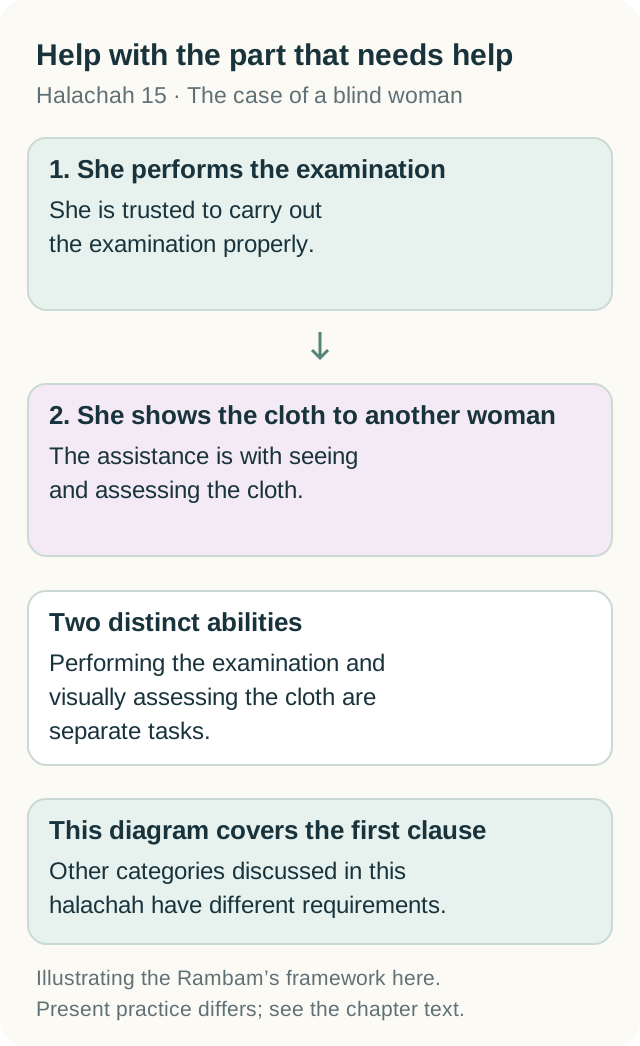
A blind woman can carry out her own examination properly. She then shows the examination cloth to another woman who can assess its appearance. Her need for help seeing the cloth does not mean that she cannot perform the examination. This illustrates the first clause of the ; the other categories described there have different requirements.

In the first clause of halachah 15, a blind woman performs her own examination and then shows the examination cloth to another woman for visual assessment. Performing the examination and visually assessing the cloth are separate abilities. Other capacity categories in the halachah have different requirements.
Halachah 15: this diagram illustrates the blind woman’s case. Assistance with the cloth’s appearance does not mean that she cannot perform her own examination. Any required purification must still be completed.
Open full-size illustration
Live ItHelp with the part that needs help

Help with the part that needs help

A blind woman performs her own examination and receives help assessing the cloth. The distinguishes between what she can do independently and the particular task for which she needs assistance.

We can bring that attentiveness into helping another person. Someone who needs help reading a form may still understand the decision better than we do. Before taking over, ask what assistance would be useful. includes noticing another person’s strengths and preserving their dignity while helping with a difficulty. Sometimes the kindest help is a small contribution that allows the person to continue doing the rest themselves.

Try today

When offering help, ask, “Which part would you like help with?”

Suggested reflection on 8:15.

הלכה טז

When the – Reckoning Is Unknown

Any woman who lost track and does not know the time of her ,

-

and then experienced bleeding, must account for the possibility of .

Here, refers to the starting point of her designated days of within the – reckoning. She no longer knows whether the present bleeding falls within the seven days of or the eleven days of .

She must therefore observe the restrictions required by either possibility.

These describe the underlying distinctions between and . Present practice requires seven clean days after qualifying uterine bleeding, as explained in Chapter 11.

Therefore, if she experienced bleeding for one day or two days,

-

she waits until the seven-day period is completed,

because this blood may have appeared during her days of .

If the bleeding were certainly bleeding lasting only one or two days, one subsequent clean day would suffice under the underlying laws.

However, she may instead have experienced bleeding. She cannot rely on the shorter purification process of a ; she must also satisfy the seven-day requirement of .

“Completing seven” here refers to satisfying that requirement. It does not mean seven clean days following the bleeding.

-

If she experienced bleeding for three days,

she counts seven clean days,

because she may be within her days of .

Three consecutive bleeding days within the days of establish the status of a —a major —who requires seven clean days.

Since that may be what occurred, she must count seven clean days after the bleeding stops. She cannot rely on the possibility that the bleeding was only bleeding.

Synopsis

A woman who has lost her reckoning must observe the restrictions arising from both possible classifications. Three consecutive bleeding days require seven clean days because she may be a .

הלכה יז

Restoring a Usable Reckoning

How does she restore her reckoning,

so that she can determine whether she is definitely a or possibly a ,

and identify her days of ?

Everything depends on how many days she experiences bleeding.

Two separate questions must be addressed: what purification requirements she must observe now, and how she can establish a usable reckoning for the future.

The preceding addressed the first question. Here the begins explaining the second. Restoring the reckoning does not, by itself, complete her purification or permit relations.

How so? If she experienced bleeding for one day or two days,

she completes the seven-day period,

and begins counting the eleven days after those seven.

The renewed reckoning follows the order of seven designated days and eleven designated days. These are calendar categories, distinct from the seven clean days that a possible must count.

The renewed reckoning assigns a starting point for classifying future bleeding; it does not prove where each earlier bleeding day actually fell. She must still observe the purification requirements arising from her uncertain status. The detailed assignment in the two- and three-day cases is discussed in Dig Deeper below.

Synopsis

The number of bleeding days determines how she restores her – reckoning. This calculation remains distinct from the purification requirements governing permission to her husband.

🔎Dig DeeperRestoring a Usable Reckoning

Restoring a Usable Reckoning

The explains that, according to the , maintaining the forgotten reckoning would leave her unable to classify future bleeding reliably. The Sages therefore treated her as someone establishing a new starting point.

He distinguishes between observing every necessary stringency concerning permission to her husband and assigning days for the renewed reckoning. In his explanation of the two-day case, he assigns one bleeding day to and the next to . Thus, the detailed calculation cannot simply assume that both bleeding days began a period.

The Maggid Mishneh himself regards aspects of this explanation as difficult. In particular, the detailed assignments and totals in the two- and three-day cases are not straightforward to reconcile. The distinction between restoring the reckoning and satisfying the purification requirements remains essential; these difficult cases should not be treated as a simple numerical shortcut.

Sources: Maggid Mishneh, Hilchos Issurei Biah, Chapter 8, commentary beginning “כל אשה שטעתה,” indexed as 8:16 in the edition checked.

הלכה יח

Three or Four Days of Bleeding

-

If she experienced bleeding for three days, she is possibly a ,

because one of those days may have preceded her period,

while two were at the beginning of that period.

The doubt concerns whether she became a .

If all three consecutive bleeding days fell within the days of , she became a . However, the bleeding may have crossed the boundary into the days of . In the arrangement described here, only the first day was a day, while the next two were days.

That arrangement would not establish major . Since both possibilities remain, she must count seven clean days because of the doubt.

-

The same applies if she experienced bleeding for four days:

two may have preceded the period,

and two may have been at its beginning.

Here too, the bleeding may have included fewer than three consecutive days: two days at the end of a period, followed by two days at the beginning of a period.

The days do not combine with the preceding days to establish major .

She then observes five days to complete the days of ,

followed by eleven days of after those five.

In the four-day arrangement just described, the last two bleeding days belong to the beginning of . Five further days complete that seven-day period, after which the eleven days follow.

This restores the reckoning; it does not replace her purification requirements. Because she may be a , she must still complete seven clean days and the required immersion before relations are permitted.

Synopsis

Three or four consecutive bleeding days leave major uncertain because the bleeding may have crossed from into . The renewed reckoning does not replace the seven clean days required because of that uncertainty.

הלכה יט

Nine or Eleven Days of Bleeding

-

Likewise, if she experienced bleeding for nine days,

she is possibly a ,

because two may have preceded the days of ,

and seven may have been days of .

Even nine consecutive bleeding days need not include three consecutive days. They could consist of the final two days of followed by all seven days of .

Another placement could include three consecutive days. She therefore remains a possible and requires seven clean days.

She begins counting eleven days

after the nine days, when the bleeding stopped.

For the renewed reckoning, the nine bleeding days are arranged as two days followed by seven days. The following day begins the eleven-day period.

The intermediate cases of five through eight bleeding days follow the same principle: the bleeding can include two days followed by part of the seven-day period, whose remaining days must then be completed.

-

Likewise, if she experienced bleeding for eleven days,

she is possibly a ,

because two may have preceded the period,

seven may have been days of ,

and two may have followed the period.

Nine days of her period therefore remain.

The possible arrangement is:

Position in the reckoningBleeding days
End of the preceding period2
period7
Beginning of the following period2

The two days before cannot combine with the two afterward to establish major : seven days separate them.

For the renewed reckoning, two of the following eleven days have elapsed, leaving nine. The ten-day case follows the same principle, with only one bleeding day after the seven days.

These calendar calculations do not remove the requirement of seven clean days and immersion arising from her possible status as a .

Synopsis

Even nine or eleven consecutive bleeding days leave major uncertain. The bleeding may surround a seven-day period without including three consecutive days.

הלכה כ

Twelve or Thirteen Days Establish Definite

-

If she experienced bleeding for twelve days,

she is definitely a .

For even if two of those days preceded the period,

-

and seven were days of ,

three would remain after the period,

leaving eight days of her period.

Twelve consecutive bleeding days necessarily include three consecutive days, establishing definite major .

The is not claiming that the bleeding certainly began two days before . He demonstrates that even the arrangement that avoids major for as long as possible cannot avoid it once bleeding continues for twelve days.

Two days before , seven days, and two days afterward total eleven. A twelfth bleeding day produces three consecutive days on at least one side of the period.

For the renewed reckoning described here, three of the following eleven days have elapsed, leaving eight. She certainly requires seven clean days.

-

Likewise, if she experienced bleeding for thirteen days,

seven days of her period remain,

and these are the days of her clean-day count.

In the corresponding thirteen-day arrangement, four bleeding days follow the seven days. Seven of the eleven days therefore remain.

After the bleeding stops, those seven remaining days serve as her seven clean days, provided they remain clean. The required immersion must also take place before relations are permitted.

Synopsis

Twelve consecutive bleeding days establish definite major . After thirteen bleeding days, the seven remaining days of the renewed period coincide with her required seven clean days.

Why one extra day changes the result

Consecutive bleeding daysPossible arrangementResult
112 + 7 + 2 Major remains doubtful
122 + 7 + 3 Major is definite

Picture the CaseA concrete example + illustration

Why one extra day changes the result

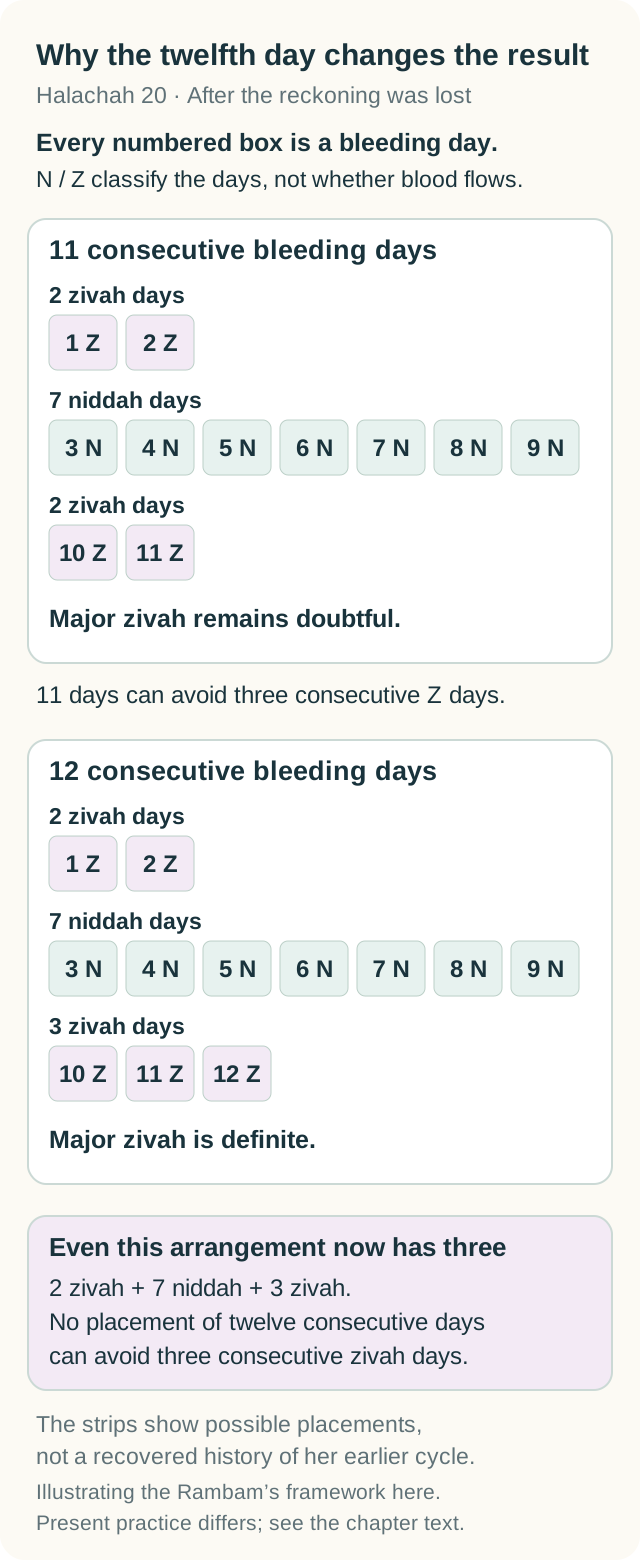
A learner is helping understand her record of eleven consecutive bleeding days after she lost her reckoning. They can arrange those days as two days, seven days, and two more days—without three consecutive days. Now suppose her record shows twelve consecutive bleeding days. Even that arrangement cannot avoid three consecutive days: two before , seven during , and three afterward. Eleven days leave major uncertain; twelve establish it definitely.

All boxes are consecutive bleeding days. Eleven days can be arranged as two zivah days, seven niddah days and two zivah days, without three consecutive zivah days. Twelve days necessarily include three consecutive zivah days, even in the two-plus-seven-plus-three arrangement. N means niddah and Z means zivah.
Halachah 20: the strips illustrate possible placements within the – reckoning after its starting point was forgotten. All boxes are bleeding days. Eleven days leave major uncertain; twelve establish it definitely. Purification still requires the clean-day count and immersion.
Open full-size illustration
הלכה כא

Restoring the Reckoning After Prolonged Bleeding

If her bleeding continued,

-

even if she experienced bleeding for a thousand days,

when the bleeding stops, she counts seven clean days,

and after those seven, the days of begin

for this woman who lost her reckoning.

This continues the preceding case of a woman who lost her – reckoning and experienced thirteen or more consecutive bleeding days.

Even if the bleeding continues far longer, she still requires seven clean days after it stops. The length of the preceding flow does not increase that count.

For this woman, completing those seven clean days also establishes the starting point of her renewed – reckoning.

The arrival of her designated “days of ” does not itself make her impure. These are days during which new bleeding would be classified as bleeding. Without new bleeding, the calendar designation alone creates no impurity.

The required immersion must also take place before relations are permitted; counting seven clean days alone is insufficient.

Synopsis

After prolonged bleeding stops, a woman who lost her reckoning counts seven clean days. Her renewed designated days of begin afterward, without making her impure merely because those days have arrived.

Live ItBegin with the next faithful step

Begin with the next faithful step

For the woman whose reckoning was lost, even extremely prolonged bleeding does not increase the seven clean days required once it stops. The describes a defined way forward despite how long the preceding condition lasted.

In our , we sometimes postpone returning because we feel we have been away too long. Perhaps a learning commitment has slipped for months, and opening the now feels uncomfortable. calls us to return to through a real choice in the present. We can acknowledge what needs repair while beginning something concrete today. A few sincere minutes of learning can be the first step toward renewed consistency.

Try today

Resume one worthwhile practice for five minutes, without waiting to feel fully ready.

Suggested reflection on 8:21.

הלכה כב

The Range for Restoring the Reckoning

-

We have thus learned that any woman who lost her reckoning

counts, from when the bleeding stops,

no fewer than seven days and no more than seventeen,

after which her days of arrive.

The number of days needed to restore the reckoning depends on how long the bleeding lasted. The calculation identifies when her renewed designated days of begin.

This is not a general rule requiring a woman to wait between seven and seventeen days before becoming permitted to her husband. Restoring the reckoning and completing the required purification are separate matters.

-

How so? If she experienced bleeding for one day and it stopped,

she counts seventeen days:

six to complete her period,

and eleven days of ,

after which her days of arrive.

For this calculation, the single bleeding day is assigned as the first day of . Six further days complete that seven-day period, and eleven designated days follow.

Thus, seventeen days pass after the bleeding day before her next designated period begins.

Part of the reckoningDays after the bleeding day
Remainder of the seven-day period6
Following period11
Total17

This example assumes that no further bleeding occurs during those seventeen days. New bleeding would require assessing her status and the calculation accordingly.

-

If she experienced bleeding for thirteen days or more,

she counts seven days after the bleeding stops,

and her days of arrive, as we explained.

Here, she is definitely a and must count seven clean days. Completing them also brings her to the starting point of her renewed reckoning.

These examples establish the limits: seventeen days after a single bleeding day, and seven clean days after thirteen or more consecutive bleeding days. The intervening cases follow the calculations discussed earlier.

As throughout this discussion, reaching a new point in the reckoning does not replace any purification requirement, including immersion.

Synopsis

Depending on the duration of the bleeding, her renewed designated period begins between seven and seventeen days after bleeding stops. Entering those designated days does not itself make her impure.

Sources & editorial method

Hebrew text: Mishneh Torah, Hilchos Issurei Biah, Chapter 8. The Hebrew is preserved as the primary text and divided into short learning units.

Translation and elucidation: Independently prepared for Rambam, Clearly in contemporary English. Translation follows the Rambam’s words; elucidation supplies only the context needed to understand them.

Word cards and glossary: Hebrew word cards distinguish a word’s basic meaning from its meaning in the particular phrase. Shared glossary entries explain recurring terms; biography entries identify the cited authorities.

Explain and Background: Explain provides context needed for the ruling. Optional Background panels provide additional context that can be skipped without losing the essential explanation.

Synopsis: A short summary follows each halachah. It is a guide to the central ruling, not a replacement for the full text and its qualifications.

Dig Deeper: Based on the classic commentaries named inside each panel. Editorial explanations are not presented as quotations.

Live It: Where present, these panels connect a particular halachah to a suggested personal reflection and an action to try. Original applications are labeled as suggested reflections. They are distinct from the ruling and are not attributed to the Rebbe merely because his guidance supports seeking a practical lesson.

Measurements: Modern equivalents draw on Chabad.org’s measurement glossary and cited halachic calculations. They show a range when major accepted calculations differ. Monetary equivalents fluctuate with the price of silver.

The Rebbe’s teachings and guidance: Source links accompany the completion teachings and the guidance inside Dig Deeper and Live It. Quotations, translations, and adaptations are identified; the general guidance is separate from the sources for a panel’s particular discussion.

Editorial responsibility: Created and prepared for this project by Levi Gelb. Corrections and suggestions can be submitted below. This presentation supports learning; practical halachic questions should be brought to a qualified rav.

Chapter 8 at a glance

Chapter Synopsis

This chapter explains how recurring menstrual patterns are established, changed, or uprooted, and how uncertainty affects the reckoning of and . The presentation follows the ’s framework, identifying relevant disagreements where they arise.

  • A is a recurring pattern associated with the onset of menstrual bleeding. The description here distinguishes a woman with a fixed schedule from one without a fixed day or recognizable warning sign.
  • Bodily signs can regularly precede menstrual bleeding. Their association with bleeding must recur three times to acquire established status; the description here connects these signs with a fixed day and time.
  • The requires an examination before marital relations when a woman has no fixed . When she has a fixed , marital relations are forbidden throughout the daytime or nighttime period in which bleeding is expected.
  • An established is not uprooted by one or two deviations. Three missed occurrences of the old interval, together with three occurrences of the new interval, replace the old pattern with the new one.
  • Repeated bleeding associated with jumping alone does not establish a fixed according to the . When the complete sequence identifies the recurring day as the determining factor, a day-based is established independently of jumping.
  • Onsets on the fifteenth, sixteenth, seventeenth, and eighteenth of successive months establish a one-day advancing pattern. An unestablished monthly-date concern, unlike a fixed , is uprooted by one missed recurrence.
  • When a woman departs from a fixed monthly date, the original date remains a concern until it has been missed three times. Each new, unestablished date can be removed by one missed recurrence.
  • If the original established returns before it has been missed three times, it is reaffirmed immediately. The competing pattern described here is removed because it never acquired established status.
  • Further bleeding within an already bleeding period does not establish a new . A pattern arising during days requires concern, but even repeated occurrences are uprooted by one missed recurrence.
  • A arising during days requires concern despite its limited established status. Because the bleeding may belong to a changed reckoning or to the earlier reckoning, she observes the relevant stringencies of both.
  • The praises examinations even when a woman has an established . During the eleven designated days of , however, she is presumed pure and does not require the examinations discussed here.
  • Missing an examination does not itself establish impurity. Her previous presumption of purity remains, subject to the separate requirements associated with her .
  • Blood discovered after a delayed examination can produce retroactive consequences for ritual purity. However, the special impurity of a man who has relations with a is not imposed retroactively, and her count begins with the actual discovery. A clean examination preserves her presumption of purity.
  • According to the , bleeding properly attributed to a uterine wound remains pure even at the expected . The existence of a wound alone, however, does not establish the source of every appearance of blood.
  • A blind woman performs her own examination and receives help assessing the cloth. In the technical categories of and discussed here, competent women must assist with the examinations and establishing patterns. All other purification requirements still apply.
  • A woman who has lost her reckoning must observe the restrictions arising from both possible classifications. Three consecutive bleeding days require seven clean days because she may be a .
  • The number of bleeding days determines how she restores her – reckoning. This calculation remains distinct from the purification requirements governing permission to her husband.
  • Three or four consecutive bleeding days leave major uncertain because the bleeding may have crossed from into . The renewed reckoning does not replace the seven clean days required because of that uncertainty.
  • Even nine or eleven consecutive bleeding days leave major uncertain. The bleeding may surround a seven-day period without including three consecutive days.
  • Twelve consecutive bleeding days establish definite major . After thirteen bleeding days, the seven remaining days of the renewed period coincide with her required seven clean days.
  • After prolonged bleeding stops, a woman who lost her reckoning counts seven clean days. Her renewed designated days of begin afterward, without making her impure merely because those days have arrived.
  • Depending on the duration of the bleeding, her renewed designated period begins between seven and seventeen days after bleeding stops. Entering those designated days does not itself make her impure.
פרק ח

End of chapter.

You have reached the end of all twenty-two halachos.