The distinctions below describe the original laws of ,, and childbirth. Chapter 11 explains the accepted practice of counting seven clean days after qualifying bleeding; the permissions concerning labor-related bleeding and discussed here do not describe present practice.
In the ’s reckoning used here, seven designated days of alternate with eleven designated days of . These periods classify bleeding; they do not predict when a woman will physically bleed. One or two consecutive qualifying bleeding days during establish minor , requiring one clean guarding day. Three consecutive qualifying days establish major , requiring seven clean days. “Minor” and “major” describe the classification, not the woman’s age. These requirements, together with immersion, determine when she becomes permitted to her husband.
Immersion means a valid immersion in a , a ritual bath meeting requirements, after the applicable requirements have been fulfilled. A day without bleeding may still belong to an ongoing period of impurity or be needed for counting; the absence of bleeding alone does not make the woman permitted.
פרק ז24 halachosMonday, October 26, 2026ט״ו במרחשון תשפ״ז◷ Estimated study time: 75–95 min
אTap any Hebrew word to see its meaning and how it works in the phrase.
Chapter progress 0 of 24 completed🔎 0 learned in depth
When Labor-Related Bleeding Receives Special Treatment
,
When a pregnant woman begins experiencing pain and labor pains take hold of her,
-
and bleeding begins before she gives birth—
״״.
that blood is called “,” labor-related blood.
?,
What is its status? If it appears during her days of ,
;.
it is blood, and she becomes impure as a .
,,
But if it appears during her days of , she remains pure,
״״(,).
for concerning a it states, “Her discharge within her flesh shall be blood” (Leviticus 15:19).
:,
The Oral Tradition interprets this as a discharge arising from herself,
.
rather than one caused by the child.
The “days of ” and “days of ” are the designated periods explained in Chapter 6. Labor-related bleeding can be excluded from the laws of because it is attributed to childbirth. This exclusion does not ordinarily apply to bleeding that begins during the days of .
“Pure” describes the status of this bleeding: it does not itself create impurity. It does not remove impurity that already exists for another reason.
;
This applies only if she gives birth to a living child;
,.
if she miscarries, the exemption for labor-related bleeding does not apply to miscarriages.
The special treatment depends on the labor leading to the birth specified here. Pain accompanying a miscarriage does not, by itself, exempt the preceding bleeding from the otherwise applicable laws of or .
Even if the blood continues flowing
,-
together with labor pains and distress for fourteen days before birth—
,;
it is labor-related blood and is pure.
Although the period of contains only eleven days, this allowance can extend for fourteen days. When the qualifying labor-related bleeding begins during the days of , its exemption can continue into the following days of . This does not create a general exemption for bleeding that first begins during the days of .
But if the bleeding began before birth
-
fifteen days earlier or more—
,
it is blood,
.
and she is a woman giving birth with .
The passage continues the case of ongoing bleeding. Once its beginning falls outside the fourteen-day allowance, the special exemption does not protect the sequence described here. The resulting status is called : childbirth accompanied by an existing major- obligation. Its purification requirements appear in Halachah 5.
This should not be understood to mean that a single sighting fifteen days before birth automatically establishes major . That status requires bleeding on three consecutive qualifying days of .
Synopsis
Labor-related bleeding that begins during the days of can receive special treatment when it leads to a living birth, subject to the fourteen-day limit and the conditions explained below. Bleeding beginning during the days of remains blood.
🔎Dig DeeperWhen Labor-Related Bleeding Receives Special Treatment
When Labor-Related Bleeding Receives Special Treatment
The days of last only eleven days. How, then, can the discuss fourteen days of labor-related bleeding that do not establish ?
The exemption can extend beyond the period in which it began. When the qualifying labor-related bleeding begins during the days of , its special treatment can continue into the following days of . The derives this extension through its interpretation of the ’s verses.
The starting point therefore matters: bleeding that begins during the days of does not receive this same allowance merely because labor accompanies it.
This explains the original law being studied here. The accepted practice described in Chapter 11 does not permit reliance on this labor-related allowance.
A Full Day of Relief Can Change the Bleeding’s Status
?
When does the preceding ruling apply?
,
When the contractions, labor pains, and distress did not cease,
.
and she continued experiencing labor until she gave birth.
The exemption depends on the bleeding remaining connected to the labor that leads to birth. The following passage defines the substantial interruption that breaks this connection.
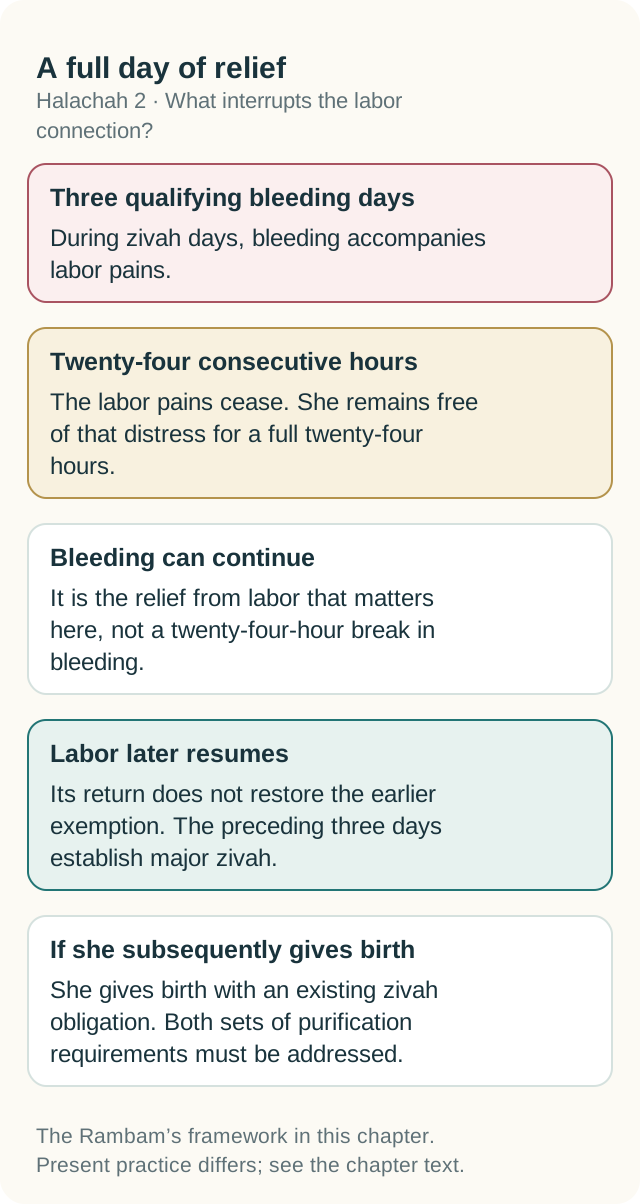
But if she experienced bleeding for three days or more
,
during her days of , accompanied by pain and labor pains,
and the pain stopped and she obtained relief from the labor pains
,
after those three days,
-
and she remained free of that distress for twenty-four hours or more—
,
even though the bleeding did not stop,
and even though the pain and labor pains returned
-
after twenty-four hours—
;
she is a .
The decisive respite is twenty-four consecutive hours of relief from labor. Merely entering another calendar day does not establish this interruption, and a shorter pause does not by itself meet the condition stated here.
The bleeding need not stop during the respite. It is the interruption of labor that changes the classification of the preceding bleeding. Those three consecutive days are consequently treated as ordinary bleeding, establishing major- status. The later return of labor does not restore their exemption.
,
For if the blood had been attributable to the child,
.
the pain and labor pains would not have ceased.
,
If she subsequently gives birth,
.
she is a woman giving birth with .
The birth adds the requirements of childbirth to the existing obligation. It does not erase that obligation.
Synopsis
After three qualifying days of bleeding, twenty-four consecutive hours of relief from labor remove the exemption for the preceding bleeding. She becomes a major , even if bleeding continues and labor later resumes.
Picture the CaseA concrete example + illustration
A full day of relief
For three consecutive days within her days of , a woman experiences bleeding together with labor pains. The labor pains then stop for twenty-four consecutive hours, although the bleeding continues. Labor subsequently resumes. Under the ruling here, the completed respite removes the exemption from the preceding bleeding; the return of labor does not restore it. If she subsequently gives birth, she gives birth with an existing obligation.
Halachah 2: this illustrates the complete conditions of the case in the text. A brief pause or merely crossing into another calendar date is not the twenty-four-hour respite described here. This is a classification, not a medical assessment of labor.Open full-size illustration
Whether Labor or Relief Immediately Precedes Birth
If she experienced bleeding for one day without pain,
,
followed by two days with labor, and gave birth;
,
or two days without pain followed by one day with labor, and gave birth;
or one day with labor followed by one day without pain
-
and another day with labor, and gave birth—
.
she is not a woman giving birth with .
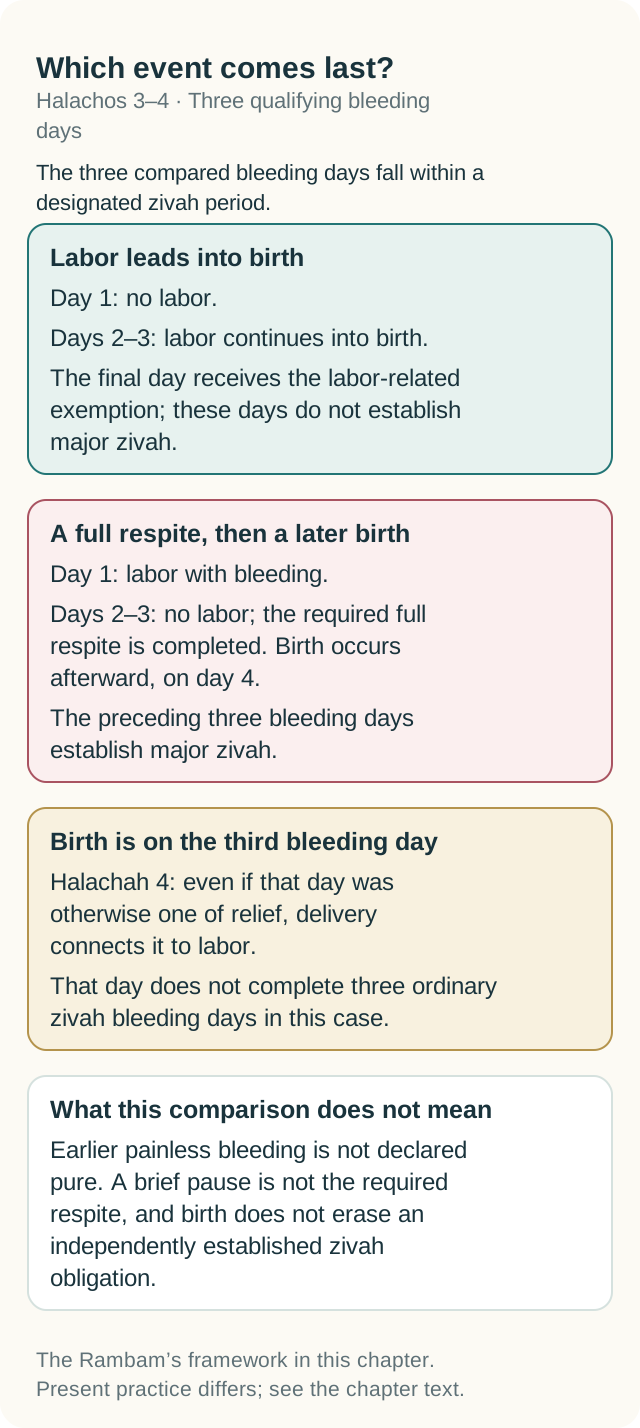
These cases concern three consecutive bleeding days within the days of . In each sequence, the final day’s bleeding accompanies labor connected to the birth. That day therefore does not complete the three ordinary days needed to establish major- status.
The earlier painless bleeding is not thereby declared pure. The ruling means that these sequences do not establish the additional seven-clean-day obligation of major .
But if she experienced bleeding for one day with labor
,
followed by two days without pain, and gave birth;
,
or two days with labor followed by one day without pain, and gave birth;
or one day without pain followed by one day with labor
-
and another day without pain, and gave birth—
.
she is a woman giving birth with .
Here the sequence ends with a completed period of relief from labor. As explained in Halachah 2, that respite removes the exemption from the preceding labor-related bleeding, allowing the three days to establish major .
In light of Halachah 4, these cases are understood to describe birth occurring afterward, on the following day, rather than during the third bleeding day itself. Birth on the third day receives a different ruling.
:,
This is the principle: When labor immediately precedes birth,
;
she is not a woman giving birth with ;
,
when relief immediately precedes her birth,
.
she is a woman giving birth with .
This principle summarizes the cases just discussed, including their requirements of qualifying bleeding days and a sufficient respite. It does not mean that any brief relief establishes , or that labor at birth removes an independently established obligation.
Synopsis
When qualifying labor remains connected to birth, the labor-related bleeding does not complete a sequence of three ordinary days. A completed respite before the subsequent birth can remove that exemption and establish major .
Picture the CaseA concrete example + illustration
Which event comes last?
Compare two calendars with bleeding on three consecutive days. On one, labor continues through the final bleeding day into birth. On the other, a full respite from labor is completed before a later birth on day four. The outcomes differ. If birth itself occurs on day three, Halachah 4 supplies a separate ruling. The chart keeps those sequences apart.
3–4: the order and complete conditions matter. The respite follows Halachah 2. This is a teaching example of the original framework, not a medical assessment.Open full-size illustration
Birth on the Third Bleeding Day and an Uncertain Expulsion
,
If her third bleeding day falls on the day of birth,
-
even if the entire day is characterized by relief—
,
she is not a woman giving birth with ,
.
because the day of birth is immediately connected to labor.
The explains that delivery itself necessarily involves the difficulty of birth. Thus, even when the day is otherwise characterized by relief, its connection to delivery prevents its bleeding from completing the three ordinary days in this case.
This differs from the second group in Halachah 3, where the painless third bleeding day is completed before the subsequent birth.
,
If she experienced bleeding for two days and expelled something on the third,
-
and it is unknown what she expelled—
.
her status as a is uncertain, and so is her status as a woman who has given birth.
The uncertainty is whether she expelled a fetus without additional bleeding or merely discharged a substantial quantity of blood.
If a fetus was expelled without additional bleeding, childbirth impurity applies. The preceding two bleeding days also require one clean day for minor ; they do not by themselves establish major . If the discharge was blood instead, it may constitute the third consecutive day, establishing major . Both possibilities must therefore be taken into account.
Synopsis
When birth occurs on the third bleeding day, that day does not complete the major- sequence described here. An unidentified expulsion after two bleeding days creates uncertainty about both childbirth and major- status.
Combining the Clean-Day Count with Childbirth Impurity
?
What requirements apply to a woman giving birth with ?
,
She must observe seven clean days,
,
and immerse at night.
,
Afterward, she becomes permitted to her husband,
;
and afterward the laws of apply to her.
,.
She brings both a offering and a childbirth offering.
Two requirements apply together. Childbirth creates its own period of impurity: seven days after the birth of a boy and fourteen after the birth of a girl. Her major- status additionally requires seven clean days. Completing the childbirth period alone does not discharge the obligation.
, “blood of purity,” is bleeding within the -defined period following the initial childbirth impurity. Here, the existing obligation must first be addressed before that allowance can permit her to her husband.
Delayed purification does not start a new purity window. The relevant period remains the thirty-three days following the initial seven after a boy, or the sixty-six following the initial fourteen after a girl. Only the remaining portion of that fixed period can apply. ( 4:5; 7:7.)
The two offerings correspond to her two separate obligations: and childbirth.
,
Accordingly, if she gave birth to a boy,
-
even if the bleeding stopped on the day of birth—
,.
she counts seven clean days and immerses.
Although the bleeding has stopped, the existing obligation still requires a clean-day count. Days within the childbirth period can count toward that requirement when they qualify; she need not automatically begin another seven-day count after the childbirth period ends.
,,
If she gave birth to a girl and counted seven clean days,
,
and they concluded together with the fourteen days of childbirth,
-
or afterward—
;
she immerses and becomes permitted to her husband.
-
But if her counted days concluded within those fourteen days—
.
she remains forbidden to her husband until the fifteenth night.
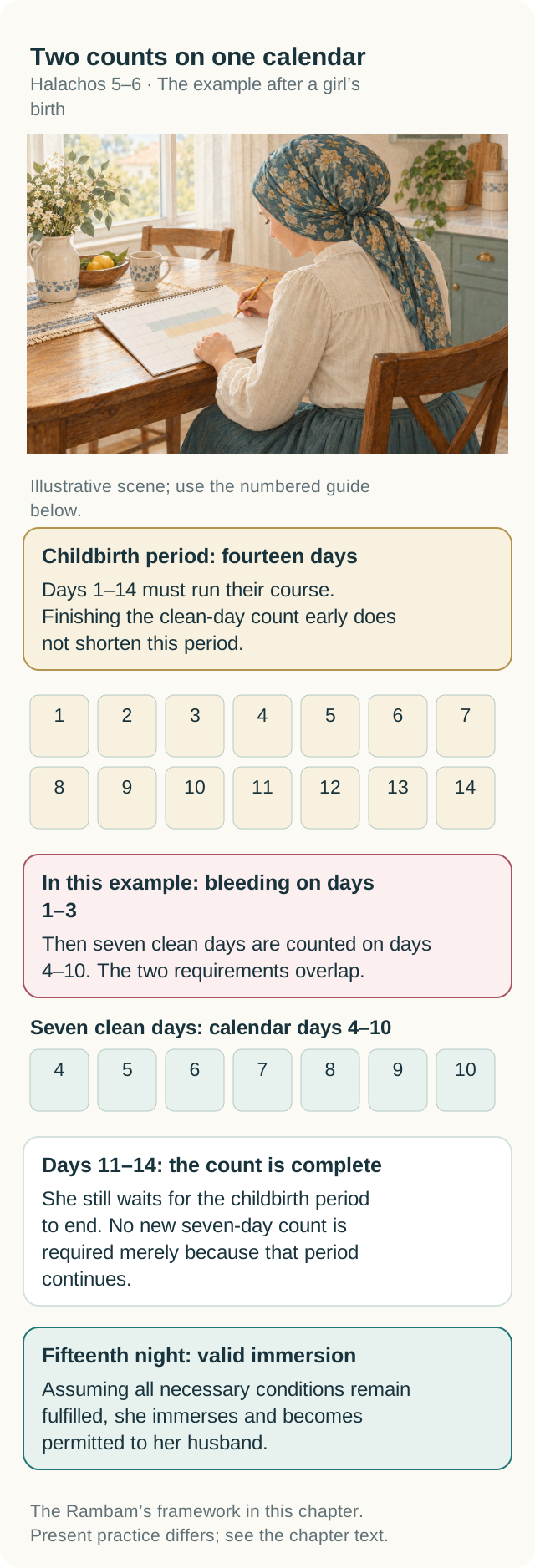
The seven clean days and the fourteen childbirth days can overlap, but both requirements must be completed. Finishing the clean-day count early does not shorten the fourteen-day childbirth period.
The explains that immersion during those fourteen days cannot remove the childbirth impurity. If her clean-day count has already been completed, she immerses on the fifteenth night. If the count finishes later, she waits until its completion and immerses at night.
Synopsis
A woman giving birth with major must complete both her seven-clean-day requirement and the applicable childbirth period before nighttime immersion. The periods can overlap, but neither requirement replaces the other.
How does this work? Suppose she experienced bleeding for three days,
-,
and then counted seven clean days—a total of ten days.
,
She nevertheless remains forbidden until the fifteenth night,
.
because throughout the fourteen days she has the status of a .
This continues the case of a woman who gave birth to a girl while bearing a major- obligation. If she bleeds during the first three days following birth and then counts seven clean days, her count finishes on the tenth day. Her count is complete, but the fourteen-day childbirth period is not.
She must therefore wait until the fifteenth night and immerse before becoming permitted to her husband. Completing the clean-day count earlier does not shorten the childbirth period.
Why do we not require a woman giving birth with
,
to count seven days after the seven days following a boy’s birth
?
or after the fourteen days following a girl’s birth?
Because the days of her childbirth impurity and her days of
,
during which she experiences no bleeding count toward her seven-day count,
.
as will be explained.
A day can count toward purification from even while another form of impurity remains. Here, days without bleeding can count despite the continuing childbirth impurity.
The childbirth period and clean-day count can therefore overlap; they need not run one after the other.
Synopsis
Days without bleeding during childbirth impurity can count toward the seven clean days required for . Nevertheless, after a girl’s birth she remains forbidden until the fourteen-day childbirth period ends and she immerses.
Picture the CaseA concrete example + illustration
The count is finished, but the waiting period continues
gave birth to a girl while she had an existing major- obligation. Her calendar shows bleeding on days one–three, followed by seven clean days on days four–ten. She has completed the clean-day count, but the fourteen-day childbirth period is still running. Assuming the necessary conditions remain fulfilled, she waits until the fifteenth night and immerses. She does not need to begin another seven-day count after day fourteen.
5–6: a girl’s birth and an existing major- obligation create two requirements. Qualifying clean days can count during childbirth impurity, but both requirements and valid immersion are necessary. The kitchen scene is illustrative; its paper calendar is not a counting guide.Open full-size illustration
A woman giving birth with whose bleeding has not stopped—
,
does not have the allowance of .
.
Rather, all blood she experiences is treated as blood.
The arrival of the days ordinarily designated for , “blood of purity,” does not remove an existing major- obligation. She must first complete seven clean days. As long as her bleeding prevents that count, she cannot rely on the postpartum purity allowance.
“All blood” refers to the uterine bleeding under discussion. It does not mean that blood from an unrelated wound becomes blood.
Here her clean-day count has not been completed. Halachah 8 addresses a different situation: the count is complete, but immersion has been delayed.
,
But if she counted seven clean days,
,,
and the fourteen days following a girl’s birth ended, and she immersed,
and afterward she experienced bleeding
-
within the forty days following a boy’s birth or the eighty following a girl’s—
.
that is .
Once the required count, childbirth period, and immersion are complete, renewed bleeding within the remaining purity window is . The fourteen-day requirement concerns a girl’s birth; after a boy, the childbirth period is seven days.
The forty and eighty days are totals measured from birth. They include the initial seven or fourteen days of childbirth impurity. Immersion does not begin a fresh forty- or eighty-day period.
These permissions describe the original framework studied here. Chapter 11 explains the accepted practice that does not permit postpartum bleeding on the basis of .
Synopsis
A woman giving birth with cannot rely on before completing her required purification. Afterward, renewed bleeding within the remaining -defined postpartum window is .
Bleeding After the Clean-Day Count but Before Immersion
,
If she counted seven clean days but did not immerse,
-
and afterward experienced bleeding—
,;
she immerses and immediately becomes permitted to her husband,
because none of the days of purity are eligible
.
to establish either or .
This case assumes that both the seven clean days and the applicable childbirth period have ended, and that the renewed bleeding occurs within the days of purity.
Her completed count remains valid. This bleeding therefore does not require another seven clean days, and she may immerse despite its appearance. Nevertheless, she remains forbidden to her husband until immersion.
“Immediately” means that after a valid immersion she does not need another waiting period because of this bleeding.
-
The blood itself, however,
,
is impure and imparts impurity like blood,
.
until she immerses.
The woman’s counting obligation and the blood’s ritual impurity are separate questions. The renewed bleeding does not undo her completed count, but blood discharged before immersion carries ritual impurity and can transmit it under the laws governing blood.
Thus, preserving her count does not itself make her permitted or remove every consequence of her existing impurity. Immersion is still required.
Synopsis
After the required count and childbirth period are complete, renewed bleeding during the days of purity does not require a new count. She becomes permitted after immersion, although blood discharged before immersion carries ritual impurity.
Picture the CaseA concrete example
Bleeding returns before immersion
has completed both her seven clean days and the required childbirth period, but she has not yet immersed. While she is still within the -defined days of purity, uterine bleeding begins again. She wonders whether her completed count has been lost. In this case, it has not: she may immerse without counting another seven clean days. Until she immerses, however, she remains forbidden to her husband.
If a woman gave birth to a girl and became pregnant after her fourteen-day period,
-
and labor-related bleeding began within the eighty days—
,
it is ,
;
even though the exemption for labor-related bleeding does not apply to miscarriages.
,
For all blood she experiences during the days of purity
.
is pure until she expels the fetus.
Halachah 1 established that labor preceding a miscarriage does not receive the ordinary exemption for , labor-related blood. Here, however, the bleeding has another basis for purity: it occurs during the period following the earlier birth.
The subsequent miscarriage does not retroactively remove the earlier birth’s purity allowance from this preceding bleeding. That allowance continues until the new expulsion takes place.
,.
When she expels the fetus, she becomes impure with childbirth impurity.
-,
If she expelled a male, the childbirth impurity for a male applies;
-.
if she expelled a female, the childbirth impurity for a female applies.
.
She counts the days of impurity and the completion period from the second offspring.
This ruling concerns a miscarriage that qualifies as childbirth under the laws explained in Chapter 10. Not every pregnancy loss creates childbirth impurity or a new postpartum purity period.
In the case described here, the new childbirth begins a new calculation: seven days of childbirth impurity for a male or fourteen for a female, together with the corresponding postpartum period.
The “completion period” refers to the period running through the fortieth day for a male or the eightieth for a female. The calculation is now tied to the second birth rather than the earlier one.
Even if there were twins and she expelled one today
-
and expelled the other several days later—
.
she counts the days of impurity and the completion period from the second one.
Even though both belong to one pregnancy, the later expulsion begins the calculation stated here. The periods do not remain fixed solely to the earlier twin’s expulsion.
Synopsis
Bleeding before a miscarriage can remain because of an earlier birth’s purity period. A new expulsion that qualifies as childbirth begins a new childbirth calculation; when twins are expelled separately, the later expulsion begins the calculation stated here.
Counting Toward Purification While Another Impurity Remains
,
If a ’s discharge stopped,
,
and she began counting seven clean days,
-
and labor-related blood appeared during those clean days—
,
it does not invalidate the count,
.
and the days of labor count toward her seven days.
This refers to bleeding that qualifies for the labor-related exemption explained earlier. Because it is not treated as blood, it neither cancels the days already counted nor prevents the labor days from counting toward the seven.
“Clean” here describes a day’s eligibility for the count. Qualifying labor-related blood does not disqualify it, despite the physical bleeding.
-
Likewise, if she gave birth during the seven clean days—
,
the birth does not invalidate the count,
,
and the days of childbirth count toward her seven days,
,
even though she is impure during them,
The birth itself does not erase the days already counted. Furthermore, days within the childbirth period can count toward the remaining days even though childbirth impurity continues.
As the explains, these childbirth days count when she experiences no bleeding on them. Childbirth impurity alone does not disqualify a day. Bleeding during that period requires the further distinctions explained in Halachah 11.
״״(,)-
For it states, “If she has become pure from her ” (Leviticus 15:28)—
״״,
once she has become free “from her ,”
,
even though she bears another form of impurity,
,,
such as childbirth impurity or impurity,
-
or the impurity of —
,
she may count during those days,
.
and these forms of impurity, and others like them, do not invalidate the count.
The verse identifies freedom from as the relevant condition for this count. A separate form of impurity can remain without preventing that particular process of purification. is the -defined affliction that carries its own laws of ritual impurity.
Similarly, a day within the period can qualify when there is no bleeding, despite continuing impurity. The distinction is between an ongoing status of impurity and bleeding that affects the count. Halachah 11 explains how bleeding during those periods changes the calculation.
Synopsis
Qualifying labor-related blood does not invalidate the count, and its days count toward the seven. Other independent forms of impurity do not themselves invalidate the count; childbirth and days without bleeding can count despite continuing impurity.
🔎Dig DeeperCounting Toward Purification While Another Impurity Remains
Counting Toward Purification While Another Impurity Remains
At first glance, a day of childbirth impurity seems unsuitable for a “clean-day” count. Yet the allows a nonbleeding day within that period to count toward purification from .
The reason is that the count addresses a particular obligation. A day can qualify for the count even though an independent form of impurity remains. Completing that count does not, by itself, end the separate childbirth impurity.
The same distinction explains why qualifying labor-related bleeding can count here: under the original law, this bleeding is exempt from impurity. The explains that such bleeding therefore does not interrupt the count.
Ordinary bleeding during the childbirth period requires the different treatment explained in Halachah 11. The permission depends on the blood’s classification, not simply on whether it accompanies childbirth.
The days of her childbirth impurity and her days of ,
-
if she experienced no bleeding during them—
.
count toward her seven clean days.
This continues the distinction in Halachah 10. An independent state of impurity does not itself prevent a day from counting toward purification from . A day without bleeding can therefore count even while childbirth or impurity remains.
-
But if she experienced bleeding during them—
,
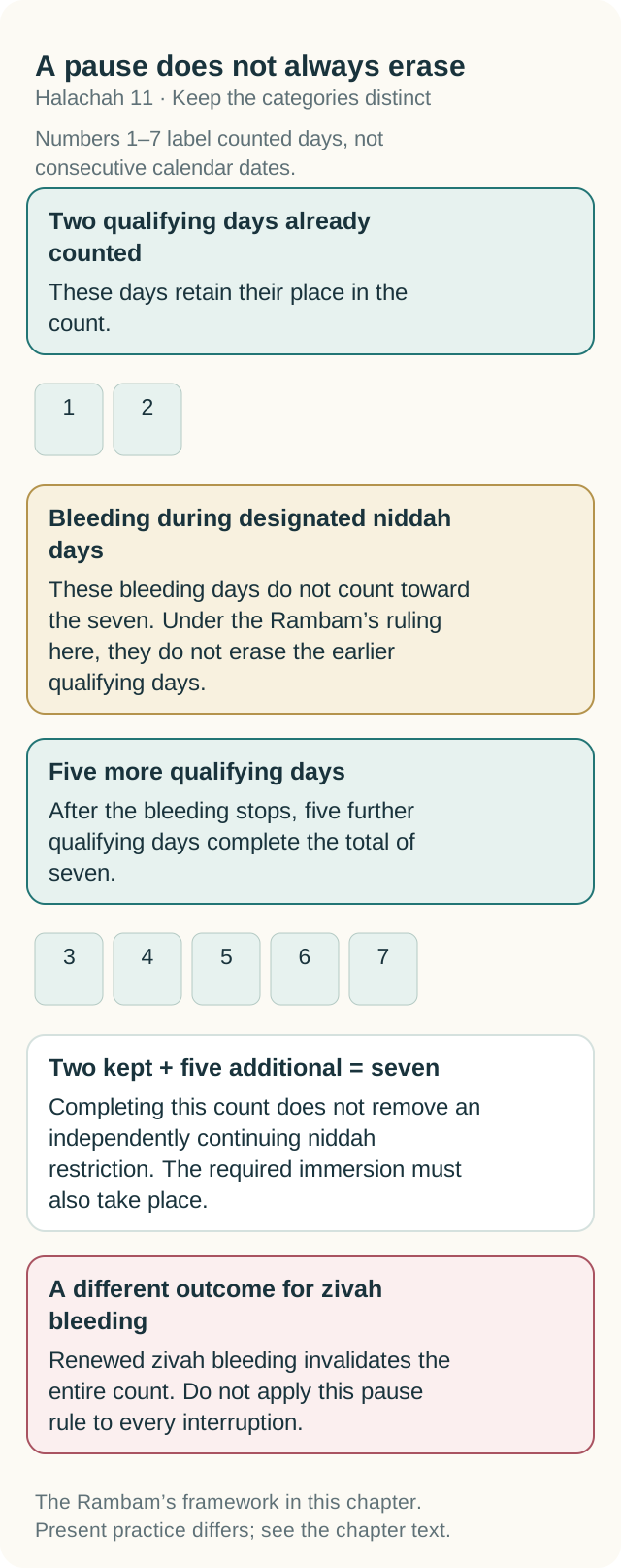
the days on which she bled do not count,
,
but they do not invalidate all the previously counted days.
,
Rather, she adds the remaining days to those already counted
;
when the bleeding stops.
,
For only a sighting of blood invalidates the entire count;
.
these invalidate only their own days.
According to the ’s reckoning, a woman can enter the designated days of before completing purification from an earlier obligation. Bleeding during those days, or during the childbirth period, prevents the affected days from counting. It does not erase the qualifying days already accumulated.
The distinction is between pausing and restarting. These days pause the count; renewed bleeding cancels the earlier count and requires a new one.
Consequently, according to the , the seven qualifying days in this situation need not be consecutive. This belongs to the original framework being studied here. It does not describe the accepted present practice of requiring seven consecutive clean days after qualifying bleeding.
Synopsis
Days without bleeding during childbirth or impurity can count toward purification from . Bleeding during those periods pauses the count without erasing earlier qualifying days; renewed bleeding invalidates the entire count.
Picture the CaseA concrete example + illustration
Keep the days already counted
has counted two qualifying clean days toward purification from . She then experiences bleeding during her designated days of . She marks those bleeding days separately on her calendar. Under the ’s ruling here, they do not count, but her earlier two days remain. Once the bleeding stops, she can add five more qualifying days to complete the count. Completing that count does not remove any independently continuing restriction.
Halachah 11 distinguishes the categories of bleeding, rather than declaring every interruption harmless. The count shown follows the ’s original framework here; present practice requires consecutive clean days after qualifying bleeding.Open full-size illustration
🔎Dig DeeperWhen Bleeding Pauses the Count Without Erasing It
When Bleeding Pauses the Count Without Erasing It
The distinguishes between two effects: a day may fail to count, or it may cancel the days already counted.
Within his framework, bleeding during the designated days of or during childbirth impurity prevents those days from joining the count, but preserves earlier qualifying days. Renewed bleeding, by contrast, cancels the earlier count.
This ruling reflects two connected features of the Rambam’s approach: the designated period can arrive before an earlier obligation has been resolved, and the qualifying days in this particular situation can be accumulated across the intervening interruption.
The notes that the and other authorities disagree with this approach.
For present practice, this passage does not authorize combining clean days separated by disqualifying uterine bleeding. The accepted practice requires seven consecutive clean days.
Certain bleeding interrupts the clean-day count without erasing the qualifying days already counted. The woman still needs to complete the required process, but the earlier days retain their place in it.
We sometimes treat an interruption in our learning as though everything before it has disappeared. You learned consistently for several days, missed an evening, and now feel reluctant to reopen the . Those earlier minutes of still matter. The next step is to return to today’s learning. When something needs correcting, address it while remembering the good you have already accomplished.
Try today
Resume one interrupted learning commitment with a small, definite session.
Suggested reflection on 7:11.
Related teaching: , Chapter 25, explains that the union with created through and is eternal Above. This supports valuing the good already accomplished while continuing our present .Likutei Amarim
Once you understand all these principles that we have explained,
:
you will understand the Sages’ statement:
A woman can experience uterine bleeding
,
day after day for one hundred fourteen days,
.
without becoming a .
“” here means a major , whose status requires three consecutive qualifying days of bleeding. The statement does not mean that she remains ritually pure or permitted to her husband throughout this time. impurity, minor- status, and childbirth impurity can apply without major being established.
?,
How is this possible? Two days before her period,
,
followed by her seven days of ,
,
then two days after her days of ,
,
then fourteen days of labor-related bleeding,
,
then the eighty-day period following a girl’s birth,
,
then seven days of ,
.
and then two days after the days of .
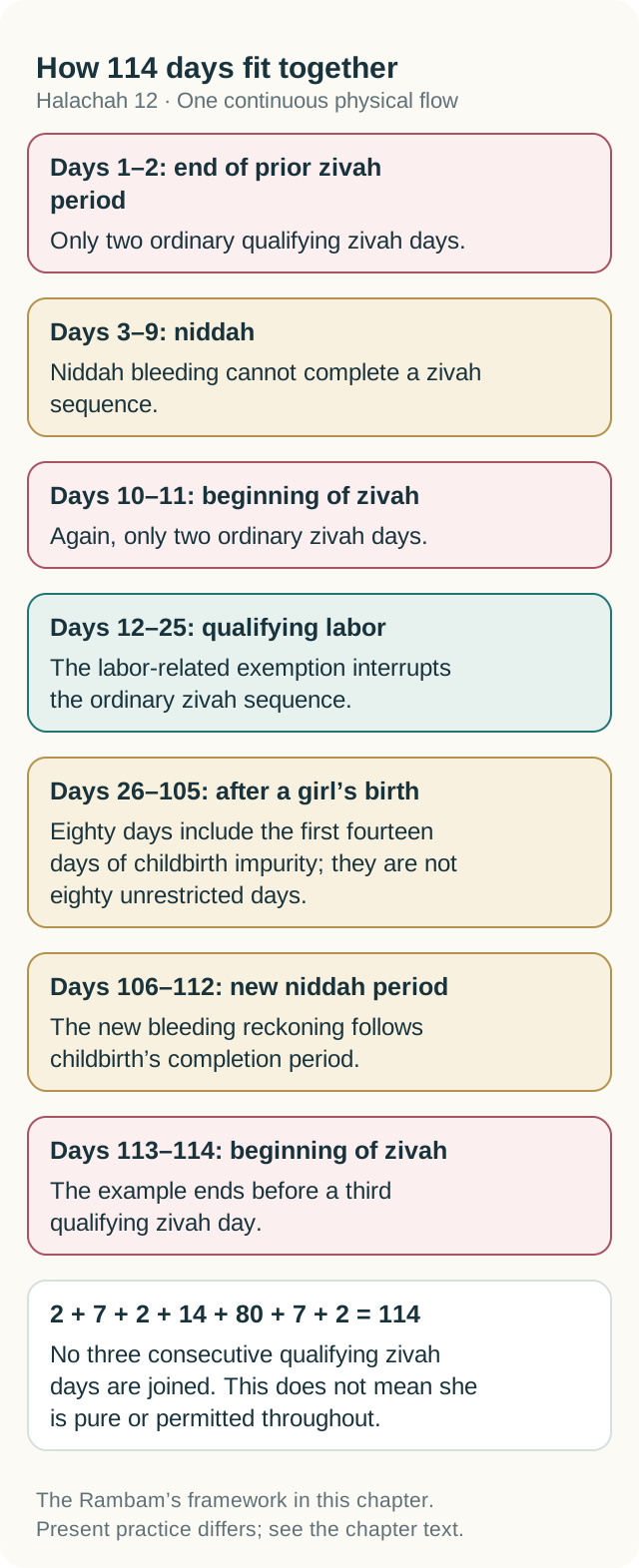
The opening two days are the tenth and eleventh days of the preceding period. The complete sequence is:
Stage
Days
Why major is not established
Final two days of the preceding period
2
Only two qualifying days occur before begins.
period
7
bleeding does not complete a sequence.
Beginning of the next period
2
There are only two ordinary days before the labor-related bleeding.
Qualifying labor-related bleeding
14
This bleeding receives the labor-related exemption.
Period following a girl’s birth
80
These days belong to the childbirth framework rather than an ordinary sequence.
New period
7
The bleeding is classified as blood.
Beginning of the following period
2
The sequence ends before a third qualifying day.
Total
114
No three consecutive qualifying days occur.
The fourteen labor-related days must satisfy the conditions explained earlier. The eighty days following birth include the initial fourteen days of childbirth impurity; they are not eighty days of unrestricted purity.
Although the physical bleeding continues, its changing classifications prevent the separate pairs of days from combining into three consecutive qualifying days.
,
You thus learn that any blood a woman first experiences
-,
after the completion period marks the beginning of her period,
.
and her earlier established times are disregarded.
After the postpartum completion period ends, the first subsequent bleeding begins a new reckoning. The calculation does not simply resume the timetable that existed before childbirth.
,
Therefore, a woman who experiences bleeding at the end of the completion period
,;
during twilight has an uncertain status,
,
because she may have experienced the bleeding at night,
.
which would begin her days of .
, twilight between sunset and nightfall, may belong to the preceding day or the following night. Here the uncertainty determines whether the bleeding occurred within the final postpartum day or after the period ended.
If it occurred afterward, it begins . Because the timing cannot be determined, her status is doubtful.
Synopsis
Continuous bleeding can extend for 114 days without establishing major when its changing classifications prevent three consecutive qualifying days. After the postpartum completion period, the first bleeding begins a new reckoning; bleeding at the twilight boundary creates uncertainty.
Picture the CaseA concrete example + illustration
One flow, several classifications
Imagine marking every day on a long calendar because bleeding continues throughout. Beneath the marks, separate the days into the seven blocks described by the . The physical flow is continuous, but the ordinary days never form a qualifying three-day sequence. The absence of major does not make all these days permitted.
Halachah 12: numbered ranges are positions in this example, not calendar dates. All labor and childbirth conditions in the text apply. The eighty-day block includes childbirth impurity.Open full-size illustration
✦Live ItLook beyond what you can see
Look beyond what you can see
The same physical bleeding can receive different classifications depending on its timing and circumstances. Counting the visible bleeding alone does not tell us the woman’s status; the relevant distinctions must be understood.
We also see only part of another person’s circumstances. Someone arrives late to a , and we quickly assume that learning is unimportant to him. We may know nothing about the responsibilities or difficulties that preceded his arrival. asks us to leave room for what we do not know. We can take seriously while speaking and thinking about another Jew with greater humility.
Try today
When an unfavorable judgment arises, identify one relevant fact you may not know.
Suggested reflection on 7:12.
Related teaching: , Chapter 30, develops the instruction to consider another person’s “place,” including the circumstances and inner challenges that differ from our own. Likutei Amarim
We have already explained that a who experienced bleeding throughout all seven days—
.
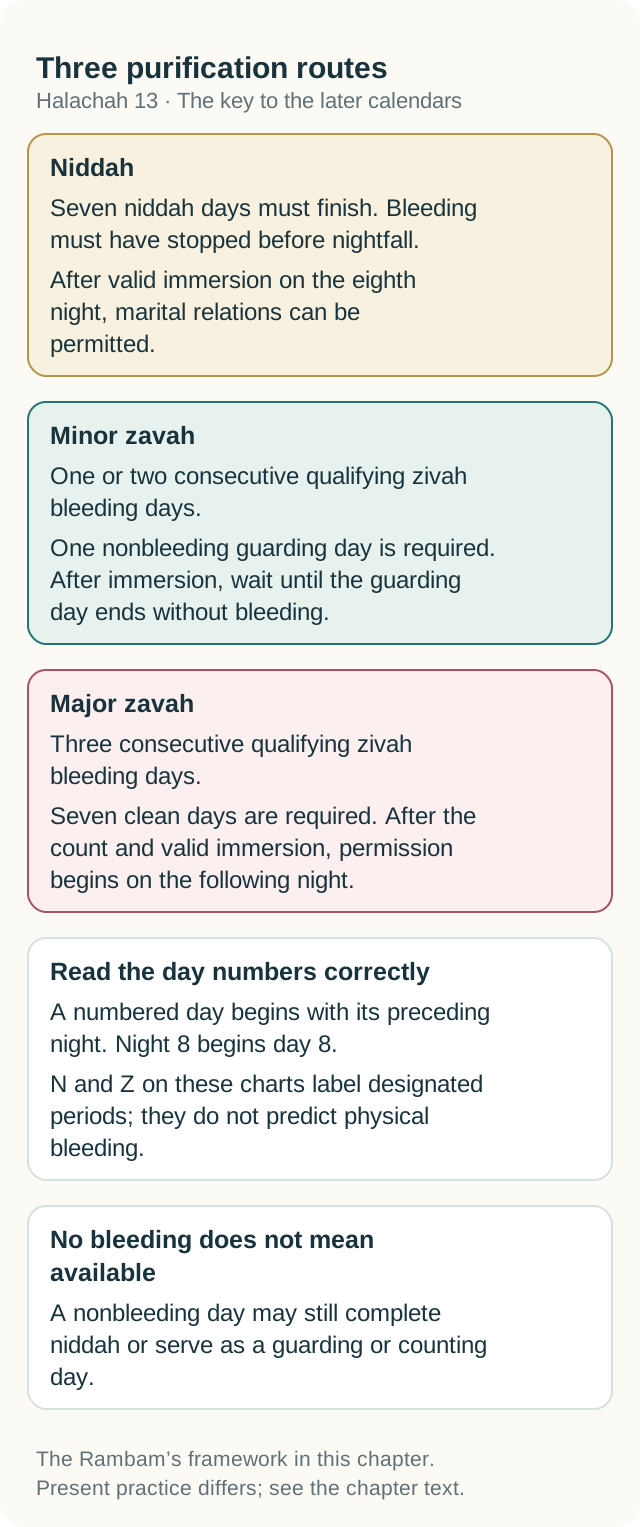
may have marital relations on the eighth night after immersing.
This assumes that the bleeding stops before nightfall. Under the original framework, bleeding during the seven days does not itself require seven additional clean days. Once the period ends and she immerses, she can become permitted.
-
A observes one pure day
,.
and immerses, and may have marital relations that evening.
A experienced bleeding on one or two consecutive days of . One clean guarding day is sufficient after either sequence. Although she may immerse during that day as explained in Chapter 6, she must wait until evening before marital relations, allowing the guarding day to finish without further bleeding.
“Minor” describes the classification, not her age.
-
A major counts seven clean days
,.
and immerses, and may have marital relations on the eighth night.
A major experienced three consecutive qualifying days of bleeding. She therefore requires the longer clean-day count. The eighth night here is the night following the seventh clean day.
Between one period and the next there are
;
only eleven days,
.
and during those eleven days she can become either a minor or a major .
These are the eleven designated days of . Bleeding on one or two consecutive days establishes minor ; three consecutive qualifying days establish major .
These distinctions explain the calculations that follow. They describe the ’s original framework rather than the accepted present practice of seven clean days after qualifying bleeding.
How to read the calculations: In the following calculations, day one is the initial bleeding day that begins the reckoning. Each numbered day begins with its preceding night: “the eighth night” begins day eight. The day numbers continue through the calculation rather than restarting whenever bleeding resumes. In Halachah 20, week one means days one–seven.
Synopsis
In the original framework, a requires completion of her seven-day period and immersion; a requires one clean guarding day and immersion; a major requires seven clean days and immersion. The eleven days between periods are the designated days of .
Picture the CaseA concrete example + illustration
Three calendars, three requirements
Before reading the recurring patterns, identify what the previous bleeding established. A completed period, two qualifying bleeding days, and three qualifying bleeding days lead to different requirements. The chart shows why the same blank calendar square can be available in one case and still needed for purification in another.
Halachah 13 summarizes the original routes used by the calculations. “Minor” and “major” describe classifications, not age. Present practice differs as explained in the chapter.Open full-size illustration
Alternating One Bleeding Day and One Day Without Bleeding
,
Once you keep all these principles in mind,
:
you will understand this statement of the Sages:
A woman whose established lifelong pattern is that
-
she experiences bleeding one day and none the next—
,
may initially have marital relations on the eighth night and eighth day,
.
which is the first day after her days of .
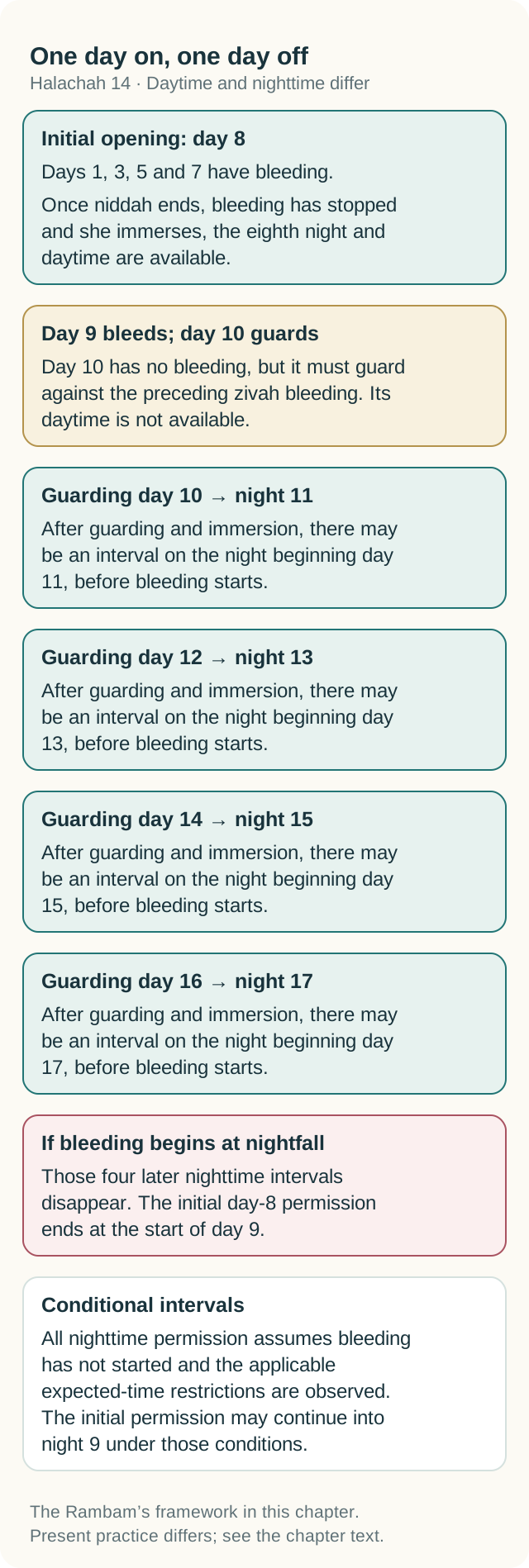
Numbering begins with a bleeding day. She bleeds on days one, three, five, and seven, and has no bleeding on days two, four, six, and eight.
The first seven days belong to her period. Although she bleeds on the seventh day, she can immerse after that period ends, provided the bleeding has stopped. Day eight is free of bleeding and has not been preceded by a bleeding day requiring a guarding day.
The initial permission includes the eighth night and eighth day after immersion. It can also continue into the night beginning day nine until the next bleeding begins, subject to the applicable restrictions concerning its expected time.
During each eighteen-day cycle, she may have marital relations
,
on only four nights,
,
and she cannot have marital relations during the days,
.
because the pure day serves as a guarding day for the impure day.
After the initial permission described above, each bleeding day during requires the following nonbleeding day to serve as a guarding day. Day ten guards against the bleeding of day nine; day twelve guards against day eleven; and so forth.
After she has immersed and the guarding day is complete, there can be a permitted nighttime interval before the next bleeding begins. The four later nights are:
Completed guarding day
Following nighttime interval
Day 10
Night beginning day 11
Day 12
Night beginning day 13
Day 14
Night beginning day 15
Day 16
Night beginning day 17
These intervals depend on bleeding not having begun and on the applicable restrictions concerning its expected time. The guarding days themselves are unavailable for marital relations.
Therefore, if on every bleeding day she experiences blood
-
from the beginning of the night—
,
she may have marital relations only on the eighth,
.
which is the first day after her period.
A day begins at night. If the next bleeding begins as soon as that night starts, no permitted interval remains after the guarding day. The four later nighttime opportunities disappear. Likewise, bleeding at the beginning of the ninth night ends the initial permission when day eight concludes.
Synopsis
With alternating bleeding and nonbleeding days, day eight is initially available after immersion. Later nonbleeding days serve as guarding days, permitting only limited nighttime intervals afterward. If every new bleeding day begins with bleeding at nightfall, those later intervals disappear.
Picture the CaseA concrete example + illustration
A blank daytime square can still be unavailable
On an alternating calendar, day ten has no bleeding, yet it must be a guarding day after the bleeding of day nine. Only after that day is completed and the required immersion has taken place can a nighttime interval be considered. If the next bleeding begins immediately at nightfall, that interval disappears.
Halachah 14: these are conditional nighttime intervals, not whole permitted bleeding days. If bleeding starts at nightfall, no such later interval remains. Required immersion and expected-time restrictions apply.Open full-size illustration
Alternating Two Bleeding Days and Two Days Without Bleeding
If her pattern is two days of bleeding
-
followed by two days without bleeding—
,,
she may have marital relations on the eighth and twelfth,
,.
and on the sixteenth and twentieth days.
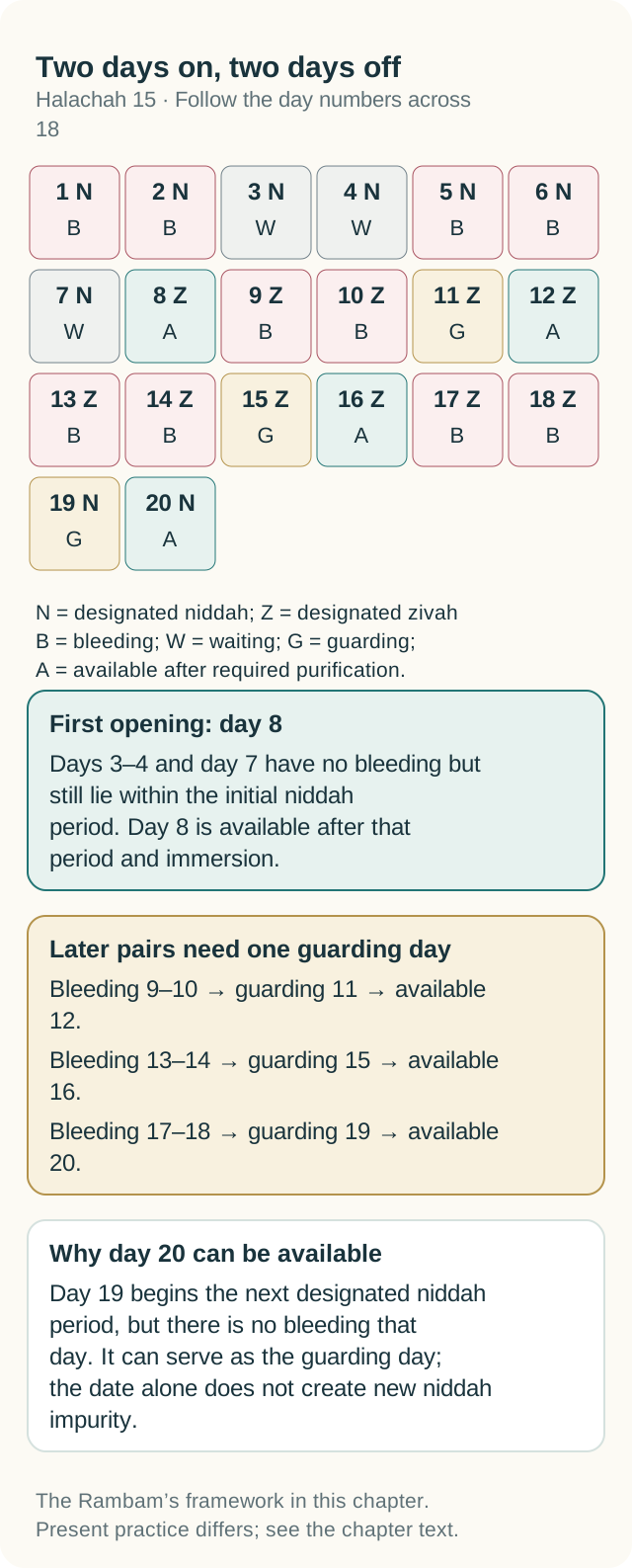
Her pattern is bleeding on days one–two, no bleeding on days three–four, bleeding on days five–six, and no bleeding on days seven–eight, continuing in that manner.
Days three and four remain within the initial period, and day seven is its final day. Their absence of bleeding does not end that period early. The first available day after completing it and immersing is day eight.
The later pairs of bleeding days fall within the designated days of . Two consecutive bleeding days establish minor , requiring one clean guarding day. The first nonbleeding day serves that purpose; after its completion and the required immersion, the following day is available.
Bleeding days
Required guarding day
Following permitted day
Days 9–10
Day 11
Day 12
Days 13–14
Day 15
Day 16
Days 17–18
Day 19
Day 20
Day nineteen belongs to the next designated period, but she does not bleed on it. Merely reaching the designated days of does not itself create new impurity. Day nineteen can therefore serve as the required guarding day, allowing day twenty after the necessary immersion.
Mentioning day twenty shows how the calculation continues across the boundary between the first eighteen-day reckoning and the next.
Synopsis
With two bleeding days followed by two nonbleeding days, day eight is initially available after immersion. Later, the first nonbleeding day serves as the guarding day, leaving the twelfth, sixteenth, and twentieth days available after the required immersion.
Picture the CaseA concrete example + illustration
The first blank day is used for guarding
A calendar repeatedly shows two bleeding days and two days without bleeding. After the initial period, the next pairs establish minor . The first blank day is used for guarding, leaving the next day available after the required purification. The same calculation continues across day eighteen into days nineteen and twenty.
Halachah 15: A marks available numbered days after the required purification; it is not a separate calculation of every intervening nighttime interval. N/Z label designated periods.Open full-size illustration
Three Bleeding Days Followed by Three Days Without Bleeding
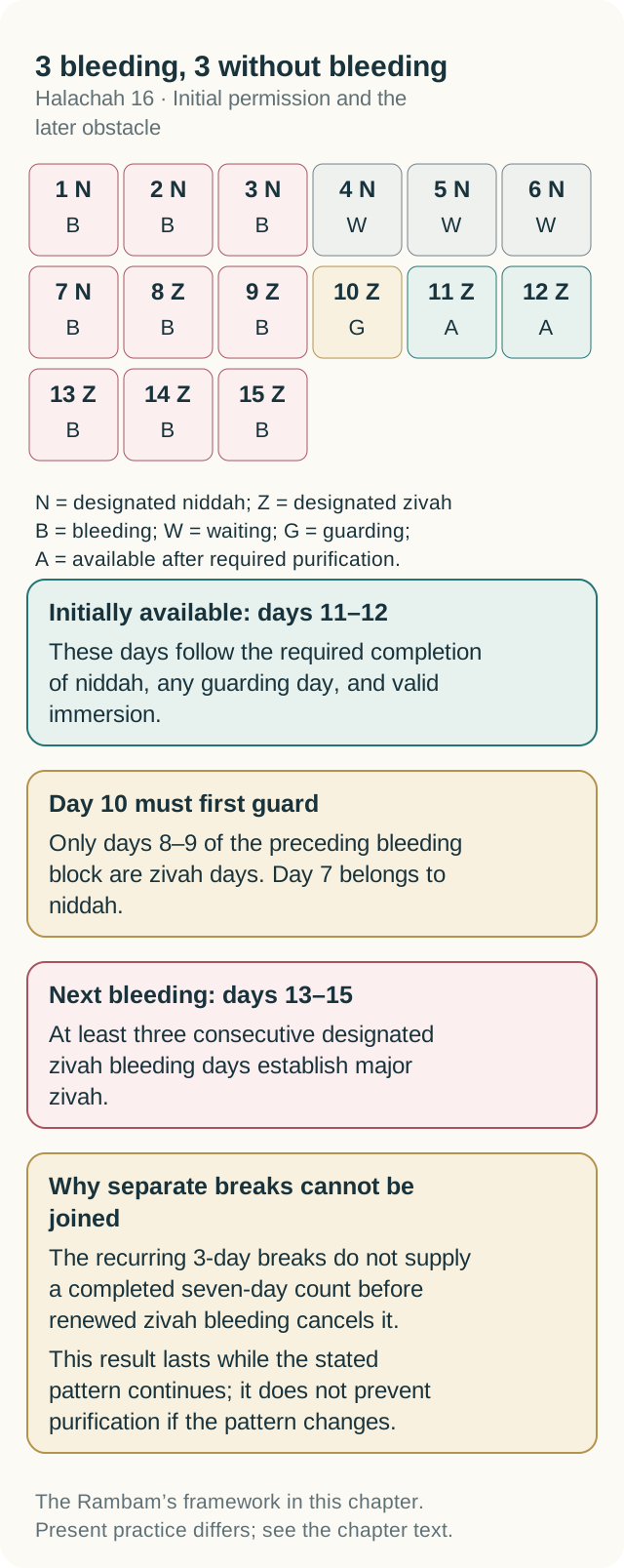
If her pattern is three days of bleeding
-
followed by three days without bleeding—
she may have marital relations on two of the three nonbleeding days
,
following her days of ,
because one of them serves as a guarding day for the two bleeding days
.
immediately following her period.
Numbering begins with the first bleeding day. She bleeds on days one–three, has no bleeding on days four–six, and bleeds again on days seven–nine.
Day seven remains within the initial period. Days eight and nine are days, so their bleeding establishes minor . Of the following nonbleeding days, day ten must serve as the guarding day. After its completion and the required immersion, days eleven and twelve are available.
-
Afterward, she may no longer have marital relations,
,
because she becomes established as a major ,
.
and she does not have seven clean days.
The next bleeding occurs on days thirteen–fifteen, all within the designated days of . These three consecutive days establish major .
Her recurring three-day breaks do not allow her to complete the required count before renewed bleeding invalidates it. She cannot simply combine days from separate breaks: bleeding erases the accumulated count, rather than merely pausing it as described for certain other bleeding in Halachah 11.
“No longer” describes the result while this established pattern continues. It does not mean that purification would remain impossible if the bleeding pattern changed.
Synopsis
With three bleeding days followed by three nonbleeding days, days eleven and twelve are initially available after a guarding day and immersion. The next bleeding establishes major , and the continuing pattern prevents completion of the required clean-day count.
Picture the CaseA concrete example + illustration
A short break is not always enough
The calendar alternates 3 bleeding days and 3 days without bleeding. Initially, days 11–12 are available after the required purification. The later bleeding block on days 13–15 establishes major . While this pattern continues, separate short breaks cannot simply be combined, because renewed bleeding cancels the accumulated count.
Halachah 16: day 1 begins the initial period. The chart illustrates the initial sequence; later renewed bleeding prevents completion of purification while this pattern persists.Open full-size illustration
Four Bleeding Days Followed by Four Days Without Bleeding
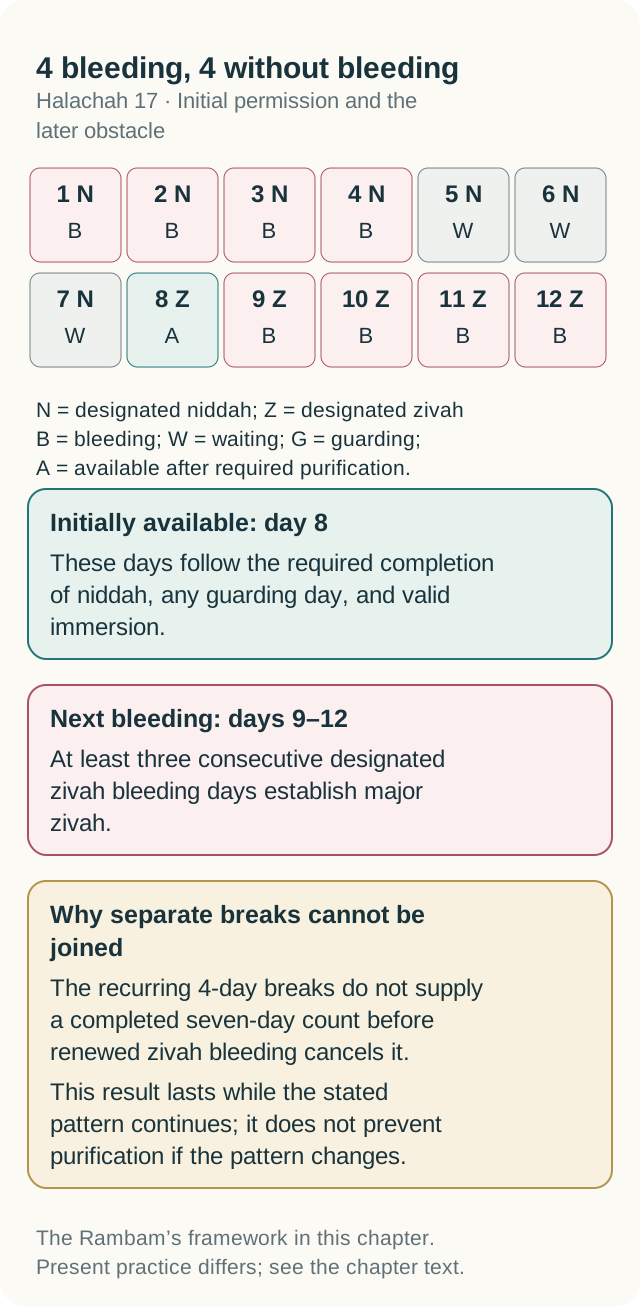
If her pattern is four days of bleeding
-
followed by four days without bleeding—
,
she may have marital relations on one day following her period,
.
and afterward she may no longer have marital relations.
She bleeds on days one–four and has no bleeding on days five–eight. Days five–seven remain within the initial period, so their absence of bleeding does not permit her early. After that period ends and she immerses, day eight is available.
The next bleeding occurs on days nine–twelve, within the days of , establishing major . Thereafter, the recurring four-day breaks do not allow her to complete seven clean days before renewed bleeding invalidates the count.
The continuing prohibition depends on this pattern continuing.
Synopsis
With four bleeding days followed by four nonbleeding days, only day eight is initially available after immersion. Subsequent bleeding establishes major , and the recurring four-day breaks prevent completion of the required count.
Picture the CaseA concrete example + illustration
A short break is not always enough
The calendar alternates 4 bleeding days and 4 days without bleeding. Initially, days 8 are available after the required purification. The later bleeding block on days 9–12 establishes major . While this pattern continues, separate short breaks cannot simply be combined, because renewed bleeding cancels the accumulated count.
Halachah 17: day 1 begins the initial period. The chart illustrates the initial sequence; later renewed bleeding prevents completion of purification while this pattern persists.Open full-size illustration
Five Bleeding Days Followed by Five Days Without Bleeding
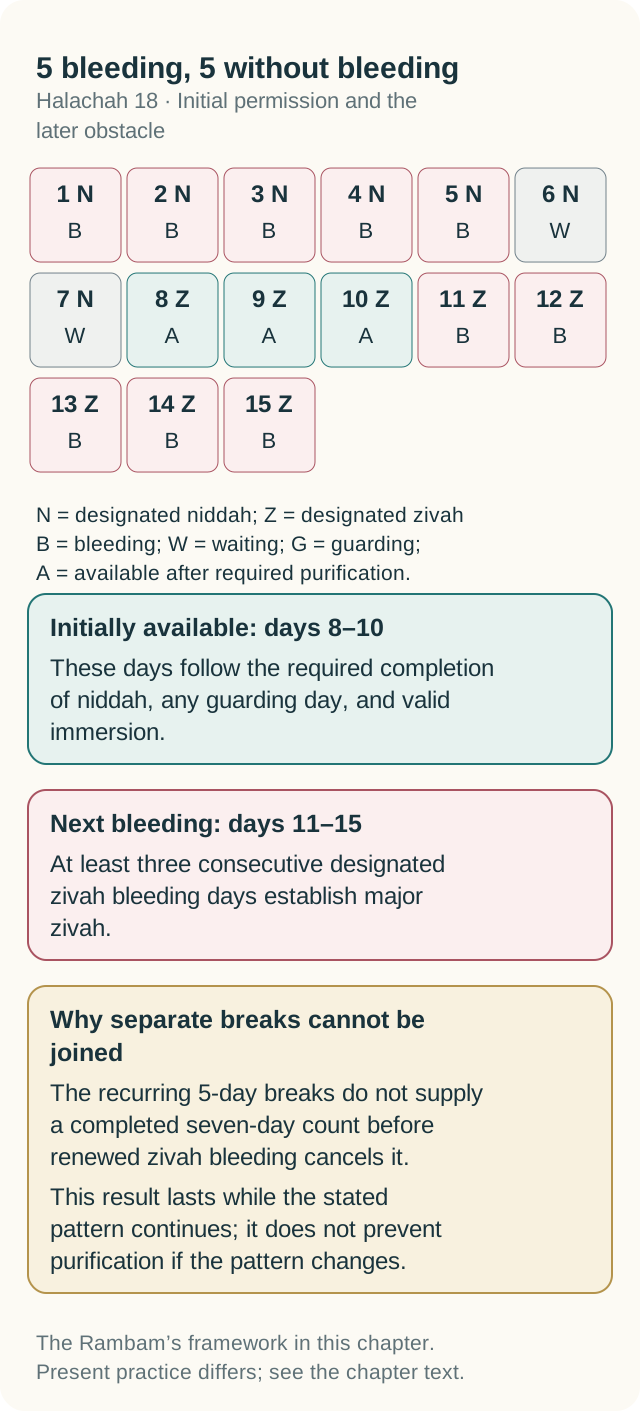
If her pattern is five days of bleeding
-
followed by five days without bleeding—
,
she may have marital relations on the three days immediately following her period,
.
and afterward she may no longer have marital relations.
She bleeds on days one–five and has no bleeding on days six–ten. Days six and seven remain within the initial period. After that period ends and she immerses, days eight, nine, and ten are available.
The next bleeding occurs on days eleven–fifteen, within the designated days of , establishing major . The recurring five-day breaks do not allow completion of seven clean days before renewed bleeding invalidates the count. She therefore remains forbidden while this pattern continues.
Synopsis
With five bleeding days followed by five nonbleeding days, days eight–ten are initially available after immersion. Subsequent bleeding establishes major , and the recurring five-day breaks prevent completion of the required count.
Picture the CaseA concrete example + illustration
A short break is not always enough
The calendar alternates 5 bleeding days and 5 days without bleeding. Initially, days 8–10 are available after the required purification. The later bleeding block on days 11–15 establishes major . While this pattern continues, separate short breaks cannot simply be combined, because renewed bleeding cancels the accumulated count.
Halachah 18: day 1 begins the initial period. The chart illustrates the initial sequence; later renewed bleeding prevents completion of purification while this pattern persists.Open full-size illustration
Six Bleeding Days Followed by Six Days Without Bleeding
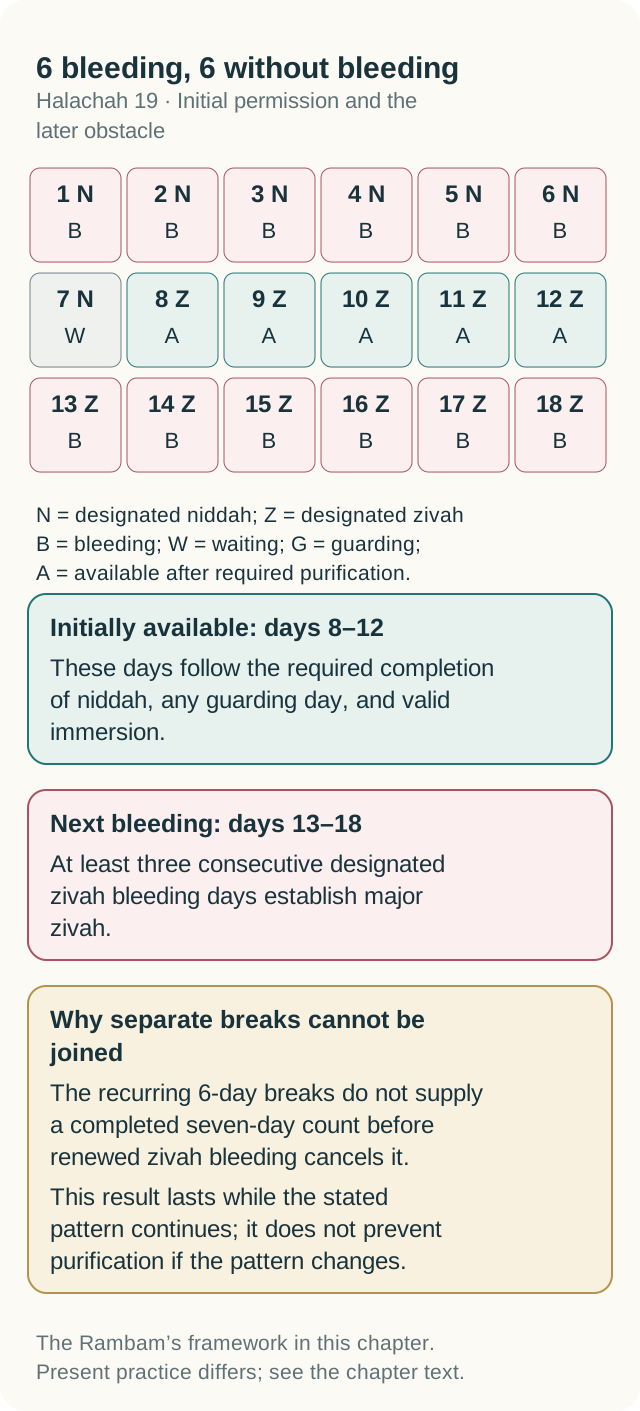
If her pattern is six days of bleeding
-
followed by six days without bleeding—
,
she may initially have marital relations on the five days immediately following her period,
.
and afterward she may no longer have marital relations.
She bleeds on days one–six and has no bleeding on days seven–twelve. Day seven still belongs to the initial period. After that period ends and she immerses, days eight–twelve are available.
Her next bleeding occurs on days thirteen–eighteen, within the days of , establishing major . Even a six-day break falls short of the required seven clean days.
The difficulty is not merely that each individual break is too short. Renewed bleeding invalidates the accumulated count, so she cannot combine qualifying days from separate breaks to complete purification. She remains forbidden for as long as this established pattern continues.
The initial available days in these four are:
Bleeding pattern
Initially available days after the required purification
Three bleeding, three nonbleeding
Days 11–12, after guarding day 10
Four bleeding, four nonbleeding
Day 8
Five bleeding, five nonbleeding
Days 8–10
Six bleeding, six nonbleeding
Days 8–12
The different results arise from where each physical bleeding pattern falls within the designated and periods.
Synopsis
With six bleeding days followed by six nonbleeding days, days eight–twelve are initially available after immersion. Once major is established, the continuing pattern prevents completion of seven clean days; renewed bleeding erases the accumulated count.
Picture the CaseA concrete example + illustration
A short break is not always enough
The calendar alternates 6 bleeding days and 6 days without bleeding. Initially, days 8–12 are available after the required purification. The later bleeding block on days 13–18 establishes major . While this pattern continues, separate short breaks cannot simply be combined, because renewed bleeding cancels the accumulated count.
Halachah 19: day 1 begins the initial period. The chart illustrates the initial sequence; later renewed bleeding prevents completion of purification while this pattern persists.Open full-size illustration
Seven Bleeding Days Followed by Seven Days Without Bleeding
If her pattern is seven days of bleeding
-
followed by seven days without bleeding—
,
she may have marital relations during the first nonbleeding week immediately following her period.
,
A bleeding week follows it,
,
during which she becomes established as a ,
,
and the nonbleeding week that follows is used for counting,
.
and she is forbidden to have marital relations during it.
,
Thus, during four weeks she has marital relations
.
during only one week.
The first bleeding week is her initial period. After it ends and she immerses, the second week is available.
The third week covers days fifteen–twenty-one. Its first four days fall within the designated days of , so the bleeding establishes major . The fourth week must therefore supply her seven clean days. Although she is no longer bleeding, she is not permitted during that count.
A nonbleeding week is therefore not automatically a permitted week. Its use depends on the preceding bleeding: after it can be available following immersion; after major it must first supply seven clean days.
Unlike the shorter patterns in the preceding , this pattern provides a full seven-day break. She can complete the count, but the next bleeding week follows immediately.
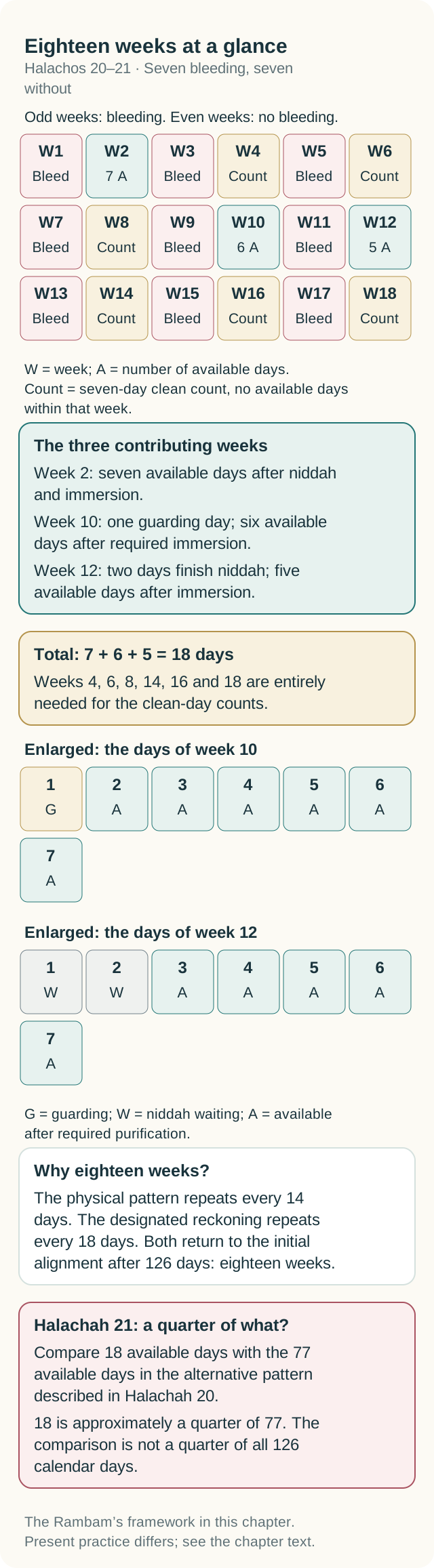
,
Throughout the continuation of this pattern, she may have marital relations on eighteen days
.
in every eighteen weeks.
Two different patterns operate together: her physical pattern repeats every fourteen days, while the designated – reckoning repeats every eighteen days. They return to the same starting alignment after 126 days—eighteen weeks.
The following calculation identifies the eighteen available days within that period.
?,.
How is this calculated? During the fifth week, she is a .
,.
The sixth week, during which she has no bleeding, is for counting.
,.
During the seventh week, she is a .
,.
The eighth week is for counting.
Each of these bleeding weeks establishes major . The following nonbleeding week is consequently needed for the clean-day count, leaving no available days within it.
,,
During the ninth week, when she experiences bleeding,
,
five of its days belong to the days of ,
;
and two belong to the beginning of the days of .
,
She observes one guarding day from the tenth, nonbleeding week,
.
and may have marital relations on six days.
The ninth week contains only two bleeding days. These establish minor rather than major . The first day of the tenth week serves as the guarding day; after its completion and the required immersion, the remaining six days are available.
,,
During the eleventh week, when she experiences bleeding,
,
two days belong to the end of her days of ,
;
and five belong to the beginning of her days of .
.
She may have marital relations on five days of the twelfth, nonbleeding week.
The two bleeding days do not establish major . However, the five subsequent bleeding days begin a new period.
The first two days of the twelfth week complete that seven-day period. The first of them also supplies the required guarding day for the preceding minor . After the period ends and she immerses, the remaining five days are available.
,,
During the thirteenth week, she is a ,
,.
and the fourteenth week is for counting.
,,
Likewise, during the fifteenth week, she is a ,
,,
and the sixteenth week is for counting;
,,
during the seventeenth week, she is a ,
,.
and the eighteenth week is for counting.
.
She continues reckoning in this manner for as long as the pattern continues.
These later bleeding weeks again establish major , requiring the following nonbleeding weeks for counting. The available days over the complete eighteen-week pattern are:
Nonbleeding week
Its use
Available days after the required purification
Week 2
Follows the completed initial period
7
Weeks 4, 6, and 8
Seven-clean-day counts
0
Week 10
One guarding day, then permission
6
Week 12
Two days completing , then permission
5
Weeks 14, 16, and 18
Seven-clean-day counts
0
Total
18
:,
It follows that in every eighteen weeks,
.
she may have marital relations on eighteen days.
,
Had this condition not occurred,
-
and she instead had a week of followed by eleven pure days—
,
she could have marital relations during those eighteen weeks
,.
for eleven weeks’ worth of days, totaling seventy-seven days.
The comparison is with the stated hypothetical pattern of seven days followed by eleven pure days. Eighteen weeks contain 126 days, enough for seven complete eighteen-day cycles. Eleven available days in each cycle give seventy-seven days.
“Eleven weeks” expresses the total number of days; it does not mean eleven consecutive permitted weeks.
Synopsis
With seven bleeding days followed by seven nonbleeding days, some nonbleeding weeks are required entirely for purification. Across the repeating eighteen-week calculation, eighteen days are available after the required purification: seven in week two, six in week ten, and five in week twelve.
Picture the CaseA concrete example + illustration
Three weeks contribute the available days
In an eighteen-week calendar, color every odd week for bleeding. The even weeks are all free of bleeding, but their uses differ. Week two provides seven available days; week ten provides six after its guarding day; week twelve provides five after ends. The other nonbleeding weeks are used entirely for seven-day counts. The total is eighteen available days, compared with seventy-seven in the alternative calculation.
20–21: week 1 means days 1–7. Every odd week has bleeding. The chart lists every even week; A assumes the required purification. The comparison to seventy-seven uses the separate hypothetical pattern in the text.Open full-size illustration
✦Live ItGive preparation its proper place
Give preparation its proper place
In the alternating-week calculation, a week without bleeding may be needed entirely for the clean-day count. Although permission has not yet arrived, those days fulfill a necessary requirement in the process of purification.
Preparation for a also deserves our attention. Before opening the , taking a brief moment to remember before Whom we are about to stand can change how we begin. We may be tempted to rush past that moment because we want to started. teaches us to prepare our minds and hearts for serving , then carry that awareness into the itself.
Try today
Before your next tefillah, pause briefly and think: “I am about to speak to Hashem.”
Suggested reflection on 7:20.
Related teaching: , Chapter 41, calls for contemplation before and , according to one’s capacity and available time, to awaken awareness of standing before .Likutei Amarim
“She may have marital relations for a quarter of her days.”
The comparison is with the seventy-seven available days described at the end of Halachah 20—not with all 126 calendar days in eighteen weeks.
Under the alternating-week pattern, eighteen days are available. In the comparison case of seven days followed by eleven pure days, seventy-seven days would be available over the same period.
A quarter of seventy-seven is nineteen and a quarter. Eighteen is therefore approximately, rather than exactly, a quarter of that number.
Synopsis
The eighteen available days under the alternating-week pattern are approximately a quarter of the seventy-seven days available in the comparison case. The fraction does not refer to all the calendar days.
🔎Dig DeeperWhat “A Quarter of Her Days” Means
What “A Quarter of Her Days” Means
The expression “approximately a quarter of her days” raises a question: what is being compared?
The reference is to the seventy-seven available days in the comparison at the end of Halachah 20, rather than to all 126 calendar days in eighteen weeks.
In the alternating-week calculation, eighteen days are available. One quarter of seventy-seven is nineteen and a quarter, so eighteen is approximately a quarter of that comparison figure.
The connects the difficulty in obtaining an exact calculation to the ’s understanding of the designated and periods. He explains that the ’s different understanding allows the ’s wording to be read as an exact calculation.
This is a useful reminder when learning numerical passages: identifying the quantity being compared is as important as doing the arithmetic.
Eight Bleeding Days Followed by Eight Days Without Bleeding
If her pattern is eight days of bleeding
-
followed by eight days without bleeding—
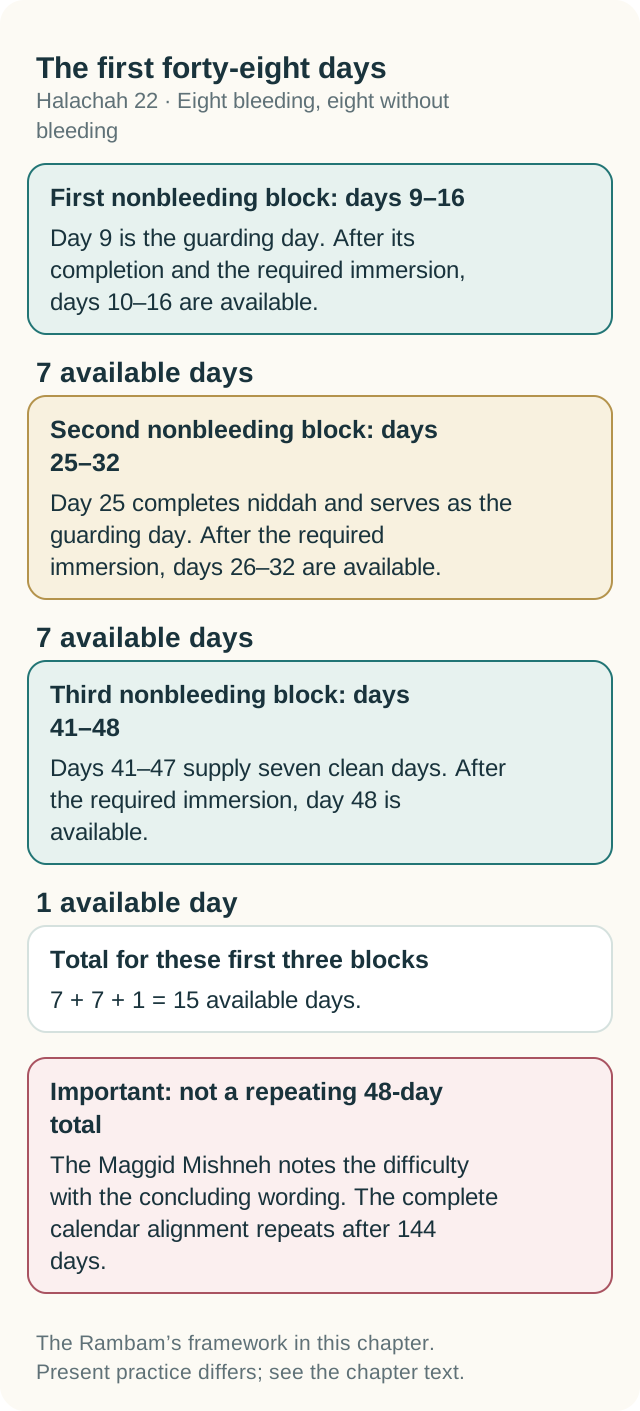
she may have marital relations on fifteen days
.
out of forty-eight days.
The following calculation examines three sixteen-day blocks, each consisting of eight bleeding days and eight nonbleeding days.
The notes that the fifteen-day result below describes the first forty-eight days. The full calendar alignment repeats after 144 days; the difficulty with the concluding wording is explained below.
?,
How is this calculated? Of the initial eight bleeding days,
,
seven are her days of ,
;
and one is a day immediately following her period.
,
She observes one guarding day for it from the eight nonbleeding days,
.
and may have marital relations on seven days.
Days one–seven are days. Bleeding on day eight establishes minor , requiring one clean guarding day.
Day nine supplies that guarding day. After its completion and the required immersion, days ten–sixteen are available.
,
Then come another eight bleeding days,
,
of which two complete her days of ,
.
and six belong to her days of .
,
Then come eight nonbleeding days,
,
the first of which completes her days of ,
.
and she may have marital relations on another seven days.
The second bleeding block is days seventeen–twenty-four. Days seventeen and eighteen are the final two days; days nineteen–twenty-four are the first six days of the next period.
Day twenty-five, although free of bleeding, is still the seventh day. It also serves as the clean guarding day required because of the earlier two bleeding days. After the period ends and she immerses, days twenty-six–thirty-two are available.
,
Then come another eight bleeding days,
,
of which four complete her days of ,
,
and four belong to her days of .
,
She consequently becomes a major
.
and requires a seven-day count.
,
Then come eight nonbleeding days;
,
she counts seven of them
.
and may have marital relations on one day.
The third bleeding block is days thirty-three–forty. Its first four days are days, establishing major . The next four belong to .
She counts days forty-one–forty-seven as her seven clean days. The remaining days within that interval do not prevent counting, because she experiences no bleeding on them, as explained in Halachah 11. After completing the count and immersing, day forty-eight is available.
,
Thus, she may have marital relations on fifteen days
.
in every forty-eight days.
The calculation presented is:
Nonbleeding block
Required preparation
Available days
Days 9–16
Guarding day 9 and immersion
7
Days 25–32
Completion of on day 25, which also serves as the guarding day, followed by immersion
7
Days 41–48
Seven clean days and immersion
1
Total in the first forty-eight days
15
The notes a difficulty with the concluding wording “in every forty-eight days”: under the ’s calendar reckoning, this calculation applies to the first forty-eight days, while the complete pattern repeats only after 144 days.
Synopsis
In the first forty-eight days of an eight-bleeding/eight-nonbleeding pattern, the three nonbleeding blocks provide seven, seven, and one available days after the required purification—a total of fifteen. The identifies a difficulty with the concluding wording because the full alignment repeats only after 144 days.
Picture the CaseA concrete example + illustration
Three blocks in the first forty-eight days
A calendar shows eight bleeding days followed by eight days without bleeding, repeated three times. The first nonbleeding block provides seven available days after its guarding day and the required immersion. The second provides seven after and guarding requirements are completed, followed by immersion. The third provides one after seven clean days and immersion. These first forty-eight days therefore provide fifteen available days. The full calendar alignment repeats after 144 days, as the explains.
Halachah 22: this illustrates the first forty-eight days only. It preserves the ’s qualification and does not imply that every later forty-eight-day block supplies the same fifteen days.Open full-size illustration
🔎Dig DeeperEight Bleeding Days Followed by Eight Days Without Bleeding
Eight Bleeding Days Followed by Eight Days Without Bleeding
Eight bleeding days followed by eight nonbleeding days form a sixteen-day physical pattern. The ’s designated and periods form an eighteen-day calendar pattern.
After forty-eight days, three physical patterns have passed. But forty-eight is not a whole number of eighteen-day periods. The next bleeding block therefore begins at a different point in the – calendar.
Both patterns return to their original alignment after 144 days: nine sixteen-day patterns and eight eighteen-day periods.
The consequently identifies a difficulty with the concluding expression “in every forty-eight days.” The calculation of fifteen available days describes the first forty-eight days; it should not be assumed to repeat unchanged in every subsequent forty-eight-day block.
The chart illustrates that first block while preserving this qualification.
Nine Bleeding Days Followed by Nine Days Without Bleeding
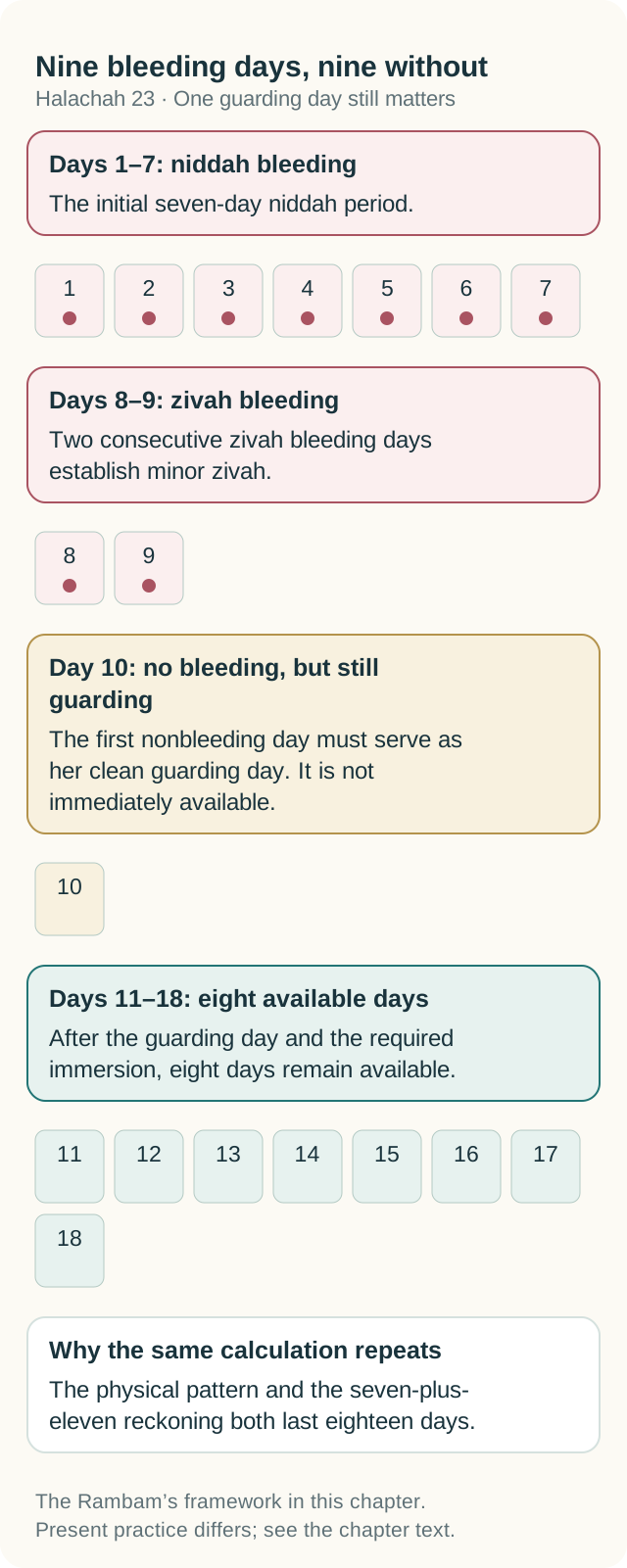
If her pattern is nine days of bleeding
-
followed by nine days without bleeding—
,
she may have marital relations on eight days
.
in every eighteen-day period, for as long as the pattern continues.
?,
How is this calculated? Of the nine bleeding days,
,
seven belong to her period,
;
and two are days immediately following her period.
,
She observes one guarding day for them from the nine nonbleeding days,
.
and may have marital relations on eight days.
.
The same applies for as long as the pattern continues.
Days one–seven are days. Bleeding on days eight and nine establishes minor , requiring one clean guarding day rather than seven clean days.
Day ten serves as that guarding day. After its completion and the required immersion, days eleven–eighteen are available.
Here the physical pattern lasts eighteen days, exactly matching the seven-day period followed by eleven designated days. Both return to the same starting point together, so the calculation repeats without the shifting alignment encountered in Halachah 22.
Synopsis
With nine bleeding days followed by nine nonbleeding days, the bleeding establishes minor . One guarding day and immersion leave eight available days. Because both patterns last eighteen days, the calculation repeats identically.
Picture the CaseA concrete example + illustration
Two extra bleeding days change what is required
’s calendar repeatedly shows nine bleeding days followed by nine days without bleeding. The first seven bleeding days belong to ; the next two establish minor . She therefore cannot treat the first nonbleeding day, day ten, as immediately available. It must serve as her guarding day. After completing it and the required immersion, days eleven–eighteen are available. The nine-day break thus provides eight available days.
Halachah 23: “without bleeding” is not the same as “already permitted.” Day ten fulfills the guarding requirement. The eight available days assume completion of that requirement and valid immersion. The eighteen-day pattern here is the stated hypothetical case, not a prediction of ordinary menstruation.Open full-size illustration
Equal Bleeding and Nonbleeding Periods of Ten Days or More
If her pattern is ten days of bleeding
,
followed by ten days without bleeding,
or equal periods of ten days or more,
-
even a thousand bleeding days followed by a thousand nonbleeding days—
.
the number of days available for marital relations equals the number of her days.
The examples below explain the numerical rule. Seven days of the nonbleeding period are used for the clean-day count. After completing the required purification, the remaining days are available.
The expression “her days” needs qualification in the longer examples. The explains that, according to the , it counts the bleeding days beyond the initial seven days. It does not mean that every subsequent bleeding day falls within a designated eleven-day period. The eighteen-day calendar reckoning continues.
?,
How is this calculated? Of the ten bleeding days,
.
seven are days and three are days.
,,
Of the ten nonbleeding days, she counts seven
.
and may have marital relations on three.
,
The available days for marital relations are therefore three,
.
and her bleeding days are three.
In the initial ten-day bleeding block, days eight–ten are three consecutive days, establishing major .
She then counts seven clean days from the ten nonbleeding days. After completing the count and immersing, three days remain available. The numbers match: three bleeding days beyond the initial seven, and three available days after the seven-day count.
-
Likewise, with a hundred bleeding days followed by a hundred nonbleeding days—
,,
of the hundred bleeding days, seven are assigned to
;
and ninety-three to ;
,,
of the hundred nonbleeding days, seven are for counting
.
and ninety-three are available for marital relations.
As the explains, the ninety-three are the bleeding days remaining after the initial seven. They begin with the days that establish ; they are not ninety-three consecutive designated days.
During the subsequent hundred-day break, seven clean days are needed for purification. After the required immersion, ninety-three days remain available.
.
The same applies to a thousand.
.
The same method applies to every such number.
The examples illustrate the stated numerical rule: seven days of the nonbleeding period are used for counting, leaving the remainder available after purification.
Length of each bleeding and nonbleeding period
Days used for the clean-day count
Remaining available days after purification
10 days
7
3
100 days
7
93
1,000 days
7
993
This calculation does not mean that every bleeding block begins a new seven-day period. The designated and days must still be distinguished according to the ’s reckoning.
Synopsis
In the examples of equal bleeding and nonbleeding periods lasting ten days or more, seven clean days are used for purification, leaving the remainder available afterward. The comparison with “ days” counts bleeding beyond the initial seven; it does not classify every such day as a designated day.
🔎Dig DeeperEqual Bleeding and Nonbleeding Periods of Ten Days or More
Equal Bleeding and Nonbleeding Periods of Ten Days or More
The ’s hundred-day example appears to assign seven bleeding days to and ninety-three to . But designated periods contain only eleven days. How should this be understood?
The explains that the ninety-three are the bleeding days remaining after the initial seven. They begin with the days that establish ; the expression does not classify all ninety-three as consecutive designated days.
The numerical comparison is then clear. Of the hundred subsequent nonbleeding days, seven are used for the clean-day count. After the required purification, ninety-three remain available.
The comparison does not suspend the Rambam’s calendar reckoning or turn the entire extended bleeding period into one uninterrupted designated period.
Translation and elucidation: Independently prepared for Rambam, Clearly in contemporary English. Translation follows the Rambam’s words; elucidation supplies only the context needed to understand them.
Word cards and glossary: Hebrew word cards distinguish a word’s basic meaning from its meaning in the particular phrase. Shared glossary entries explain recurring terms; biography entries identify the cited authorities.
Explain and Background: Explain provides context needed for the ruling. Optional Background panels provide additional context that can be skipped without losing the essential explanation.
Synopsis: A short summary follows each halachah. It is a guide to the central ruling, not a replacement for the full text and its qualifications.
Dig Deeper: Based on the classic commentaries named inside each panel. Editorial explanations are not presented as quotations.
Live It: Where present, these panels connect a particular halachah to a suggested personal reflection and an action to try. Original applications are labeled as suggested reflections. They are distinct from the ruling and are not attributed to the Rebbe merely because his guidance supports seeking a practical lesson.
Measurements: Modern equivalents draw on Chabad.org’s measurement glossary and cited halachic calculations. They show a range when major accepted calculations differ. Monetary equivalents fluctuate with the price of silver.
The Rebbe’s teachings and guidance: Source links accompany the completion teachings and the guidance inside Dig Deeper and Live It. Quotations, translations, and adaptations are identified; the general guidance is separate from the sources for a panel’s particular discussion.
Editorial responsibility: Created and prepared for this project by Levi Gelb. Corrections and suggestions can be submitted below. This presentation supports learning; practical halachic questions should be brought to a qualified rav.
Chapter 7 at a glance
Chapter Synopsis
The distinctions below describe the original laws of ,, and childbirth. Chapter 11 explains the accepted practice of counting seven clean days after qualifying bleeding; the permissions concerning labor-related bleeding and discussed here do not describe present practice.
Labor-related bleeding that begins during the days of can receive special treatment when it leads to a living birth, subject to the fourteen-day limit and the conditions explained below. Bleeding beginning during the days of remains blood.
After three qualifying days of bleeding, twenty-four consecutive hours of relief from labor remove the exemption for the preceding bleeding. She becomes a major , even if bleeding continues and labor later resumes.
When qualifying labor remains connected to birth, the labor-related bleeding does not complete a sequence of three ordinary days. A completed respite before the subsequent birth can remove that exemption and establish major .
When birth occurs on the third bleeding day, that day does not complete the major- sequence described here. An unidentified expulsion after two bleeding days creates uncertainty about both childbirth and major- status.
A woman giving birth with major must complete both her seven-clean-day requirement and the applicable childbirth period before nighttime immersion. The periods can overlap, but neither requirement replaces the other.
Days without bleeding during childbirth impurity can count toward the seven clean days required for . Nevertheless, after a girl’s birth she remains forbidden until the fourteen-day childbirth period ends and she immerses.
A woman giving birth with cannot rely on before completing her required purification. Afterward, renewed bleeding within the remaining -defined postpartum window is .
After the required count and childbirth period are complete, renewed bleeding during the days of purity does not require a new count. She becomes permitted after immersion, although blood discharged before immersion carries ritual impurity.
Bleeding before a miscarriage can remain because of an earlier birth’s purity period. A new expulsion that qualifies as childbirth begins a new childbirth calculation; when twins are expelled separately, the later expulsion begins the calculation stated here.
Qualifying labor-related blood does not invalidate the count, and its days count toward the seven. Other independent forms of impurity do not themselves invalidate the count; childbirth and days without bleeding can count despite continuing impurity.
Days without bleeding during childbirth or impurity can count toward purification from . Bleeding during those periods pauses the count without erasing earlier qualifying days; renewed bleeding invalidates the entire count.
Continuous bleeding can extend for 114 days without establishing major when its changing classifications prevent three consecutive qualifying days. After the postpartum completion period, the first bleeding begins a new reckoning; bleeding at the twilight boundary creates uncertainty.
In the original framework, a requires completion of her seven-day period and immersion; a requires one clean guarding day and immersion; a major requires seven clean days and immersion. The eleven days between periods are the designated days of .
With alternating bleeding and nonbleeding days, day eight is initially available after immersion. Later nonbleeding days serve as guarding days, permitting only limited nighttime intervals afterward. If every new bleeding day begins with bleeding at nightfall, those later intervals disappear.
With two bleeding days followed by two nonbleeding days, day eight is initially available after immersion. Later, the first nonbleeding day serves as the guarding day, leaving the twelfth, sixteenth, and twentieth days available after the required immersion.
With three bleeding days followed by three nonbleeding days, days eleven and twelve are initially available after a guarding day and immersion. The next bleeding establishes major , and the continuing pattern prevents completion of the required clean-day count.
With four bleeding days followed by four nonbleeding days, only day eight is initially available after immersion. Subsequent bleeding establishes major , and the recurring four-day breaks prevent completion of the required count.
With five bleeding days followed by five nonbleeding days, days eight–ten are initially available after immersion. Subsequent bleeding establishes major , and the recurring five-day breaks prevent completion of the required count.
With six bleeding days followed by six nonbleeding days, days eight–twelve are initially available after immersion. Once major is established, the continuing pattern prevents completion of seven clean days; renewed bleeding erases the accumulated count.
With seven bleeding days followed by seven nonbleeding days, some nonbleeding weeks are required entirely for purification. Across the repeating eighteen-week calculation, eighteen days are available after the required purification: seven in week two, six in week ten, and five in week twelve.
The eighteen available days under the alternating-week pattern are approximately a quarter of the seventy-seven days available in the comparison case. The fraction does not refer to all the calendar days.
In the first forty-eight days of an eight-bleeding/eight-nonbleeding pattern, the three nonbleeding blocks provide seven, seven, and one available days after the required purification—a total of fifteen. The identifies a difficulty with the concluding wording because the full alignment repeats only after 144 days.
With nine bleeding days followed by nine nonbleeding days, the bleeding establishes minor . One guarding day and immersion leave eight available days. Because both patterns last eighteen days, the calculation repeats identically.
In the examples of equal bleeding and nonbleeding periods lasting ten days or more, seven clean days are used for purification, leaving the remainder available afterward. The comparison with “ days” counts bleeding beyond the initial seven; it does not classify every such day as a designated day.
פרק ז
End of chapter.
You have reached the end of all twenty-four halachos.