These explain the ’s categories of and according to the ’s reckoning. Present practice requires seven clean days after qualifying uterine bleeding before immersion, as explained later in Chapter 11.
“Pure” and “impure” describe statuses; they do not describe cleanliness, personal worth, or wrongdoing. “Clean days” means days free of the qualifying bleeding relevant to the count.
פרק ו23 halachosSunday, October 25, 2026י״ד במרחשון תשפ״ז◷ Estimated study time: 65–85 min
אTap any Hebrew word to see its meaning and how it works in the phrase.
Chapter progress 0 of 23 completed🔎 0 learned in depth
blood associated with labor and blood associated with childbirth,
-
and the blood of purity following childbirth—
,
are all the same kind of blood.
,
It comes from the uterus,
.
from one and the same source.
and describe different statuses arising from uterine bleeding. is bleeding associated with labor pains; its particular laws are explained in Chapter 7. Blood associated with childbirth includes bleeding during the initial period of impurity. , “blood of purity,” refers to bleeding during the subsequent period that the treats differently, as discussed in Chapter 4.
These names identify legal categories. They do not indicate that the blood necessarily comes from different bodily sources.
,
Its legal status changes only according to the times involved,
-
so that a woman experiencing bleeding
,,.
may be pure, a , or a .
The distinction depends on when the bleeding occurs within the periods defined by the . Blood from the same source can therefore have different consequences during the days of , the days of , or the periods associated with childbirth. Each category remains subject to its own conditions; the detailed rules concerning labor and childbirth follow later.
Synopsis
The same uterine blood can produce different statuses because the assigns different laws to the periods in which it appears.
How does this work? When a woman first experiences bleeding,
,
or when she experiences bleeding at her established time,
-
which is the time established for her period,
,
she is a throughout all seven days,
whether she experiences bleeding on all seven days
.
or sees only the initial drop.
A is an established time for the onset of bleeding, such as a recurring calendar date or interval. At the initial onset described here, the seven-day period begins. An early end to the bleeding does not shorten that period, and continued bleeding during it does not restart the seven-day count.
In the continuing reckoning explained below, bleeding is classified according to whether it occurs during the designated days of or . A new sighting of blood does not automatically begin a new reckoning.
These are seven days of , not seven clean days. Under the framework being described, they can include days on which bleeding continues. Permission to resume marital relations also requires valid immersion after the required period; the passage of seven days alone does not make her permitted.
-
If she experiences bleeding on the eighth day,
,
that is blood of ,
.
because it occurs outside the time of her period.
The eighth day belongs to a different category, even if the bleeding continues without interruption from the preceding days. The expression “outside the time of her period,” drawn from 15:25, refers here to the ’s defined periods rather than simply to bleeding that seems medically irregular.
Bleeding on this one day does not by itself make her a , a major . The distinctions between one, two, and three consecutive days of bleeding are explained in 7–11.
Synopsis
Bleeding that begins a period establishes seven days of . Bleeding on the eighth day belongs to the category of .
The preceding identified bleeding on the eighth day as . This extends that classification to the entire intervening period.
,
It is a law transmitted to at
that between one period and the next
.
there are exactly eleven days.
A is a law received through the Oral Tradition from at . Here, that tradition establishes an eleven-day interval following the seven days of . Counting from the beginning of the seven-day period, days 8–18 are the eleven days of .
This is a classification of days. It does not mean that a woman must physically menstruate every eighteen days. The ’s continuing reckoning is explained in Halachah 6.
Synopsis
The Oral Tradition establishes eleven days of between successive seven-day periods.
“Days of ” Describe a Period, Not Necessarily Bleeding
The entire seven-day period
-
whose beginning was established as her time—
״״,
is called “her days of ,”
.
whether she experiences bleeding during those days or not.
The name belongs to the designated seven-day period in the reckoning. Those days retain their classification even when no bleeding occurs. Calling them “days of ” does not, by itself, mean that a woman who has seen no blood becomes impure.
״״?
Why are they called “days of ”?
.
Because they are days suited to status.
,
Any blood she sees during them
.
is classified as blood of .
The distinction is between the classification of the days and the woman’s actual status. “Days of ” identifies the kind of bleeding those days can produce: if qualifying bleeding occurs during them, it is classified as blood rather than blood.
Synopsis
“Days of ” names a designated seven-day period. The name applies even without bleeding; blood seen during that period is classified as blood.
whether she experiences bleeding during them or not.
Like “days of ,” this name identifies a period in the reckoning; it does not by itself make her a .
״״?
Why are they called “days of ”?
.
Because they are days suited to status.
,
Any blood she sees during them
.
is classified as blood of .
Blood seen during this eleven-day interval is governed by the laws of . The number of consecutive days on which bleeding occurs determines whether she becomes a minor or major , as explained beginning in Halachah 7.
,
Be careful to distinguish these two terms:
״״״.
“her days of ” and “her days of .”
The chapter’s later rulings depend on keeping these periods distinct. The terms identify when bleeding occurs; they do not simply describe how long she has been bleeding or whether she has already completed purification from an earlier episode.
The end of the eleven-day interval does not itself remove impurity already incurred. The required purification must still be completed.
Synopsis
The eleven days following the seven days of are called days of . Bleeding during them is classified as blood; the designation of the days alone neither creates impurity nor removes existing impurity.
Throughout a woman’s life, from the day her established time is fixed
,
until she dies,
,
or until that established time shifts to another day,
she continually counts seven days beginning with the day of that established time,
,
followed by eleven days,
.
then seven followed by eleven.
According to the ’s reckoning here, the designated periods continue in a repeating pattern: seven days of , followed by eleven days of . The count continues even when no bleeding occurs. A later sighting is classified by its place within that reckoning; it does not automatically begin a new seven-day period.
The designated periods classify bleeding; as explained above, their arrival alone does not create impurity.
,
Be careful with this count,
so that when she experiences bleeding, you will know
whether she saw it during days of or days of ,
:
for this is the pattern throughout a woman’s life:
,
seven days of and eleven days of ,
,
unless childbirth interrupts the reckoning,
.
as will be explained.
The classification determines which purification rules apply when bleeding occurs. Childbirth can interrupt this reckoning; the resulting calculation is explained in Chapter 7, Halachah 2.
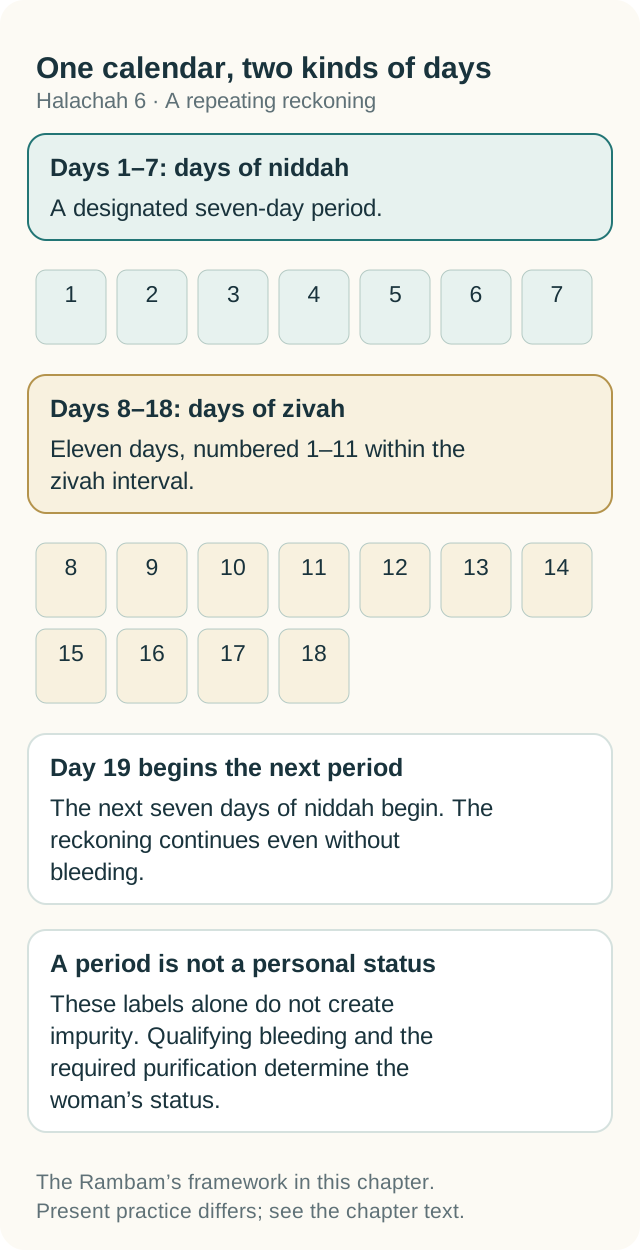
Counting guide
Days 1–7: the seven days of .
Days 8–18: the eleven days of , numbered 1–11 within that interval.
Day 19: the beginning of the next period.
In 16–18, “the twelfth day” means the day following the eleven-day interval. It is the first day of the next period, not a twelfth day of . In Halachah 19, the first case counts from the beginning of ; the second counts within the interval.
Synopsis
The describes a continuing reckoning of seven days of followed by eleven days of , whether or not bleeding occurs, subject to the changes he identifies.
Picture the CaseA concrete example + illustration
Two kinds of days on one calendar
marks the reckoning on a calendar: days 1–7 are the days of , and days 8–18 are the days of . She sees no blood during the first seven days, but sees blood on day 10. Although this is her first bleeding in that stretch, day 10 is already within the designated period. The absence of earlier bleeding does not move the calendar’s boundaries.
Halachah 6: the ’s repeating reckoning classifies bleeding; it does not predict a physical eighteen-day menstrual cycle. A new sighting does not automatically restart the reckoning. Childbirth and other changes identified in the text must be taken into account. Existing impurity does not end merely because a period ends.Open full-size illustration
A woman who experiences bleeding during her days of
,
on only one day,
-
or on two consecutive days,
״״,
is called a “,”
״״.
and is called “one who observes a day corresponding to a day.”
“Minor” describes the extent of her status, not her age. A ordinarily must observe one clean day following the bleeding before completing the purification process described below. The expression names this requirement. Even after two consecutive bleeding days, one clean day is sufficient under this framework.
The special rules for bleeding at the end of the eleven-day period are explained in 17–18.
-
If she experiences bleeding on three consecutive days,
,
she is a in the full sense,
״״,
and is called a “major ,”
״״.
or simply “a ,” without qualification.
All three consecutive bleeding days must fall within the days of . Three consecutive days of bleeding do not establish major- status if one of them belongs to the days of , as explained later in Halachah 16.
״״(,)-
As it states: “If a woman has a flow of her blood for many days” ( 15:25)—
״״,
the minimum implied by “days” is two;
״״.
“many” indicates three.
The plural “days” already indicates at least two. The additional word “many” establishes a minimum of three for the full status discussed here.
Synopsis
Bleeding on one or two consecutive days of creates minor- status. Bleeding on three consecutive days of creates major- status.
Picture the CaseA concrete example + illustration
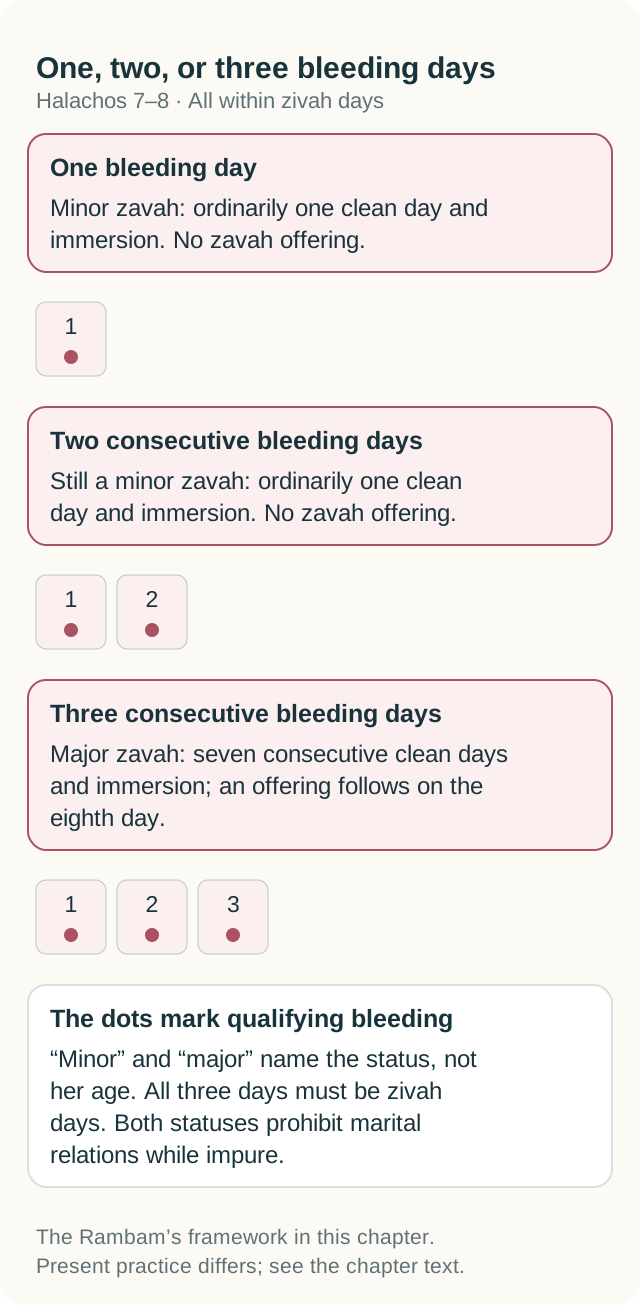
Counting the bleeding days
Within her period, experiences qualifying bleeding on one day, then on a second consecutive day. She is still a . If bleeding occurs on a third consecutive day, she becomes a major . The diagram compares the purification requirements for each case.
The point
“Minor” and “major” describe her status, not her age. All three days must belong to the period.
7–8: one clean day ordinarily suffices for a ; a major needs seven consecutive clean days. Valid immersion and the applicable wait until evening are also required. The major ’s offering does not delay permission for marital relations. Special rules at the end of the interval appear in 17–18.Open full-size illustration
is the counting of seven days and the bringing of an offering:
,
a major must count seven clean days,
.
whereas a counts only one day.
“Clean days” are days free of the uterine bleeding that would invalidate the count. A major needs seven consecutive clean days; a ordinarily needs one. The immersion requirements and the time at which marital relations become permitted are explained in the following .
A major brings an offering when she becomes purified,
.
[whereas a does not bring an offering when she becomes purified].
A major brings her offering on the eighth day, following the seven clean days. After the required immersion and completion of the seventh clean day, however, she may resume marital relations that evening; she does not have to wait until the offering is brought. The offering belongs to the further purification requirements explained in ,Chapter 1.
,
But regarding impurity and the prohibition of marital relations,
.
the two are equal.
The shorter purification process of a does not mean that relations with her are permitted while she remains impure. The distinction concerns what she must do to become purified, not whether the prohibition applies.
Synopsis
A major requires seven clean days and an offering; a ordinarily requires one clean day and no offering. Both are impure and prohibited in marital relations until the applicable requirements are fulfilled; the offering itself does not delay permission for marital relations.
How does this work? If she experiences bleeding during her days of —
whether she sees it at the beginning of the night
-
or at the end of the day—
,
that entire day is impure,
as though the bleeding had not stopped from the time she saw it
,
until sunset,
.
and she watches throughout the night.
A day begins at night. Bleeding anywhere within that night and the following daytime makes it a bleeding day for this reckoning. Even if the bleeding stops quickly, the remainder of that same day cannot serve as the clean day required afterward.
“Watching” means establishing that no further bleeding occurred. It does not require remaining awake all night; checking the following morning for signs of bleeding is sufficient for the nighttime observation described here.
-
If she sees no blood during the night,
,
she rises the next morning and immerses after sunrise,
.
and continues watching throughout the day.
-
If she sees no blood,
,
this constitutes one pure day corresponding to the impure day,
.
and she is permitted to her husband that evening.
Under the framework being described, she immerses during the daytime of the clean day but must wait until evening before resuming marital relations. Bleeding later that day could invalidate the clean day and the immersion retroactively, as explained in 13–14. Immersion in the morning therefore does not make marital relations immediately permissible.
Synopsis
After one day of bleeding, she observes the following night and day without bleeding, immerses after sunrise, and becomes permitted to her husband that evening.
Two Bleeding Days Still Require Only One Clean Day
,
If she experiences bleeding on the second day as well,
-
whether during its daytime or its nighttime, including bleeding after her immersion—
,
the second day is impure,
.
and she watches throughout the third night.
The second day begins with the night following the first bleeding day. If she bleeds that night, the second day cannot serve as her clean day. If the night passes without bleeding and she immerses the following morning, bleeding later that daytime likewise invalidates the day and her earlier immersion.
She has now experienced bleeding on two consecutive days of . She remains a , and the next day can serve as the required clean day if no further bleeding occurs.
-
If she sees no blood,
,
she rises the next morning and immerses after sunrise,
.
and continues watching throughout the day.
-
If she sees no blood,
this constitutes one pure day
,
corresponding to the two impure days,
.
and she is permitted to her husband that evening.
She does not need two clean days to match the two bleeding days. For a , one clean day ordinarily suffices after either one or two consecutive bleeding days. If bleeding occurs on a third consecutive day within the days of , however, she becomes a major , whose requirements are explained next.
Synopsis
After two consecutive days of bleeding, one clean day is still sufficient. She immerses after sunrise on that day and becomes permitted to her husband that evening if no further bleeding occurs.
Picture the CaseA concrete example + illustration
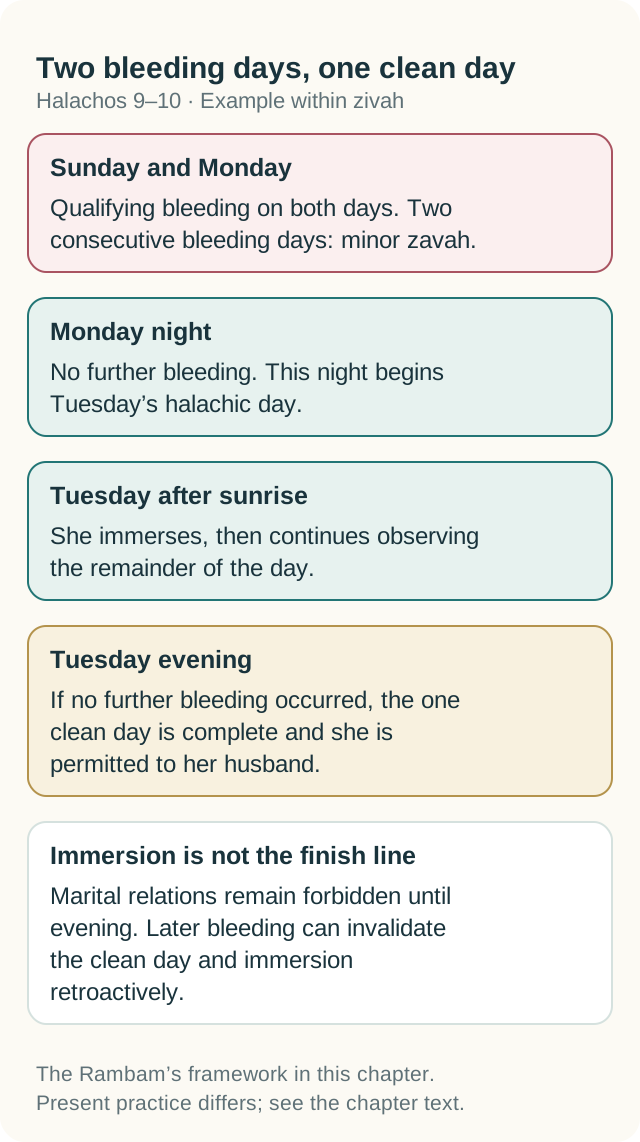
Two bleeding days, one clean day
Within her days, sees blood on Sunday and again on Monday. The bleeding then stops. Monday night and all of Tuesday pass without further bleeding, and she immerses after sunrise on Tuesday. Under the framework described here, she becomes permitted to her husband Tuesday evening. She needs one clean day after the two bleeding days, rather than a separate clean day for each.
9–10: this example falls within the interval, away from its special end boundary. One clean day follows either one or two consecutive bleeding days. The clean day begins with the preceding night; valid daytime immersion does not permit marital relations before evening.Open full-size illustration
If she experiences bleeding on the third day as well,
-
whether during its daytime or its nighttime,
,
she is a major ,
,
and must count seven pure days without bleeding,
״״(,).
as it states: “She shall count seven days for herself, and afterward she shall become pure” ( 15:28).
This continues the preceding case: she has now experienced bleeding on three consecutive days within the days of . She therefore becomes a , a major . One clean day no longer suffices; after the bleeding stops, she must count seven consecutive days free of qualifying uterine bleeding.
,
She immerses on the seventh day after sunrise,
.
and is permitted to her husband that evening.
Under the framework described here, immersion takes place during the seventh clean day. Marital relations remain forbidden until that day ends, because further bleeding before its completion would invalidate the count, as explained below.
This daytime immersion rule concerns a woman whose status as a is established. Halachah 23 gives a different immersion time when her status is doubtful. Present practice likewise requires immersion at night, as explained later in Chapter 11.
-
On the eighth day she brings her offering—
.
two turtledoves or two young pigeons.
The eighth day follows the seven clean days. As explained in Halachah 8, the offering is a further purification requirement and does not delay permission for marital relations.
Synopsis
A major counts seven consecutive clean days, immerses after sunrise on the seventh day, and becomes permitted to her husband that evening. She brings her offering on the eighth day.
Immersion Before the Required Daytime Is Ineffective
,
A who immerses during the night beginning her observation day,
-
or a major who immerses during the night beginning her seventh day—
,
is regarded as though she had not immersed,
.
and is like a who immersed within her seven days.
The “observation day” is the clean day a must observe after her bleeding. A major ’s corresponding final day is the seventh clean day. In the ordinary cases discussed here, daytime immersion remains subject to the day ending without further bleeding.
The night mentioned here comes before the daytime when immersion is prescribed. For a , it begins her observation day. For a major , it begins the seventh clean day, after only six clean days have been completed.
These immersions occur too early and do not remove her existing impurity. The comparison to a concerns this ineffectiveness: just as immersion during her seven-day period cannot end her impurity, immersion at the premature nighttime described here cannot purify a .
Synopsis
Immersion during the night beginning a ’s observation day or a major ’s seventh clean day is too early and does not purify her.
After Daytime Immersion, the Outcome Remains Pending
A man who has relations with a major
,
on the seventh day of her count, after she has immersed,
or with a
-
on her observation day, after she has immersed—
;
is exempt from ,
,.
since she immersed at the proper time for her immersion and is pure.
is the severe punishment imposed by Heaven for certain deliberate transgressions. Here, unlike the premature nighttime immersion in the preceding , she immersed at a time when immersion can be effective.
Her immersion is effective provided that the remainder of the required clean day passes without bleeding. Until evening, her purification remains subject to that condition. Exemption from therefore does not mean that relations before evening are permitted.
If bleeding subsequently invalidates her purification, the earlier relations are not treated as a deliberate violation carrying .Halachah 14 explains the resulting obligation to bring a sin-offering.
,
This woman has acted improperly,
.
for the status of her relations and her contact remains pending.
The criticism concerns proceeding with relations before the day’s outcome is known. Bleeding later that same day can invalidate her purification retroactively. Both the consequences of relations and the status of objects she touches therefore depend on what happens before the day ends.
Synopsis
After immersion at the proper daytime, relations before evening do not incur , but remain forbidden. Their consequences, and those of her contact with objects, depend on whether bleeding occurs later that day.
Later Bleeding Can Invalidate Purification Retroactively
?
How does their status remain pending?
-
If the day ends after her immersion without her seeing blood,
,,
everything she touched after her immersion is pure,
,
and for relations with her after her immersion,
.
no liability is incurred.
If the day remains free of bleeding, her purification is confirmed. Objects she touched after immersion are not rendered impure through the impurity discussed here, and relations after immersion do not create the sacrificial liability described below.
“No liability” does not mean that proceeding before evening was permitted. It describes the outcome once the day has ended without further bleeding.
-
But if she sees blood that day after immersing,
,
she proves to have been a retroactively,
,
and everything she touched is retroactively impure,
.
and she and the man who had relations with her are obligated to bring an offering.
The later bleeding invalidates the clean day and reveals that the immersion did not complete her purification. Its consequences therefore reach back to the period after immersion. Objects she touched become impure where the applicable laws of susceptibility and transmission of impurity are met.
Each member of the couple must bring a sin-offering for the inadvertent violation. These sin-offerings are separate from the offering a major brings as part of her purification. Although the couple were required to wait until evening, the later bleeding establishes retroactively that their relations occurred while she remained impure.
,
Therefore, she is forbidden to her husband until evening,
.
so that she does not place herself in a situation of uncertainty.
Waiting until evening resolves the uncertainty about that day. If no further bleeding occurs, the required clean period has been completed; if bleeding does occur, she knows that purification has not been achieved.
Synopsis
If no bleeding occurs before the day ends, her purification is confirmed. If bleeding occurs after immersion that day, her impurity applies retroactively, affecting objects she touched and requiring each member of the couple to bring a sin-offering for relations.
Picture the CaseA concrete example
The afternoon changes the result
On her seventh clean day, immerses after sunrise. By lunchtime she has seen no further blood, but the day is not finished. If she remains free of bleeding until evening, her purification is confirmed. If qualifying bleeding appears that afternoon, the count is invalidated, with consequences reaching back to the period after immersion. This is why she must wait until evening before resuming marital relations.
✦Live ItGive the next step its time
Give the next step its time
Immersion during the prescribed day does not yet permit marital relations. She must wait until evening, because the remainder of the day determines whether her purification stands. Completing one necessary step does not remove the need for the next.
In serving , enthusiasm is precious, and so is the willingness to respect a boundary. You may feel ready to answer a difficult message immediately, but a short pause can help you answer with greater care. Sometimes the meaningful is giving the next step its proper time, even when you would rather move ahead.
Try today
Before answering one frustrating message, pause and choose words that protect the other person’s dignity.
Bleeding on the Seventh Day Cancels the Entire Count
,
A who counted six clean days
-
and saw blood on the seventh—
-
even shortly before sunset—
,
has invalidated the entire count,
and must begin counting again after the impure day:
.
seven clean days.
This concerns a major , who must complete seven consecutive clean days. Bleeding on the seventh day cancels the entire count, even if it occurs shortly before sunset. She cannot preserve the earlier six days and simply replace the seventh.
The day on which bleeding occurs cannot count toward the new sequence. After the bleeding has ceased, she must count seven consecutive clean days anew.
Synopsis
Bleeding at any point on the seventh clean day invalidates the entire count. A new sequence of seven consecutive clean days is required.
Picture the CaseA concrete example + illustration
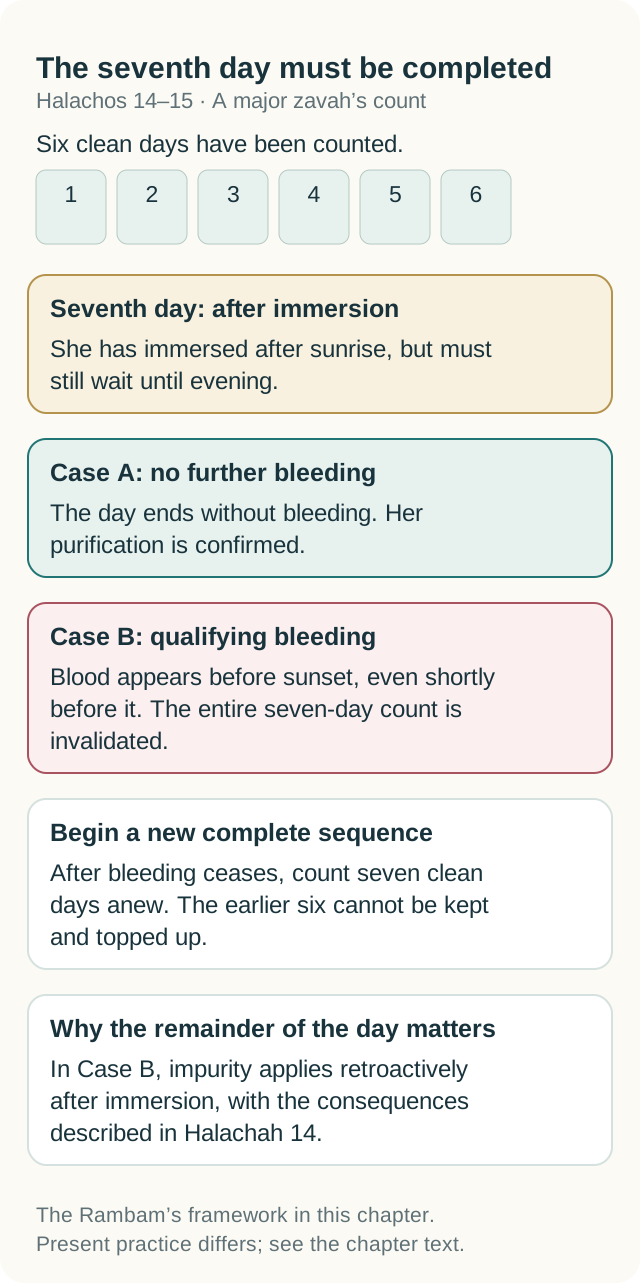
Six checkmarks cannot replace seven consecutive days
has marked six completed clean days on her calendar. On the seventh day, shortly before sunset, qualifying bleeding occurs. She cannot keep those six days and simply add another day later. Once the bleeding has ceased, she must begin a new sequence of seven clean days, because the required count must be consecutive.
14–15: the diagram concerns qualifying uterine bleeding during a major ’s seventh clean day. This differs from Halachah 16’s qualifying seminal discharge, which invalidates one day rather than all earlier days. The text explains the consequences of retroactive impurity; the diagram does not permit relations before evening.Open full-size illustration
✦Live ItBegin again without giving up
Begin again without giving up
A major needs seven consecutive clean days. If qualifying bleeding occurs even near the end of the seventh day, she must begin the count again. Almost completing the required sequence does not replace completing it.
A disrupted commitment can make restarting feel discouraging. Perhaps your daily learning routine fell apart during a busy week. The you already learned remains valuable; the task now is to renew the routine. gives us a way to return to through a concrete next step. You can begin again today without first recovering the enthusiasm you had when you started.
Try today
Restart one interrupted learning commitment with five focused minutes.
Seminal Discharge and Bleeding Across the Period Boundary
-
If she discharges semen during the days of her count,
,
she invalidates one day,
,
because she is like a who experiences a seminal emission,
.
which invalidates one day.
This refers to semen retained after relations and subsequently expelled during her clean-day count, while it still has the capacity to convey impurity.
The earlier clean days remain valid, but the day of the qualifying discharge does not count. She must add a clean day to complete the required total rather than restart all seven. This differs from qualifying uterine bleeding, which cancels the entire count.
A is a man with a particular type of discharge that creates ritual impurity. If he experiences a seminal emission during his purification count, he likewise loses one day rather than the entire count.
,
If she experiences bleeding on the tenth of her days of ,
,-
and on the eleventh and twelfth days,
-
although she has experienced bleeding on three consecutive days,
,
she is not a major .
;
Rather, she has passed from minor- status into status,
,,
because the twelfth day belongs to the beginning of the days of ,
-,
and a woman who experiences bleeding during her days of does not become a ,
.
as we have explained.
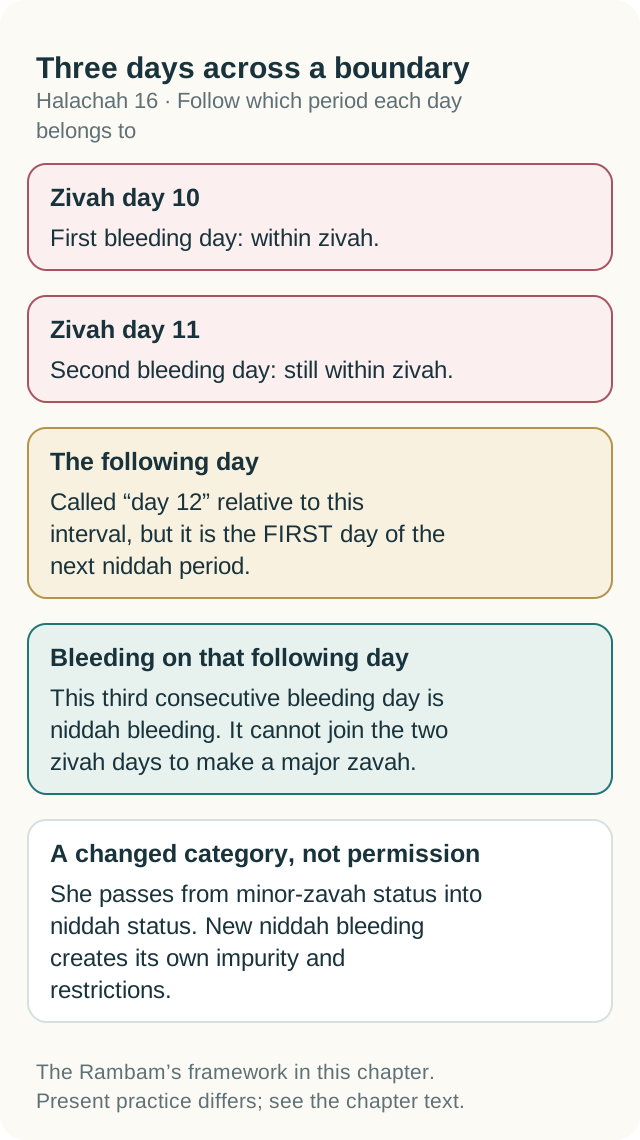
There are only eleven days in the interval. “The twelfth day” therefore means the day immediately following that interval—the first day of the next period in the reckoning.
Only the first two bleeding days in this case belong to . The third belongs to and cannot join them to establish major- status. The physical continuity of the bleeding does not erase the legal boundary between the periods.
Synopsis
A qualifying seminal discharge invalidates one day of the clean-day count, while preserving the earlier days. Bleeding on the tenth, eleventh, and following day does not establish major- status, because the third day belongs to .
Picture the CaseA concrete example + illustration
The third day crosses the boundary
experiences qualifying bleeding on days ten and eleven, and again on the following day. Although the bleeding spans three consecutive days, the third belongs to the next period. Only two of the days are days, so this sequence does not establish major- status.
The point
Crossing the boundary changes the category of the bleeding; it does not make her permitted.
Halachah 16, second ruling: “day twelve” is a relative label for the day following the eleven days; there is no twelfth day. Major- status requires three consecutive bleeding days within . The boundary does not make the new bleeding permissible or remove purification requirements.Open full-size illustration
“Or if she has a flow following her period” ( 15:25)?
,
It means that if she experiences bleeding for three days immediately following her period,
.
she is a .
For example, she experiences bleeding on the eighth day counted from the beginning of her period,
,
and on the ninth and tenth days,
which are the first, second, and third
.
of the eleven days that constitute her days of .
Bleeding immediately after the seven days of is not treated merely as an extension of that period. Days eight, nine, and ten are the first three days of . Bleeding on all three therefore establishes major- status, even if the bleeding began earlier and continued without interruption.
,
If she experiences bleeding on the eleventh of her days of ,
,
and immerses that evening, which begins the twelfth day,
-
and has marital relations,
,
although she is impure and the man who has relations with her is impure,
-
and they impart the impurity of lying and sitting,
;
they are not liable for .
This case concerns a whose bleeding occurred on the final day of the interval. She immersed that night without first observing the required clean day. The immersion and relations described here are not permitted conduct.
“Lying and sitting” refers to ritual impurity affecting eligible beds, seats, and similar supporting objects. The woman and the man who had relations with her each have the applicable impurity described here; their detailed rules of transmission are not necessarily identical.
For the twelfth day does not
,
join the eleventh day to establish her status,
so her immersion that night has the effect
.
of exempting her from the offering.
The next day belongs to , so bleeding then cannot join the preceding day’s bleeding. This boundary gives the nighttime immersion a limited effect: despite the impurity that remains, the relations do not incur or the corresponding sin-offering liability. It does not make the relations permissible.
Synopsis
Bleeding on the first three days after establishes major- status. After bleeding on the final day, nighttime immersion has a limited effect on liability, although impurity and the prohibition of relations remain.
🔎Dig DeeperBleeding Immediately After and at the End of
Bleeding Immediately After and at the End of
The explains that after bleeding on the eleventh day, she must still observe a clean day before resuming marital relations. The identifies this requirement in this particular boundary case as Rabbinic.
The following day cannot extend her bleeding, yet that does not permit her to disregard the required observation day. Exemption from or a sin-offering is therefore distinct from permission to have relations.
This continues the case of bleeding on the eleventh and final day of . She now immerses at the prescribed daytime rather than during the preceding night. Nevertheless, the requirement to wait until evening remains in place.
,
If he transgresses and has relations with her,
.
neither incurs the liability discussed here.
They do not incur or a sin-offering obligation for these relations. Nevertheless, having relations before evening violates the requirement to wait.
Even if she sees blood after he has had relations with her
,
on the twelfth day,
,
this has no effect in that regard,
,
because this is blood of ,
.
and it does not join the preceding day.
Unlike bleeding during an ordinary observation day within the interval, bleeding on this day does not retroactively invalidate her purification from the preceding in a way that creates liability for the earlier relations. It belongs to a new category: .
“This has no effect” concerns the earlier relations. It does not mean that the new bleeding is harmless or that she remains permitted afterward. The new bleeding establishes impurity and its associated restrictions.
Synopsis
After daytime immersion following the final day, relations remain forbidden until evening. Later bleeding does not retroactively create liability for relations that occurred before that new bleeding.
If she experiences bleeding at the end of her seventh day of ,
,
during twilight,
-
and experiences bleeding on the ninth and tenth days,
;
she is doubtfully a ,
,
because the first sighting may have occurred on the night beginning the eighth day,
in which case she experienced bleeding on three consecutive days
.
at the beginning of her days of .
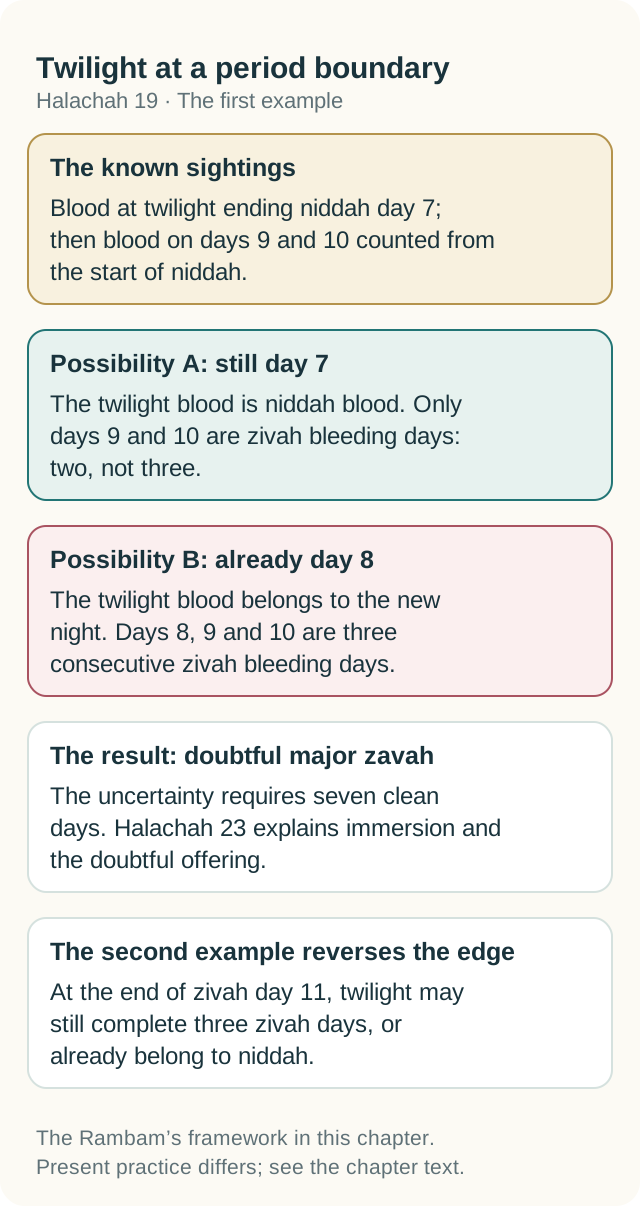
is the twilight period whose classification as day or night is uncertain. Here, that uncertainty falls exactly at the boundary between and .
If the first bleeding belongs to the seventh day, it is blood, and the later bleeding on days nine and ten establishes only minor- status. If the first bleeding belongs to the night beginning day eight, she has bled on days eight, nine, and ten—the first three consecutive days of . She is therefore certainly a and doubtfully a major .
Similarly, if she experiences bleeding on the ninth and tenth
,
of her days of ,
-
and experiences bleeding at twilight at the end of the eleventh day,
;
she is doubtfully a ,
,
because the final sighting may have occurred on the eleventh day,
in which case she experienced bleeding on three consecutive days
.
within her days of .
Here the uncertainty falls at the opposite boundary. If the twilight bleeding belongs to day eleven of , there are three consecutive bleeding days: nine, ten, and eleven. If it belongs to the following night, it is blood and cannot complete that sequence.
In both cases, the possibility of major- status requires seven clean days. The rules governing immersion and the offering in a doubtful case are explained in Halachah 23.
Synopsis
Bleeding during twilight at either boundary of the period can create doubt whether three consecutive bleeding days occurred. The possibility of major- status requires seven clean days.
Picture the CaseA concrete example + illustration
One uncertain evening changes the classification
sees blood during twilight at the end of her seventh day, and then again on days nine and ten. If the twilight sighting belonged to day seven, only the later two sightings occurred during . If it belonged to the night beginning day eight, she bled on three consecutive days: eight, nine, and ten. The uncertainty about that first sighting makes her doubtfully a major , requiring seven clean days.
Halachah 19: the main diagram counts from the beginning of the period. The second case in the text instead counts days 9, 10, and uncertain twilight after day 11. Do not mix these two numbering systems. Twilight is shown conceptually, without prescribing clock times.Open full-size illustration
What an Examination Establishes About the Intervening Days
A who examines herself during her days of
,
and finds that the bleeding has stopped,
,
even if it stopped on her second day of ,
and, inadvertently or deliberately, does not examine herself again
,
until many days after her period,
-
and then finds impurity when she examines herself—
,
we do not say that perhaps she was impure throughout all those days.
.
Rather, all the intervening days on which she did not examine herself retain a presumption of purity.
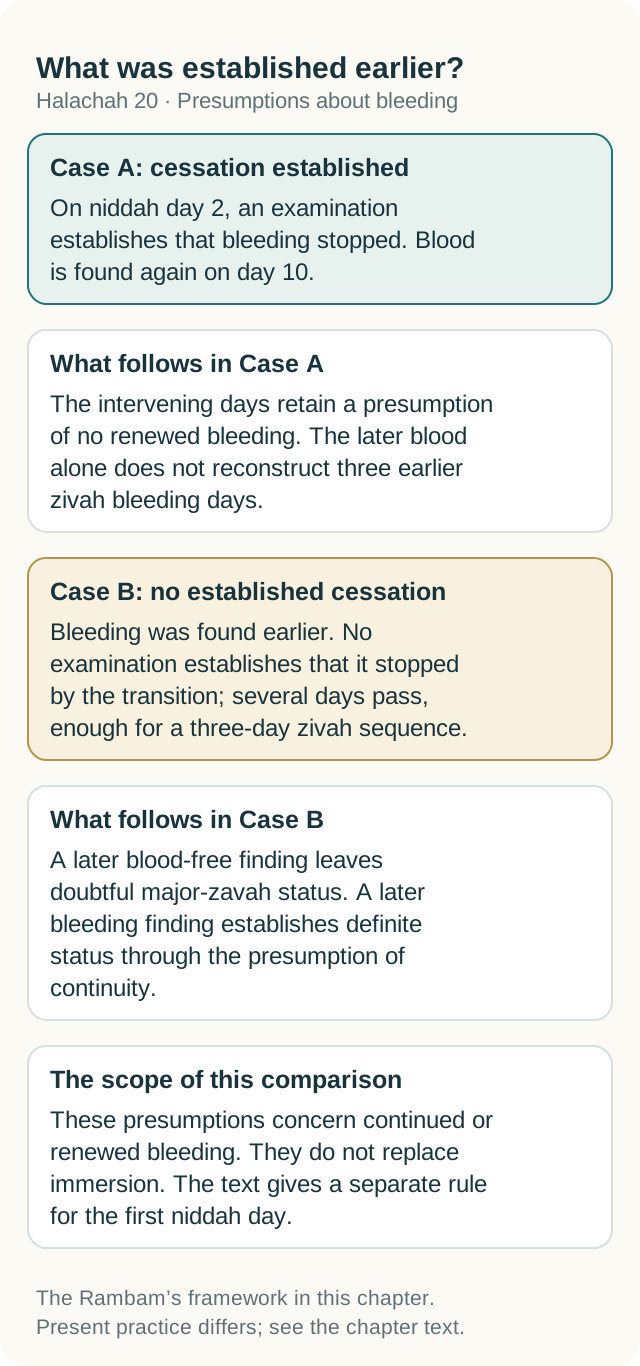
Once an examination establishes that the bleeding stopped, later bleeding does not make us assume that she had been bleeding throughout the intervening days. We therefore do not use that later discovery to establish an earlier sequence of three bleeding days.
The presumption concerns the absence of renewed bleeding. It does not mean that the examination itself ended her existing impurity or replaced the required immersion. The explains that this presumption applies whether or not she immersed.
,
If she examined herself and found impurity,
,
even if she examined herself on her seventh day of ,
,
and did not examine herself at twilight
,
to establish the cessation of her bleeding,
,
but instead waited several days,
-
and afterward examined herself and found purity—
.
she is doubtfully a .
Here, no examination established cessation by the transition from the period into the period. Finding no blood later tells us that the bleeding has now ceased, but not when it ceased. It may have continued through three consecutive days of , making her doubtfully a major .
This ruling concerns an interval long enough for the possible three-day sequence to have occurred. The reference to twilight should not be read as an instruction to postpone an examination until then. A —the examination establishing that bleeding has ceased—is performed before sunset.
,
If she finds impurity,
-
she is definitely a ,
,
for since she found impurity both at the beginning and at the end,
.
the presumption is that the bleeding did not stop.
When bleeding was found at both ends of the relevant interval, and no intervening examination established that it ceased, the law presumes continuity. She is therefore treated as a definite major , rather than merely a doubtful one.
-
On the first day of ,
-
even if she finds purity that day,
,
it is treated as though she found impurity,
.
because throughout the first day, the source is presumed to remain open.
For the presumption discussed here, a blood-free examination on the first day does not establish the same lasting cessation as an examination from the second day onward. The initial flow is presumed likely to continue during that first day. This explains why the opening ruling specifically recognizes an examination on the second day.
Synopsis
An examination establishing that bleeding stopped generally preserves a presumption of no further bleeding until new blood is found. Without an established cessation, later findings can create doubtful or definite major- status; a first-day examination is treated differently.
Picture the CaseA concrete example + illustration
The earlier examination makes a difference
On her second day, examines herself and establishes that the bleeding stopped. She makes no further examinations until day 10, when she finds blood again. That later finding does not make us assume she had been bleeding throughout the intervening days. Her earlier examination established cessation, so we do not reconstruct three consecutive bleeding days merely from the later discovery. This presumption concerns bleeding; it does not replace the required purification.
Halachah 20: Case B assumes enough time elapsed within for three consecutive bleeding days. A first-day examination does not establish the same lasting cessation in this ruling. These examples explain the ’s presumptions; they are not a substitute for the required examinations and purification process.Open full-size illustration
✦Live ItLet the facts set the story
Let the facts set the story
Once an examination establishes that bleeding stopped, a later discovery does not make us assume it continued throughout the intervening days. The established cessation matters. The later finding does not automatically rewrite everything that came before it.
We can be quick to do that with another person. After a friend disappoints us, we may start questioning every earlier kindness. asks us to make room for a fairer reading. Address what happened, while remembering the good you actually know. A present difficulty deserves attention, but it need not become the explanation for an entire relationship.
Try today
When someone disappoints you, recall one established good quality before deciding how to respond.
A who examines herself on the first day of her count
,
and finds herself pure,
and does not examine herself again until the seventh day,
-
when she again finds herself pure—
,
retains a presumption of purity,
.
as though she had examined herself on all seven days and found herself pure.
This concerns a major counting seven clean days after the bleeding has been established to have stopped. The examination establishing cessation before the count is called a .
Her examinations on the first and seventh days establish blood-free findings at both ends of the count. In the absence of an intervening sighting of blood, she is presumed to have remained free of bleeding during the days between them. Those days therefore count even though she did not examine herself on each one.
This ruling addresses examinations that were omitted. It does not prescribe checking only twice during the entire count. At the outset, the directs a woman to examine herself twice on each of the seven clean days.
Synopsis
If a finds herself pure on the first and seventh days of her clean-day count, the intervening days count as clean despite the omitted examinations.
Additional Cases in Which the Clean-Day Count Remains Valid
Similarly, if she examines herself on the first day of her count
,
and finds herself pure,
-
and on the eighth day again finds herself pure—
.
she retains a presumption of purity.
Here, the later examination took place on the eighth day rather than the seventh. According to the , that delay does not invalidate the seven-day count. With blood-free findings on the first and eighth days and no known bleeding between them, she is presumed to have remained free of bleeding throughout the intervening period.
The eighth-day examination confirms the presumed continuity of the preceding clean days. It does not create an eight-day counting requirement; the required count remains seven clean days.
,
If she examines herself on the third day of her bleeding
,
and finds that the bleeding has stopped,
,
and does not examine herself on the first day of her count,
-
but examines herself on the seventh day and finds herself pure—
.
she retains a presumption of purity.
In this case, the examination establishing that the bleeding stopped occurred on the third bleeding day, before the clean-day count began. Although she omitted the examination on the first clean day, the accepts the established cessation together with the blood-free examination on the seventh day. With no known intervening bleeding, the seven days count.
These are the ’s rulings concerning omitted examinations. The differing requirements recorded by other authorities are discussed below.
The same law applies to a in all these cases of examination:
,
he is pure,
.
and the days count toward his required count.
A must also count seven clean days as part of his purification. The same principles governing the examinations and the presumption of continued purity apply to his count.
Synopsis
The accepts the count when blood-free examinations occur on days one and eight, or when cessation was established before the count and a blood-free examination occurs on day seven. Corresponding rules apply to a .
🔎Dig DeeperAdditional Cases in Which the Clean-Day Count Remains Valid
Additional Cases in Which the Clean-Day Count Remains Valid
The , 196:4, records a stricter position associated with : examinations are required on both the first and seventh clean days. Under that position, an examination establishing cessation before the count does not replace the first-day examination.
The difference is significant in the ’s second case. He accepts the established cessation before the count together with the seventh-day examination, despite the missing first-day examination. The stricter view requires that first-day examination as well. This dispute concerns whether an incomplete pattern of examinations can validate the count; it does not change the initial requirement to examine throughout the seven days.
Any woman whose status is uncertain—whether she is a or a —
,
must observe seven clean days because of that uncertainty,
,
and immerses on the night beginning the eighth day.
.
Afterward, she is permitted to her husband.
The uncertainty requires a purification process that satisfies both possible statuses. Because she may be a major , she must count seven clean days. Because she may be a , she cannot rely on the daytime immersion described earlier for a definite .
She therefore completes all seven clean days and immerses during the following night. “The night beginning the eighth day” means the night after seven clean days have been completed, not the night beginning the seventh day.
,
She brings a offering, but it is not eaten,
.
as will be explained in its proper place.
Because she may be a major , she brings the offering required in a doubtful case. Its bird sin-offering is not eaten and must instead be burned, as explained in 1:6. The uncertainty concerns whether she actually incurred the obligation to bring that sin-offering. The burnt-offering, by contrast, is burned on the altar in any event.
As stated above, permission for marital relations follows completion of the seven clean days and immersion the following night; it does not await the offering.
Synopsis
When her status is doubtfully or , she counts seven clean days and immerses the following night. She also brings the offering required because of the doubt, whose sin-offering is burned rather than eaten.
Translation and elucidation: Independently prepared for Rambam, Clearly in contemporary English. Translation follows the Rambam’s words; elucidation supplies only the context needed to understand them.
Word cards and glossary: Hebrew word cards distinguish a word’s basic meaning from its meaning in the particular phrase. Shared glossary entries explain recurring terms; biography entries identify the cited authorities.
Explain and Background: Explain provides context needed for the ruling. Optional Background panels provide additional context that can be skipped without losing the essential explanation.
Synopsis: A short summary follows each halachah. It is a guide to the central ruling, not a replacement for the full text and its qualifications.
Dig Deeper: Based on the classic commentaries named inside each panel. Editorial explanations are not presented as quotations.
Live It: Where present, these panels connect a particular halachah to a suggested personal reflection and an action to try. Original applications are labeled as suggested reflections. They are distinct from the ruling and are not attributed to the Rebbe merely because his guidance supports seeking a practical lesson.
Measurements: Modern equivalents draw on Chabad.org’s measurement glossary and cited halachic calculations. They show a range when major accepted calculations differ. Monetary equivalents fluctuate with the price of silver.
The Rebbe’s teachings and guidance: Source links accompany the completion teachings and the guidance inside Dig Deeper and Live It. Quotations, translations, and adaptations are identified; the general guidance is separate from the sources for a panel’s particular discussion.
Editorial responsibility: Created and prepared for this project by Levi Gelb. Corrections and suggestions can be submitted below. This presentation supports learning; practical halachic questions should be brought to a qualified rav.
Chapter 6 at a glance
Chapter Synopsis
These explain the ’s categories of and according to the ’s reckoning. Present practice requires seven clean days after qualifying uterine bleeding before immersion, as explained later in Chapter 11.
The same uterine blood can produce different statuses because the assigns different laws to the periods in which it appears.
Bleeding that begins a period establishes seven days of . Bleeding on the eighth day belongs to the category of .
The Oral Tradition establishes eleven days of between successive seven-day periods.
“Days of ” names a designated seven-day period. The name applies even without bleeding; blood seen during that period is classified as blood.
The eleven days following the seven days of are called days of . Bleeding during them is classified as blood; the designation of the days alone neither creates impurity nor removes existing impurity.
The describes a continuing reckoning of seven days of followed by eleven days of , whether or not bleeding occurs, subject to the changes he identifies.
Bleeding on one or two consecutive days of creates minor- status. Bleeding on three consecutive days of creates major- status.
A major requires seven clean days and an offering; a ordinarily requires one clean day and no offering. Both are impure and prohibited in marital relations until the applicable requirements are fulfilled; the offering itself does not delay permission for marital relations.
After one day of bleeding, she observes the following night and day without bleeding, immerses after sunrise, and becomes permitted to her husband that evening.
After two consecutive days of bleeding, one clean day is still sufficient. She immerses after sunrise on that day and becomes permitted to her husband that evening if no further bleeding occurs.
A major counts seven consecutive clean days, immerses after sunrise on the seventh day, and becomes permitted to her husband that evening. She brings her offering on the eighth day.
Immersion during the night beginning a ’s observation day or a major ’s seventh clean day is too early and does not purify her.
After immersion at the proper daytime, relations before evening do not incur , but remain forbidden. Their consequences, and those of her contact with objects, depend on whether bleeding occurs later that day.
If no bleeding occurs before the day ends, her purification is confirmed. If bleeding occurs after immersion that day, her impurity applies retroactively, affecting objects she touched and requiring each member of the couple to bring a sin-offering for relations.
Bleeding at any point on the seventh clean day invalidates the entire count. A new sequence of seven consecutive clean days is required.
A qualifying seminal discharge invalidates one day of the clean-day count, while preserving the earlier days. Bleeding on the tenth, eleventh, and following day does not establish major- status, because the third day belongs to .
Bleeding on the first three days after establishes major- status. After bleeding on the final day, nighttime immersion has a limited effect on liability, although impurity and the prohibition of relations remain.
After daytime immersion following the final day, relations remain forbidden until evening. Later bleeding does not retroactively create liability for relations that occurred before that new bleeding.
Bleeding during twilight at either boundary of the period can create doubt whether three consecutive bleeding days occurred. The possibility of major- status requires seven clean days.
An examination establishing that bleeding stopped generally preserves a presumption of no further bleeding until new blood is found. Without an established cessation, later findings can create doubtful or definite major- status; a first-day examination is treated differently.
If a finds herself pure on the first and seventh days of her clean-day count, the intervening days count as clean despite the omitted examinations.
The accepts the count when blood-free examinations occur on days one and eight, or when cessation was established before the count and a blood-free examination occurs on day seven. Corresponding rules apply to a .
When her status is doubtfully or , she counts seven clean days and immerses the following night. She also brings the offering required because of the doubt, whose sin-offering is burned rather than eaten.
פרק ו
End of chapter.
You have reached the end of all twenty-three halachos.