This chapter examines which bleeding creates ritual impurity, distinguishing its source, location, appearance, and circumstances.
“Pure” and “impure” describe statuses, not cleanliness or personal worth. When a finding is called pure, it means that this finding does not create the impurity being discussed. It does not remove an existing status or replace the required purification process.
פרק ה25 halachosShabbat, October 24, 2026י״ג במרחשון תשפ״ז◷ Estimated study time: 70–90 min
אTap any Hebrew word to see its meaning and how it works in the phrase.
Chapter progress 0 of 25 completed🔎 0 learned in depth
A woman becomes impure through bleeding brought on involuntarily, whether as a or through .
and are distinct categories of uterine bleeding. Here, means that an external circumstance brought on the bleeding. Such a cause does not prevent qualifying bleeding from creating impurity.
?,
What is an example? She jumped from one place to another,
or saw animals or birds mating,
,
experienced desire, and saw blood,
-
or something comparable occurred—
,.
since she experienced bleeding, whatever brought it about, she becomes impure.
The examples describe different triggers for the bleeding: physical exertion or arousal. The determining factor is the qualifying uterine bleeding itself. Explaining what triggered it does not make it equivalent to blood from a wound.
-
Any amount can render her impure—
,
even if she saw only a drop the size of a mustard seed,
.
her status is the same as that of a woman who discharged a large quantity of blood.
Once qualifying bleeding has occurred, a larger quantity does not create a different status. This concerns the bleeding itself; the separate rules governing an uncertain stain must not be confused with this ruling.
Synopsis
Qualifying bleeding creates or impurity even when an external circumstance triggered it. Even a minute amount is sufficient.
Picture the CaseA concrete example
An outside trigger does not change the blood’s status
notices qualifying uterine bleeding after jumping during exercise. She wonders whether it counts differently because physical exertion brought it on. Under this ruling, the trigger does not remove the impurity: qualifying uterine bleeding still creates the applicable status, even when an outside circumstance caused it.
All women become impure when the blood reaches the outer chamber,
,
even though the blood has not emerged outside the body,
,
but has only left the womb without flowing out.
-
Since it has passed outward beyond the region called ,
,
she is impure,
,
although the blood remains within her flesh,
״״(,).
as it says: “Blood shall be her discharge within her flesh” ( 15:19).
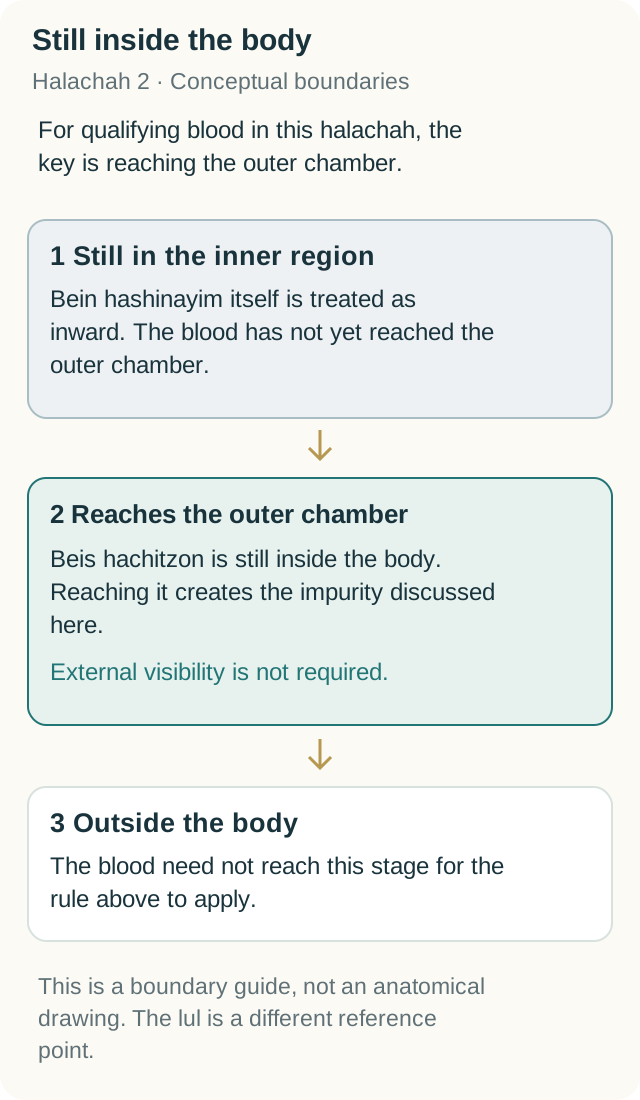
The , “outer chamber,” is still inside the body. “Outer” describes its position relative to the deeper region. Blood need not become externally visible: reaching this chamber is sufficient.
, literally “between the teeth,” is the anatomical expression used here for the inner region from which the blood must pass outward.
?
How far does extend?
To the place reached by the male organ
.
during full penetration.
,.
itself is treated as the inner region.
Blood remaining within has not yet reached the outer chamber for this law. It must pass beyond that region toward the exterior. The distinction is between locations within the body, rather than between blood inside and outside the body.
Synopsis
Blood creates impurity upon reaching the outer chamber, even while it remains inside the body. itself is treated as inward of that chamber.
Picture the CaseA concrete example + illustration
The blood has not appeared outside
Imagine qualifying blood that has passed beyond and reached the , the outer chamber, while still remaining inside the body. Waiting until it is externally visible would miss the boundary described in this .
The point
Reaching the outer chamber is sufficient under this ruling. itself is treated as inward; the discussed later is a different reference point.
Halachah 2: the , or outer chamber, is still inside the body. Qualifying blood need not become externally visible before it creates the impurity discussed here. itself is treated as inward. These are conceptual boundaries, not a modern anatomical drawing, and the is a different reference point. This finding does not remove an existing impurity or replace the required purification process.Open full-size illustration
The Sages described a woman’s anatomy through an analogy:
,
The womb, in which the child develops,
״״,
which is called the “source,”
-
and from which the blood of and emerges—
,
they call the “chamber,”
.
because it lies deep within.
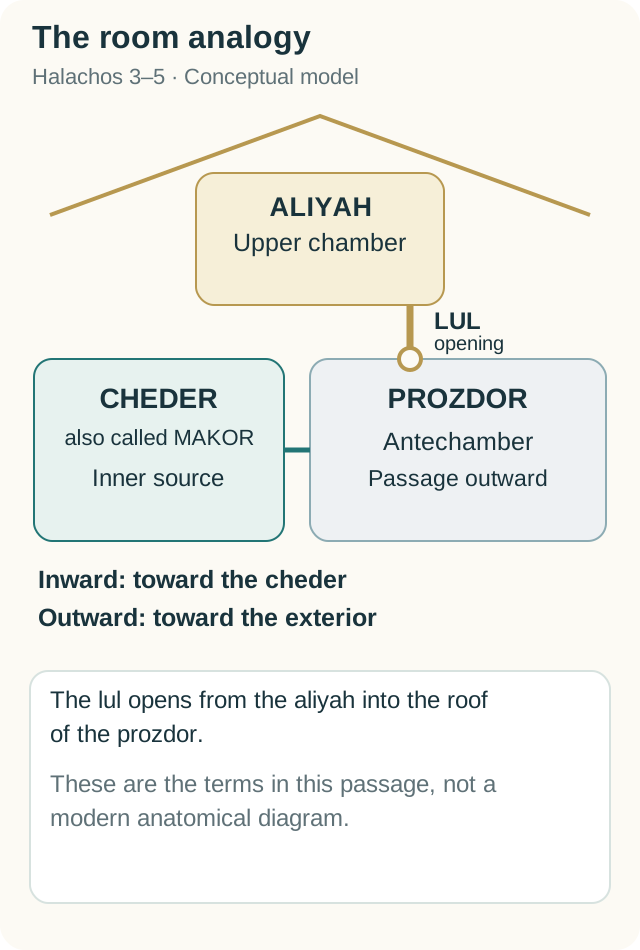
, “source,” and , “chamber,” refer here to the same region. “Source” identifies where the relevant blood originates. “Chamber” places it within the analogy of an inner room and the passage leading to it.
,
The entire neck of the womb,
which is the elongated passage
whose opening contracts during pregnancy
,
so that the child will not fall out,
-
and opens widely during birth—
״״,
they call the “antechamber,”
.
meaning that it serves as an entrance hall to the womb.
The , “antechamber,” is the passage leading to the . The distinction is between the inner source of the blood and the passage through which it travels outward.
These names follow the anatomical description used in this passage. In particular, “neck of the womb” describes the elongated passage identified here; treating the entire expression as an exact modern anatomical label can obscure the discussion.
Synopsis
The womb is called both the , “source,” and the , “chamber.” The passage leading to it is called the , “antechamber.”
remaining a little short of it, depending on the size of the organ.
The point reached during full penetration is distinguished from the antechamber’s innermost end. Entering the antechamber therefore does not mean reaching the womb itself.
,
Above the chamber and the antechamber,
,
between the chamber and the antechamber,
is the region containing
,
the woman’s two ovaries
-
and the channels in which her generative fluid develops—
״״.
this region is called the “upper chamber.”
The , “upper chamber,” is a separate region in this description. The next distinguishes blood originating there from blood originating in the . That difference makes identifying the possible source of blood legally significant.
There is, as it were, an opening from the upper chamber
,
to the roof of the antechamber,
״״.
and this opening is called the .
The male organ extends inward beyond the
.
during full penetration.
The is the opening described as connecting the upper chamber to the antechamber. In the next , its position divides the antechamber into two relevant areas: inward of the opening, toward the , and outward of it, toward the exterior.
The and are distinct reference points. The opening discussed here should not be confused with the inner region discussed in Halachah 2.
Terms used in 2–5
/ : The uterine source, called the “chamber.”
: The passage leading outward from the chamber.
: The separate “upper chamber” described in this passage.
: The opening connecting the upper chamber with the passage.
Synopsis
The , “upper chamber,” has an opening called the into the antechamber. The is the reference point for distinguishing the locations discussed in the next .
Picture the CaseA concrete example + illustration
An inner room and its entrance hall
Picture an inner room reached through an entrance hall, with a separate upper room and an opening into the hall’s roof. This helps organize the ’s terms: or is the inner source, is the passage, is the upper region, and is its opening into the passage.
The point
This is a map of the analogy used in the passage. It is not a modern anatomical diagram. Halachah 5 distinguishes locations inward and outward of the .
3–5: this schematic organizes the ’s terminology. It is not a modern anatomical reconstruction or a diagram of exact dimensions. “Inward” and “outward” are relative to the . The rulings about source, location, qualifying appearances and doubt must be learned from the text; the drawing alone does not establish permission.Open full-size illustration
Determining the Source of Blood Found in the Antechamber
,;
Blood coming from the chamber is impure,
,,
except for , which the declared pure,
,.
and labor-related blood, as will be explained.
This identifies the source of the blood associated with impurity. It does not replace Halachah 2’s requirement that the blood reach the outer chamber. Blood remaining within the womb has not yet created the woman’s impurity under that rule.
is the ’s category of blood during the designated days following the initial childbirth-impurity period, discussed in chapter 4, halachah 5. As explained there, accepted present-day practice does not permit uterine bleeding on that basis.
means bleeding associated with labor. The exception applies within the laws of under the specified conditions; labor-related bleeding during the days of can still create impurity. The distinction and its conditions are explained in Chapter 7:1–2. It does not mean that every instance of bleeding before birth is pure. The following also distinguish which appearances qualify as impure blood.
,-
Blood from the upper chamber, however, is pure,
because it is like blood from a wound in the intestines,
.
the liver, a kidney, or a comparable organ.
Blood from the is classified like wound blood, rather than the blood that creates or status. Its appearance does not itself establish those statuses.
:
As for blood found in the antechamber:
-
if it is found inward of the ,
,
it is impure,
;
because it is presumed to have come from the chamber.
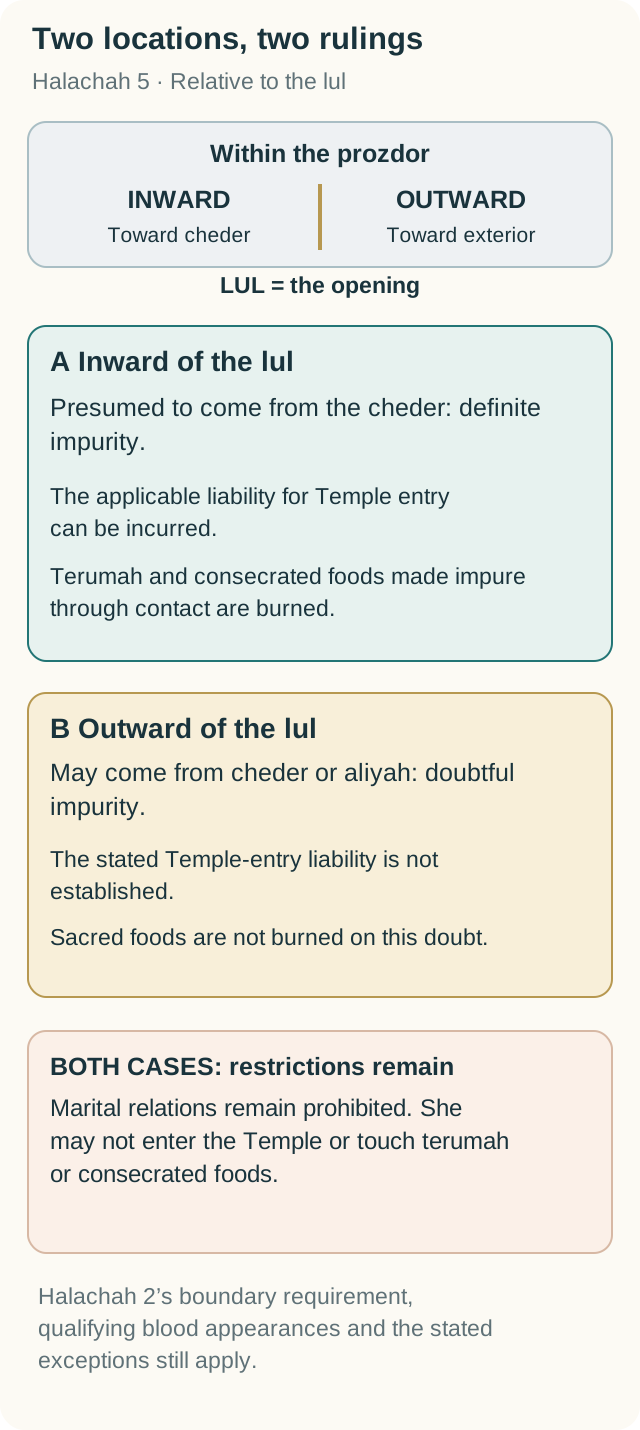
“Inward” means on the side of the nearer the . Although the blood is discovered in the passage rather than at its source, its location establishes the presumption that it originated in the .
,
This impurity establishes liability for entering the Temple,
.
and and foods are burned on its account.
The impurity is treated as definite for these legal consequences. Entering the sacred area while impure can therefore incur the applicable liability. —the sacred priestly portion—and foods that become impure through her contact must be burned.
This does not mean that someone directly observed the blood leaving the . The legal classification rests on the established presumption, whose basis is explained next.
:
We do not suggest that perhaps it descended from the upper chamber
,
through the opening,
.
because most blood found here comes from the chamber.
The possibility of another source does not make this case legally doubtful. Most blood found in this location comes from the , and the ruling follows that predominant source.
-
If blood is found in the antechamber outward of the opening,
,
its impurity is doubtful,
,
because it may have come from the chamber,
;
or it may have flowed from the upper chamber through the .
“Outward” means on the side of the opening nearer the exterior. Here, the possible sources leave an unresolved doubt: blood from the would create impurity, whereas blood from the would not.
,
Therefore, and foods are not burned on its account,
.
and it does not establish liability for entering the Temple.
The doubt does not establish the definite impurity required for these consequences. Sacred foods are therefore not burned on this basis, and the stated liability for Temple entry is not established.
Nevertheless, she may not enter the Temple or touch or foods, and marital relations remain prohibited. The distinction changes the legal consequences of the impurity; it does not turn the doubtful case into permission.
The ’s,2:7, also emphasizes the stringent practice regarding permission to her husband when blood is found. These location distinctions must therefore not be used to permit relations merely because the blood was discovered farther outward.
Synopsis
Blood from the creates impurity upon reaching the required region, subject to the stated exceptions; blood from the does not. Blood found inward of the establishes definite impurity, while blood found outward of it creates doubtful impurity. The doubt limits certain legal consequences but does not permit marital relations.
Picture the CaseA concrete example + illustration
A location difference changes the consequences
Compare blood found in the inward of the , toward the , with blood found outward of the opening, toward the exterior. In the first case, the established presumption identifies the as its source. In the second, the two possible sources leave its impurity doubtful.
The point
The doubt changes the stated consequences for Temple-entry liability and burning sacred foods. It does not permit marital relations, Temple entry, or touching or foods. Halachah 2’s boundary requirement and the other qualifications still apply.
Halachah 5: “inward” is toward the and “outward” toward the exterior, relative to the within the . Definite impurity establishes the applicable Temple-entry liability and requires burning or foods that become impure through contact. Doubt does not establish those consequences. Nevertheless, both cases retain the restrictions explained here, including the prohibition of marital relations. Halachah 2’s boundary requirement, qualifying appearances and the stated exceptions still apply; the chart does not independently establish permission.Open full-size illustration
✦Live ItGive uncertainty its proper weight
Give uncertainty its proper weight
The distinguishes definite impurity from doubtful impurity. The doubtful case still requires restrictions, but it does not justify every consequence that follows from definite impurity.
Sometimes we feel that being responsible means treating every concern as an established fact. This offers a useful point for reflection: carefulness also requires making distinctions. If someone’s brief reply leaves you wondering whether they are upset, you can speak gently without deciding that you have offended them. In serving , we can take a concern seriously while remaining honest about what we actually know.
Try today
Before reacting to one concern, distinguish what you know from what you are assuming.
Not every fluid emerging from the chamber creates impurity,
,
but only blood,
״״(,).
as it says: “Blood shall be her discharge” ( 15:19).
The preceding distinguished the sources from which blood can originate. Here, another distinction is introduced: even when a discharge comes from the , its source alone does not establish impurity. The discharge must qualify as blood.
,
Therefore, if a white discharge flowed from the womb,
-
or a greenish fluid—
,
even though its consistency resembles blood,
,
since its appearance is not that of blood,
.
it is pure.
A fluid’s thickness does not determine whether it is impure blood. A discharge can have a blood-like consistency yet remain pure because its appearance does not qualify as blood.
The Hebrew color term has a broader range than the modern English word “green.” In usage, it can also refer to yellow or golden shades, as discussed in , 188:1.
Synopsis
Originating in the womb does not make every discharge impure. A white or discharge remains pure when its appearance does not qualify as blood, even if its consistency resembles blood.
the appearance of a saffron tip, the appearance of earth mixed with water,
.
and the appearance of diluted wine.
These names identify specific comparison standards, rather than broad everyday color categories. The following specify the reference samples used to establish them.
This precise classification belongs to the underlying framework in which the required expertise in blood appearances was available. Present practice does not use these fine distinctions to permit red or black blood merely because its shade falls below one of these standards.
The ’s,2:7, and the ,188:1, discuss the stringent approach followed when that expertise is lacking. , 188:1, includes both red and black appearances in its ruling. The comparisons below therefore explain the original classification rather than provide present-day permission based on these fine distinctions.
Synopsis
The underlying law distinguishes five specific impure blood appearances. Their precise standards are defined below; present practice does not rely on these fine distinctions to permit red or black blood.
brings the sample alongside it, and examines them.
Bloodletting is a procedure in which blood is drawn from a person. The standard here is specifically the initial stream. The examiner places the blood being evaluated beside that reference sample to compare their appearances.
:.
The standard for black is the appearance of dried ink.
The reference is dried ink, rather than any object ordinarily described as black. The next explains the significance of a shade being deeper or lighter than this standard.
?
What is the standard resembling a saffron tip?
,
He brings fresh saffron with the clump of earth attached to it,
and selects from its choicest growth
,
its middle stalk,
,
which is entirely stalk-like.
,
Each such specimen has three stalks,
.
and each stalk has three leaves.
He brings the blood alongside the middle leaf
,.
of the middle stalk and examines it.
The description identifies a particular part of a fresh specimen: the middle leaf on the middle of its three stalks. A general impression of “saffron-colored” is not enough; the specified part supplies the comparison standard.
?
What is the standard resembling earth mixed with water?
,
He brings earth from the valley of or comparable earth,
,
which is reddish,
and pours water over it in a vessel
;
until the water rises above the earth by the thickness of a garlic skin.
.
There is no fixed quantity for either the water or the earth.
The comparison requires reddish earth of the described kind. There is no prescribed total amount, but the water must cover the earth to the stated depth.
,
He stirs them together in the vessel,
and makes the comparison with the mixture then and there,
.
while it is cloudy.
,.
If it clears, he stirs it again to make it cloudy.
The standard is the cloudy mixture, with the earth suspended in the water. Once the particles settle and the water clears, its appearance changes; it must therefore be stirred again before comparison.
Synopsis
The red, black, saffron, and earth-water standards are established through specific reference specimens. Their preparation and condition matter to the comparison.
🔎Dig DeeperEstablishing the Color Standards
Establishing the Color Standards
In his ,2:6, the explains that red blood can become black through changes affecting it. Black is therefore included among the impure blood appearances even though it no longer looks red.
The black category is still defined by its particular standard—dried ink—rather than by the everyday use of the word “black.”
“These four” refers to the standards just described: red, black, saffron, and earth mixed with water. The fifth appearance, diluted wine, has a different rule, explained in the next .
Within these four comparisons, matching the standard or having a deeper shade establishes impurity; a lighter shade does not. This describes the original precise classification, subject to the distinction from present practice explained above.
?,
What is an example? If the blood is blacker than dried ink,
;
she is impure.
-
If its blackness is less intense—
,
for example, its appearance resembles a black olive,
,-
tar, or a raven—
.
it is pure.
.
The same principle applies to the other three appearances.
Objects can all be called “black” while differing in the depth of their color. The comparison therefore turns on whether the sample reaches the dried-ink standard, rather than on whether it would generally be described as black.
The same method applies to the other three standards. However, the allowance for lighter shades here must not be used to permit red or black blood under present practice.
Synopsis
Under the original classification, the first four standards include matching and deeper appearances, while lighter appearances are pure. These fine distinctions do not provide present-day permission for red or black blood.
The Diluted-Wine Standard and Reporting a Lost Sample
?
What is the standard resembling diluted wine?
,
One part of wine from the Sharon region of ,
,
undiluted and new,
.
and two parts water.
The standard is a particular mixture: one part of the specified new, undiluted wine with two parts water. “Diluted wine” does not mean any wine-and-water mixture or any shade commonly associated with wine.
If the blood’s appearance is deeper than this mixture
-
or lighter than it—
,
it is pure,
.
unless it matches this particular mixture exactly.
Unlike the preceding four standards, this fifth standard requires an exact match. A deeper or lighter shade does not qualify under this category.
This does not override a classification of impurity under one of the other four standards. Nor does it override the stringent present practice concerning red and black appearances.
A woman is trusted to say:
״״,
“What I saw had this appearance, but I lost it,”
.
and the sage rules her impure or pure.
Although the original sample is unavailable, she can identify its appearance by comparison with something present. The sage may accept her report of what she saw and determine its classification.
She supplies the factual information about the appearance; the sage makes the ruling based on that information. This principle remains relevant to permitted discharge colors even when the fine distinctions among reddish shades are no longer used to permit blood.
Synopsis
The diluted-wine category requires an exact match to the specified mixture, without overriding the other standards. A woman may reliably identify the appearance of a lost sample, allowing a sage to rule on its status.
Picture the CaseA concrete example
The original sample is missing
noticed a discharge, but the cloth on which she saw it was accidentally discarded. She can point to another appearance and reliably identify it: “This is the color I saw.” The sage may accept her identification and determine the status from that information. She is reporting what she observed; he determines its classification.
🔎Dig DeeperThe Diluted-Wine Standard and Reporting a Lost Sample
The Diluted-Wine Standard and Reporting a Lost Sample
The and distinguish reporting the appearance of a lost sample from relying on a previous ruling about a similar-looking finding.
If the sample before the examiner is considered impure, or its status remains doubtful, her statement that a sage previously permitted a similar-looking sample does not establish permission for this one. The earlier ruling concerned another sample; her comparison does not settle the present examiner’s assessment.
This ruling concerns her comparison with another sample. It does not address testimony that this very sample already received a ruling.
When a sample has been lost, a woman is trusted to identify the appearance she saw. Her report supplies the factual information on which the sage can base his ruling.
At home, we sometimes begin deciding what happened before the other person has finished explaining. A child says that something was difficult, and we immediately offer a correction. Making room to listen requires a little —setting aside our need to have the answer immediately. We can first understand what the person experienced, then consider what response is appropriate. Listening carefully can itself be an act of respect and care.
Try today
Let someone finish explaining, then check that you understood before responding.
How does one place the sample beside a reference and examine it?
,
He holds the cloth containing the blood in his hand,
,
and looks at it alongside the ink,
,
or the saffron leaf,
,
or the blood from bloodletting contained in the cup,
,
or the water mixed with earth,
.
or the diluted wine in the cup.
These are the specific reference colors described in the preceding . The examiner compares the blood on the cloth with the appropriate reference to determine whether its appearance falls within a color that conveys impurity.
,
He makes the comparison according to what his eyes perceive,
.
and rules that it is impure or pure.
,
He must not examine it through the glass from outside the cup,
.
but must look directly at the liquid inside the cup.
The comparison concerns the liquid’s actual appearance. Viewing it through the side of the glass can affect the color he sees.
,
The cup should be wide,
,,
weigh a , and hold two ,
so that light can enter it
.
and its interior will not be dark.
A is a unit of weight; a is a unit of volume. The commentaries on 21a explain that a cup holding this amount should weigh no more than a , so that its walls will not be excessively thick. Its width and construction allow sufficient light for an accurate comparison.
Synopsis
The examiner compares the blood directly with the prescribed reference colors, using a cup that allows enough light to see the liquid clearly.
Picture the CaseA concrete example + illustration
A cloth beside an open reference cup
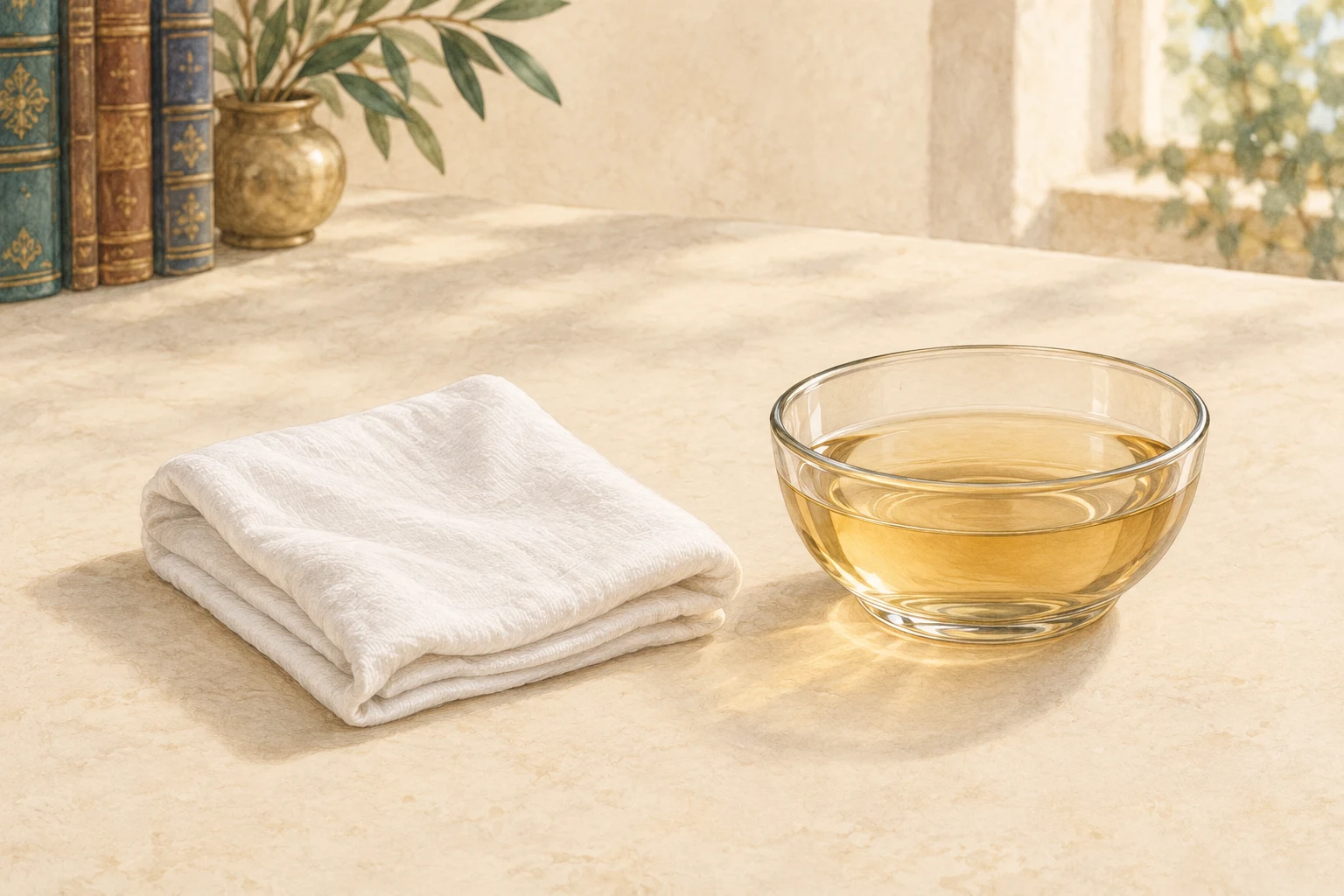
Picture the examiner holding the cloth beside the cup and looking directly at the liquid through its open top. He does not judge its appearance by looking through the cup’s side wall. The illustration helps picture the arrangement described here.
The point
The liquid and cloth are illustrative only. Their colors are not comparison standards, and the image cannot determine whether a finding is pure or impure.
8, 11–12: a cloth beside an open reference cup helps picture the comparison procedure. Looking directly at the liquid differs from looking through the side of the glass. The depicted liquid, its hue, the cup and the cloth are illustrative; no color, measure or stain is reproduced. Present practice does not rely on the fine permitted shades of red described in the earlier framework.Open full-size illustration
The white background and suitable lighting help the examiner identify the sample’s true appearance. These conditions matter because the ruling depends on what color is present.
An examiner does not need all these procedures
,
every time he examines a sample.
,
Rather, a sage develops a trained ability to recognize blood colors,
.
and upon seeing a sample, he can immediately rule it impure or pure.
A knowledgeable examiner may recognize a familiar appearance without preparing all the comparison materials each time. This recognition rests on expertise and experience.
,
If he is uncertain about a particular appearance,
he must place it beside and compare it with ink,
.
or blood, or the other reference colors.
When recognition does not resolve the question, he must use the appropriate comparison.
As explained earlier, present practice does not rely on the fine distinctions between permitted and forbidden shades of red described in these . Careful examination remains important for determining whether an appearance belongs to a forbidden color at all.
Synopsis
A trained sage may recognize a sample’s color immediately. When uncertain, he must compare it with the appropriate reference under suitable viewing conditions.
Picture the CaseA concrete example
An experienced examiner still checks
A examines a sample and immediately recognizes its appearance. Later, someone brings him a different sample whose shade he cannot confidently identify. His experience does not justify guessing. Under the comparison procedure described here, he must compare that uncertain sample with the appropriate reference.
✦Live ItAsking can be part of knowing
Asking can be part of knowing
A trained sage can recognize a familiar appearance without repeating every comparison. When he is uncertain, however, he must compare the sample with the appropriate reference. His expertise includes recognizing when further examination is needed.
We can bring that honesty into learning and daily decisions. Perhaps someone asks us a question, and an answer sounds familiar, but we cannot remember its conditions. Saying, “Let’s check,” makes room for to guide the answer. That small act of places getting it right ahead of appearing knowledgeable. We can be confident enough to acknowledge what still needs clarification.
Try today
When an answer is only vaguely familiar, check a reliable source or ask a qualified Rav.
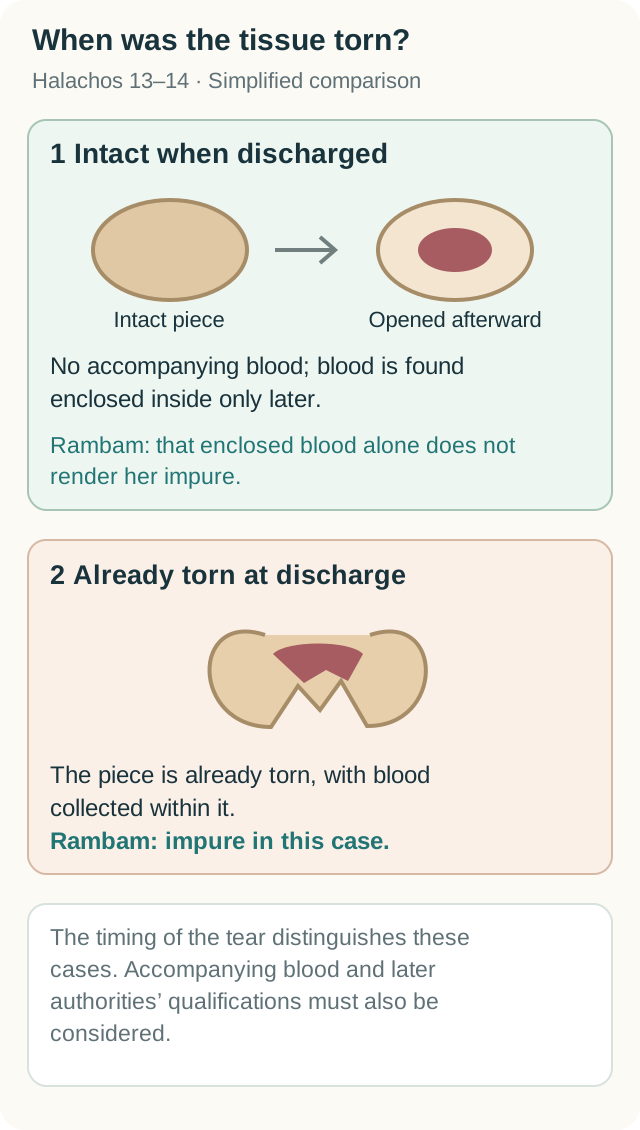
This ruling addresses the discharge of tissue; it does not establish the separate laws governing a miscarriage. The tissue’s red appearance alone does not establish impurity. The question here is whether blood accompanied its discharge.
Even if the piece is torn open
-
and found to be filled with blood—
;
she remains pure,
,
because this is not blood,
.
but blood of the tissue.
The piece emerged without accompanying blood, and blood was discovered enclosed within it when it was opened afterward. That enclosed blood is treated as part of the tissue rather than as an independent discharge of blood.
limits the relevant leniency to small pieces. A large piece renders her impure even if no accompanying blood was observed, because its passage is presumed to involve bleeding. This qualification is important when distinguishing the ’s presentation from the later ruling.
Synopsis
According to the , tissue discharged without accompanying blood does not render a woman impure, even if blood is later found enclosed within it. adds a restriction concerning large pieces.
Picture the CaseA concrete example + illustration
Blood inside the tissue
A woman discharges an intact piece of tissue with no blood accompanying it. Only after the piece is opened is blood discovered inside. According to the , that enclosed blood does not by itself render her impure. This differs from blood emerging alongside the tissue. ’s additional restriction concerning a large piece must also be considered.
13–14, first clause: the timing of the tear matters. In Halachah 13, the piece emerges intact without accompanying blood and is opened afterward. In Halachah 14, it is already torn when discharged, with blood collected inside. These are schematic shapes, not medical images. Accompanying blood, ’s restriction concerning large pieces and the disagreements explained in Dig Deeper must also be considered. No soaking-test timeline is depicted.Open full-size illustration
🔎Dig DeeperBlood Enclosed Within a Piece of Tissue
Blood Enclosed Within a Piece of Tissue
The explains that the disagreement between the and the involves a broader question: Can the womb open to discharge material without also releasing blood?
The Rambam allows for that possibility. Consequently, the absence of accompanying blood can leave the woman pure. The Ra’avad maintains that such an opening necessarily involves bleeding, even when that blood was not observed.
distinguishes between small and large pieces. Its ruling concerning a large piece reflects the concern that the opening required for its passage cannot occur without blood.
Torn Tissue and Particles Suspected of Being Blood
,
If she discharges a torn piece of tissue,
-.
with blood collected inside it, she is impure.
Here, the piece is already torn when discharged. This differs from the preceding case, where the tissue emerged intact and blood was discovered only when it was opened afterward.
,,
If she discharges something resembling a shell or a hair,
,-
or something resembling earth or tiny insects—
,
if these substances have a red appearance,
:
she should place them in lukewarm water.
-,
If they dissolve, she is impure,
,
because they are blood that congealed,
,;
and any woman who discharges dried blood is impure.
The unusual appearance creates uncertainty about what these particles are. Their dissolution can identify them as congealed blood. Blood does not cease to convey impurity merely because it emerged dry.
The leniency based on particles remaining undissolved concerns completely dry material without accompanying blood. If actual moist blood is present, the particles’ failure to dissolve does not establish purity.
,
If they remained in lukewarm water for a full twenty-four hours,
-
and afterward dissolved—
.
her impurity is doubtful.
-
If they did not dissolve over twenty-four hours—
,.
they are attributed to a wound, and she is pure.
A full twenty-four hours is called : the interval from one time of day to the corresponding time the next day.
The soaking test helps determine whether the particles are congealed blood or material from a wound. The duration of soaking matters to that determination. A classification of doubtful impurity does not permit marital relations; the restrictions of impurity must be observed.
Synopsis
Torn tissue containing blood renders her impure. Unidentified dry red particles are tested in lukewarm water; whether and when they dissolve affects whether they establish impurity, doubtful impurity, or purity.
🔎Dig DeeperTorn Tissue and Particles Suspected of Being Blood
Torn Tissue and Particles Suspected of Being Blood
Two separate disputes help clarify this .
Concerning torn tissue, the records a more lenient approach than the ’s: blood discharged within a piece of tissue can remain outside the ordinary manner of bleeding, even when the tissue is split and the blood touches her flesh. records this leniency, subject to its qualifications concerning the tissue.
Concerning dried material, the distinguishes between particles whose identity is uncertain and material already recognizable as blood. Recognizable dried blood conveys impurity even if it does not dissolve. Other authorities, including and , apply a soaking test in the relevant case as well. records both approaches.
These are different questions: one concerns the manner in which blood emerges; the other concerns identifying dried material as blood.
If she discharges something resembling locusts or fish,
,:
or other small creatures and crawling creatures:
,;
if blood accompanies them, she is impure;
,.
if no blood accompanies them, she is pure.
The description concerns discharged material resembling these forms. According to the ’s ruling here, their appearance alone does not render her impure; accompanying blood does.
requires an additional concern because we lack sufficient expertise to identify such forms reliably. They may represent fetal material, which can involve the separate impurity associated with childbirth or miscarriage even without visible accompanying blood.
Synopsis
The makes impurity in these cases depend on accompanying blood. also requires concern for possible fetal material because these forms cannot be reliably identified.
as it states: “Her discharge shall be blood within her flesh” ( 15:19)—
;
she becomes impure only when the blood appears within her flesh in the ordinary manner of women’s bleeding.
.
A woman does not ordinarily discharge blood through a tube.
The , or “antechamber,” is the passage described earlier in the chapter. Although the blood originates internally, its emergence through the tube differs from the normal manner of uterine bleeding.
explains that the relevant leniency concerns a thin tube that does not require substantial opening of the womb. If insertion requires such an opening, the separate concern that opening the womb involves bleeding must also be considered.
Synopsis
Blood emerging through a tube does not render her impure under this ruling because it emerges in an unusual manner. The tube’s size and the opening required for its insertion are important qualifications.
🔎Dig DeeperBlood Discharged Through a Tube
Blood Discharged Through a Tube
explains that this leniency does not rest simply on the tube forming a barrier between the blood and the woman’s flesh. The central point is the unusual manner of discharge: the blood emerges through a tube rather than in the ordinary way.
This explains why the emphasizes how women normally experience bleeding. The ruling concerns the manner of emergence, rather than a general requirement that the blood physically touch the surrounding flesh.
In this case, the attributes the blood to a source associated with urination rather than to the uterine source of bleeding. Her position while urinating does not change his ruling.
,
Even if she experienced a bodily sensation and shuddered,
;
she need not be concerned,
.
because this is the sensation of urination.
A bodily sensation might otherwise raise concern that uterine bleeding occurred. Here, the sensation is attributed to urination and does not by itself establish that the blood came from the womb.
,
For urine does not come from the chamber,
and this blood is blood from a wound
.
in the rectum or a kidney.
The , or “chamber,” is the uterine source defined earlier. The distinction is between blood originating there and blood from another source.
records the ’s ruling, while the and cite more stringent approaches. In an actual case, medical findings concerning the source of the bleeding should be presented to a for a ruling.
Synopsis
The attributes blood emerging with urine to a nonuterine source, even when a bodily sensation accompanies it. Other authorities impose additional restrictions.
, hymeneal blood, has a different source from the uterine bleeding that produces or impurity.
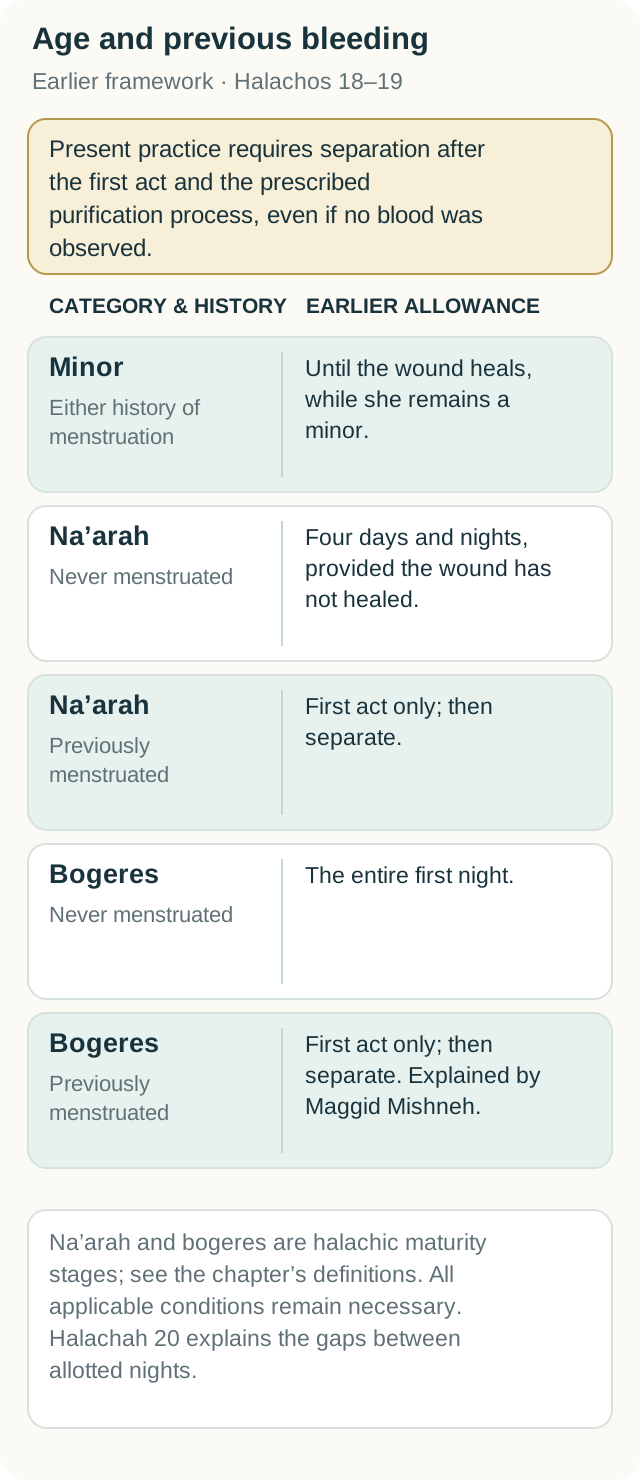
The permissions discussed from here through the end of the chapter describe the earlier rules. Present practice requires separation after the first act of marital relations, followed by the required preparation, seven clean days, and immersion in a valid , as explained in Chapter 11:8. This requirement applies even if no blood was observed. The earlier allowances below do not govern present practice.
?
What rules govern a virgin’s bleeding?
-
If she married while a minor—
,
whether she had never experienced menstrual bleeding
-
or had experienced it in her father’s home—
,
she remains permitted to her husband until the wound heals,
-.
because any blood she sees is attributed to the wound.
Under these earlier rules, a minor’s bleeding is attributed to the unhealed wound even if she had previously menstruated. Earlier menstruation at that age is treated as an unusual occurrence, so it does not prevent attributing the present bleeding to the wound.
,
If she sees blood after the wound has healed,
.
she is a .
Once the wound has healed, it no longer provides a basis for attributing subsequent bleeding to hymeneal injury. The signs used to determine whether it has healed are discussed later in this chapter.
Synopsis
Hymeneal blood is fundamentally wound blood. Under the earlier rules, a minor’s bleeding could be attributed to the wound until it healed. Present practice requires separation after the first act, followed by seven clean days and immersion through the prescribed process.
Different Allowances According to Age and Previous Menstruation
:
If she married as a :
-
if she had never experienced menstrual bleeding—
she remains permitted to her husband for four days,
,
during both the daytime and the nighttime,
.
even though blood continues to flow.
,.
This applies provided that the wound has not healed.
A is a girl who has entered the stage of maturity beginning with the required physical signs at age twelve or later. This stage lasts six months; afterward, she becomes a .
These are the earlier allowances described in Halachah 18. A who had never menstruated receives a limited period during which bleeding can be attributed to the hymeneal wound. The allowance ends earlier if the wound heals. Halachah 20 explains that the permitted nights need not be consecutive.
,
If she had experienced menstrual bleeding in her father’s home,
-
and afterward married—
,
he may have relations with her only the first time,
.
and must then separate.
,
This hymeneal blood is treated
.
as though it were the beginning of .
Previous menstruation changes the concern: subsequent bleeding might be menstrual rather than solely from the wound. The therefore requires separation after the first act and treats the bleeding as the beginning of a period.
This does not change the underlying classification of genuine hymeneal blood as wound blood. It changes how the bleeding in this situation must be treated.
,
A who had never experienced menstrual bleeding
.
is granted the entire first night.
A has completed the six-month stage of . Even if she has never menstruated, the earlier allowance extends only through the first night. The explains that if she had already menstruated, separation is required after the first act.
Synopsis
Under the earlier rules, age and previous menstruation determine the allowance: a who never menstruated receives four days and nights; one who previously menstruated must separate after the first act; a who never menstruated receives the first night.
Picture the CaseA concrete example + illustration
The same stage, a different history
Within the earlier framework, compare two women who are each a . One had never menstruated before marriage; the other had. Their maturity stage is the same, but their previous bleeding changes the allowance. The chart also shows how the minor and categories differ, using 18–19 and their explanations.
The point
These earlier allowances do not govern present practice. Present practice requires separation after the first act and the prescribed purification process, even if no blood was observed. All conditions explained in the chapter remain necessary.
18–19: this table compares the earlier allowances by maturity stage and previous menstruation. The who previously menstruated follows the ’s explanation recorded in the chapter. The wound must remain unhealed where the allowance depends on it, and all other conditions remain necessary. Halachah 20 explains that allotted nights need not be consecutive and that daytime relations do not reduce their number. These are not present-day permissions: present practice requires separation after the first act and the prescribed purification process, even if no blood was observed.Open full-size illustration
🔎Dig DeeperDifferent Allowances According to Age and Previous Menstruation
Different Allowances According to Age and Previous Menstruation
The challenges the ’s ruling that a who had already menstruated must separate after the first act. He observes that this follows ’s position rather than ’s.
The suggests that the Rambam understands and ’s ruling—requiring separation after the first act—as applying here to a who had already menstruated. Their ruling follows a later decision of the Sages requiring separation.
His explanation addresses how the Rambam reached this particular ruling within the earlier framework. The broader requirements observed in present practice are explained separately in Chapter 11.
The four nights granted to a who had never experienced menstrual bleeding
-
may be separated by intervals.
,
He may have relations one night,
,
then wait even two or three months,
.
and have relations on a second night.
,.
This applies provided that the wound has not healed.
The four nights need not be consecutive. Daytime relations are also permitted under these earlier rules and do not reduce the number of allotted nights. Thus, the allowance is not simply four consecutive calendar days beginning with the first act.
Permission remains dependent on the wound being unhealed and the other conditions continuing to apply. The passage of time alone does not use up the remaining nights, but the allowance cannot continue once the wound has healed or menstruation has begun.
adds that if she becomes a during the interval, the allowance changes: from that point, she receives only one night, rather than retaining all the unused nights granted during .
These are the earlier allowances described in Halachah 18.
Synopsis
The four permitted nights may be separated by intervals, and daytime relations do not reduce their number. Permission remains dependent on the unhealed wound and the other conditions continuing to apply.
Picture the CaseA concrete example + illustration
Four nights do not mean four consecutive dates
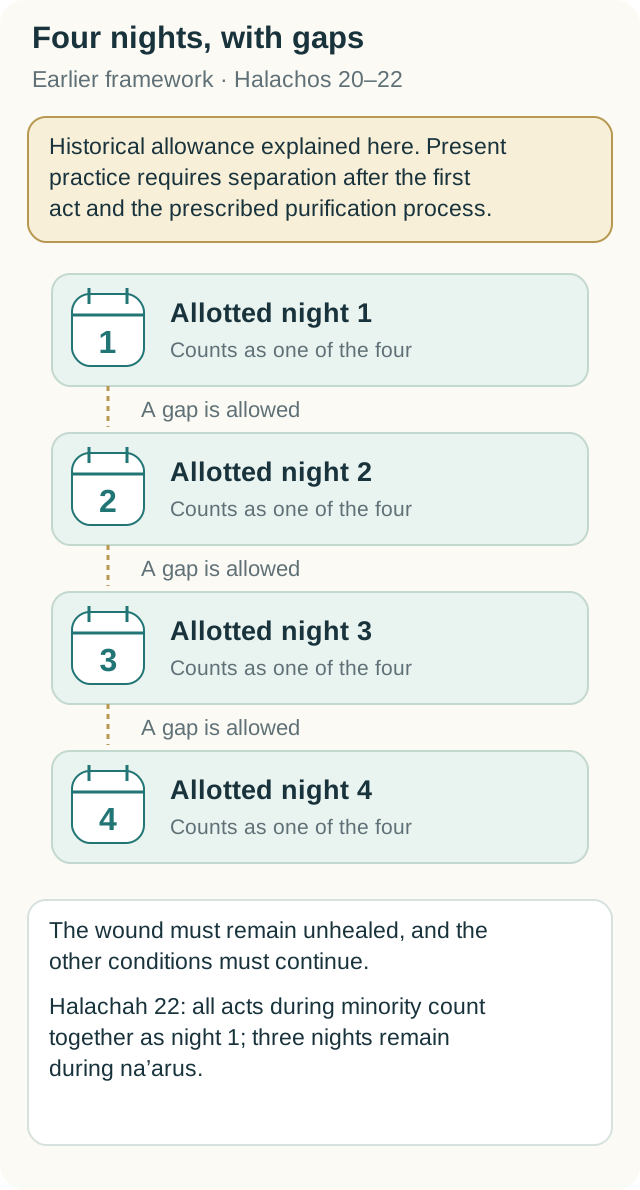
Under the earlier allowance described here, the first allotted night does not start a four-day countdown. A second allotted night can occur after a gap, provided that the wound remains unhealed and the other conditions continue to apply. The four calendar symbols count allotted nights, not consecutive dates.
The point
This illustrates the earlier framework in 20–22. Present practice requires separation after the first act, followed by the prescribed purification process. If she becomes a , the allowance changes as explained in this .
20–22: these symbols count allotted nights under the earlier framework, rather than four consecutive dates. Daytime relations do not reduce the allotted nights. The wound must remain unhealed and all other conditions must continue; becoming a changes the allowance. Halachah 22 counts all acts during minority as one night, leaving three during . Present practice requires separation after the first act and the prescribed purification process.Open full-size illustration
Similarly, a minor who is granted permission until the wound heals—
-
even if it has not healed for a year—
,
he may have relations throughout that year,
.
whether at intervals or on successive days.
Under the earlier rules described in Halachah 18, a minor’s allowance depends on the wound remaining unhealed, rather than on a fixed number of nights.
“Even a year” illustrates an extended period; it does not establish a one-year limit. The allowance continues while the wound remains unhealed and she remains a minor. The next explains what changes when she becomes a .
Synopsis
Under the earlier rules, a minor’s allowance continues while the wound remains unhealed, even for an extended period. Becoming a changes the applicable allowance.
If a girl married while a minor and became a while married,
-
and blood is still flowing because of the wound—
,
all the acts of relations that occurred while she was a minor
,
are counted for him as one night,
.
and he is allowed to complete the four days during her .
Becoming a ends the open-ended allowance associated with her minority. She now comes under the limited allowance described in Halachah 19.
For this calculation, all relations during her minority count together as one night, regardless of how many times they occurred. Three permitted nights therefore remain, subject to the continuing conditions of the allowance.
Even if the three days
,
granted during her are separated by intervals,
-
and he has relations one night every two months—
.
this is permitted.
,.
This applies provided that the wound has not healed.
As in Halachah 20, the remaining nights need not be consecutive. Their availability depends on the wound remaining unhealed and the other conditions continuing to apply. The example concerns nights occurring during ; it does not extend that stage beyond its six-month duration.
These are the earlier allowances described in Halachah 18.
Synopsis
When a minor becomes a , all relations during her minority count as one night of the four-night allowance. Three nights remain, which need not be consecutive, provided the relevant conditions continue.
How can one determine whether the wound has healed
?
or has not healed?
,
If she sees blood when standing,
,
but does not see it when sitting,
,
and sees it when sitting on the ground,
-
but does not see it when sitting on cushions and pillows—
.
the wound has not yet healed.
Two patterns indicate that the wound remains unhealed: bleeding when standing but not when sitting, or bleeding when sitting on the ground but not on cushions. In each case, the bleeding changes with the position or pressure affecting the wound.
The bleeding need not be constant for the wound to remain unhealed. Its appearance when the wound is aggravated is sufficient under these rules.
,
If the bleeding stops and she sees no blood at all,
-
whether standing or sitting on any surface—
.
the wound has healed.
The absence of bleeding even in positions that previously aggravated the wound establishes its healing for these rules. Subsequent bleeding can no longer be attributed to that wound on the same basis.
,
Likewise, if the bleeding does not stop at all,
but she continues to see blood
-
even when sitting on cushions and pillows—
,
this is not wound blood,
.
but blood.
Here the bleeding continues even without the movement or pressure associated with aggravating the wound. Under the rules being discussed, it is therefore treated as bleeding, and the wound-based allowance does not apply.
Synopsis
Bleeding that changes with positions affecting the wound indicates that it remains unhealed. Complete cessation indicates healing, while bleeding that continues even on soft seating is treated as blood.
Picture the CaseA concrete example + illustration
A hard surface and a cushioned surface
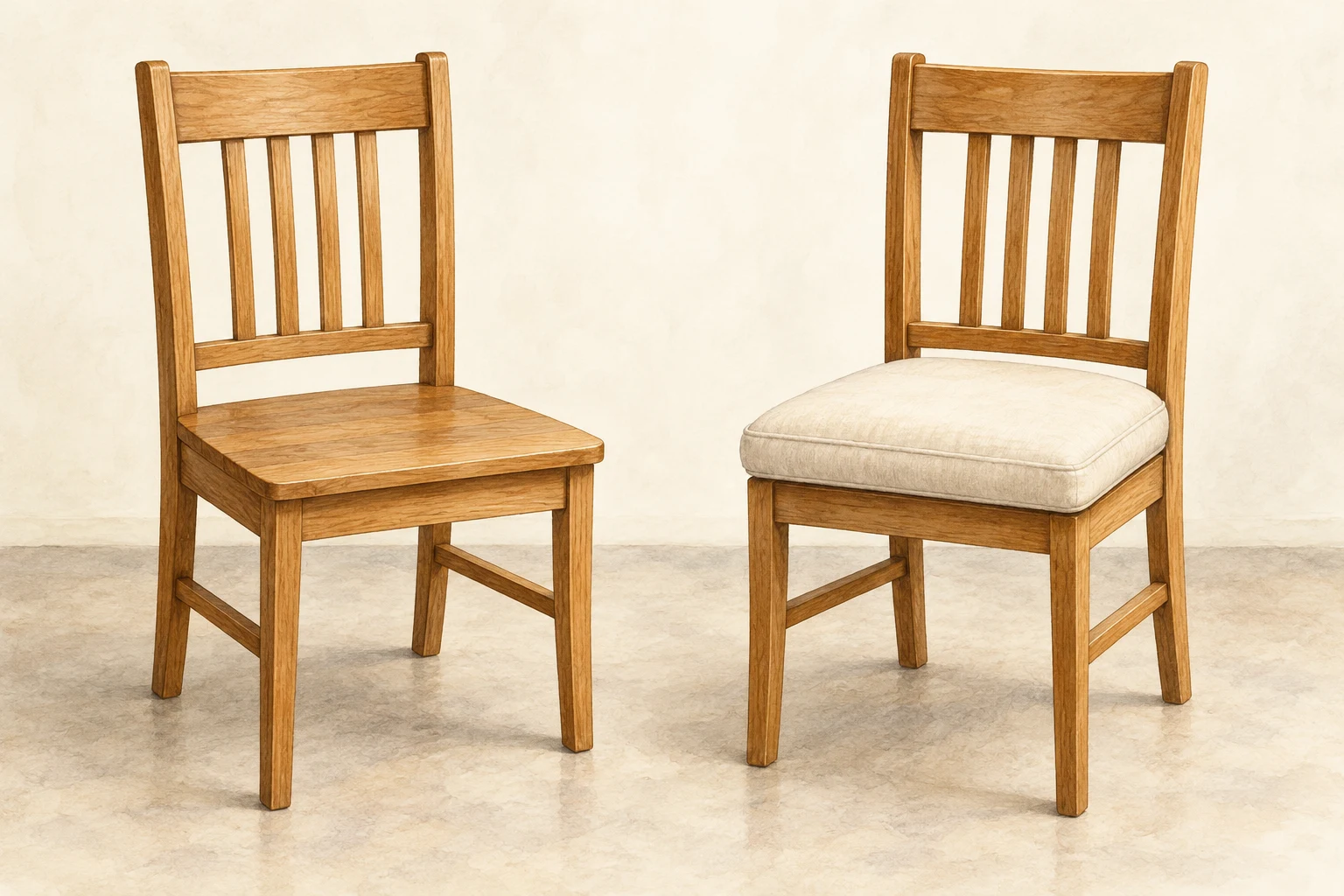
Picture the difference between sitting on a hard surface and sitting on a soft cushion. The illustration makes that contrast easier to visualize. The ’s example specifically compares sitting on the ground with sitting on cushions and pillows; the wooden chair represents a hard surface for illustration.
The point
In the earlier rules described here, bleeding that changes with the position or pressure affecting the wound is distinguished from bleeding that continues even on cushions. The picture is not a home test or a practical ruling.
Halachah 23: left, a hard surface; right, a cushioned surface. The chair is a visual stand-in for a hard surface: the ’s wording specifically contrasts sitting on the ground with sitting on cushions and pillows. He also distinguishes standing from sitting and complete cessation from bleeding that continues on cushions. This illustrates the earlier wound-based rules; it does not establish a diagnostic or practical test.Open full-size illustration
This continues the discussion of hymeneal bleeding within the earlier allowances. Relations can aggravate the unhealed wound, so bleeding occurring then can be attributed to it.
This is not a general rule that all bleeding during relations is wound blood. Chapter 4 discusses the separate laws governing recurrent bleeding during relations when no established basis exists for attributing it to a wound.
,
If she had relations without seeing blood,
and afterward saw blood
-
unconnected with relations—
.
this is blood.
The sequence changes the attribution. Relations occurred without bleeding, and blood subsequently appeared independently of relations. That later bleeding is therefore treated as blood rather than attributed to the hymeneal wound.
Synopsis
Within the earlier hymeneal allowances, bleeding during relations can be attributed to the wound. If relations occurred without bleeding and blood later appeared independently, it is treated as blood.
If a man has relations with a virgin and no blood emerges,
-
and then has relations again and blood emerges—
,
even if she is a minor,
;
this is blood,
,
because if it were hymeneal blood,
.
it would have appeared at the beginning.
Under the ’s ruling, the absence of blood on the first occasion prevents attributing blood appearing only on a later occasion to the original hymeneal wound. This applies even to a minor, despite the broader allowance ordinarily associated with her age.
If a man has relations with a girl younger than three years,
,
and blood emerges,
.
this is hymeneal blood.
The final clause gives the classification of blood resulting from the act in this age category. Its subject is the blood’s status; it does not establish permission for the act.
Synopsis
The treats blood appearing only on a later occasion, after an initial occasion without bleeding, as blood—even in a minor. The final clause separately classifies blood resulting from relations below age three as hymeneal blood.
Translation and elucidation: Independently prepared for Rambam, Clearly in contemporary English. Translation follows the Rambam’s words; elucidation supplies only the context needed to understand them.
Word cards and glossary: Hebrew word cards distinguish a word’s basic meaning from its meaning in the particular phrase. Shared glossary entries explain recurring terms; biography entries identify the cited authorities.
Explain and Background: Explain provides context needed for the ruling. Optional Background panels provide additional context that can be skipped without losing the essential explanation.
Synopsis: A short summary follows each halachah. It is a guide to the central ruling, not a replacement for the full text and its qualifications.
Dig Deeper: Based on the classic commentaries named inside each panel. Editorial explanations are not presented as quotations.
Live It: Where present, these panels connect a particular halachah to a suggested personal reflection and an action to try. Original applications are labeled as suggested reflections. They are distinct from the ruling and are not attributed to the Rebbe merely because his guidance supports seeking a practical lesson.
Measurements: Modern equivalents draw on Chabad.org’s measurement glossary and cited halachic calculations. They show a range when major accepted calculations differ. Monetary equivalents fluctuate with the price of silver.
The Rebbe’s teachings and guidance: Source links accompany the completion teachings and the guidance inside Dig Deeper and Live It. Quotations, translations, and adaptations are identified; the general guidance is separate from the sources for a panel’s particular discussion.
Editorial responsibility: Created and prepared for this project by Levi Gelb. Corrections and suggestions can be submitted below. This presentation supports learning; practical halachic questions should be brought to a qualified rav.
Chapter 5 at a glance
Chapter Synopsis
This chapter examines which bleeding creates ritual impurity, distinguishing its source, location, appearance, and circumstances.
Qualifying bleeding creates or impurity even when an external circumstance triggered it. Even a minute amount is sufficient.
Blood creates impurity upon reaching the outer chamber, even while it remains inside the body. itself is treated as inward of that chamber.
The womb is called both the , “source,” and the , “chamber.” The passage leading to it is called the , “antechamber.”
The , “upper chamber,” has an opening called the into the antechamber. The is the reference point for distinguishing the locations discussed in the next .
Blood from the creates impurity upon reaching the required region, subject to the stated exceptions; blood from the does not. Blood found inward of the establishes definite impurity, while blood found outward of it creates doubtful impurity. The doubt limits certain legal consequences but does not permit marital relations.
Originating in the womb does not make every discharge impure. A white or discharge remains pure when its appearance does not qualify as blood, even if its consistency resembles blood.
The underlying law distinguishes five specific impure blood appearances. Their precise standards are defined below; present practice does not rely on these fine distinctions to permit red or black blood.
The red, black, saffron, and earth-water standards are established through specific reference specimens. Their preparation and condition matter to the comparison.
Under the original classification, the first four standards include matching and deeper appearances, while lighter appearances are pure. These fine distinctions do not provide present-day permission for red or black blood.
The diluted-wine category requires an exact match to the specified mixture, without overriding the other standards. A woman may reliably identify the appearance of a lost sample, allowing a sage to rule on its status.
The examiner compares the blood directly with the prescribed reference colors, using a cup that allows enough light to see the liquid clearly.
A trained sage may recognize a sample’s color immediately. When uncertain, he must compare it with the appropriate reference under suitable viewing conditions.
According to the , tissue discharged without accompanying blood does not render a woman impure, even if blood is later found enclosed within it. adds a restriction concerning large pieces.
Torn tissue containing blood renders her impure. Unidentified dry red particles are tested in lukewarm water; whether and when they dissolve affects whether they establish impurity, doubtful impurity, or purity.
The makes impurity in these cases depend on accompanying blood. also requires concern for possible fetal material because these forms cannot be reliably identified.
Blood emerging through a tube does not render her impure under this ruling because it emerges in an unusual manner. The tube’s size and the opening required for its insertion are important qualifications.
The attributes blood emerging with urine to a nonuterine source, even when a bodily sensation accompanies it. Other authorities impose additional restrictions.
Hymeneal blood is fundamentally wound blood. Under the earlier rules, a minor’s bleeding could be attributed to the wound until it healed. Present practice requires separation after the first act, followed by seven clean days and immersion through the prescribed process.
Under the earlier rules, age and previous menstruation determine the allowance: a who never menstruated receives four days and nights; one who previously menstruated must separate after the first act; a who never menstruated receives the first night.
The four permitted nights may be separated by intervals, and daytime relations do not reduce their number. Permission remains dependent on the unhealed wound and the other conditions continuing to apply.
Under the earlier rules, a minor’s allowance continues while the wound remains unhealed, even for an extended period. Becoming a changes the applicable allowance.
When a minor becomes a , all relations during her minority count as one night of the four-night allowance. Three nights remain, which need not be consecutive, provided the relevant conditions continue.
Bleeding that changes with positions affecting the wound indicates that it remains unhealed. Complete cessation indicates healing, while bleeding that continues even on soft seating is treated as blood.
Within the earlier hymeneal allowances, bleeding during relations can be attributed to the wound. If relations occurred without bleeding and blood later appeared independently, it is treated as blood.
The treats blood appearing only on a later occasion, after an initial occasion without bleeding, as blood—even in a minor. The final clause separately classifies blood resulting from relations below age three as hymeneal blood.
פרק ה
End of chapter.
You have reached the end of all twenty-five halachos.